
The 2023 RIMS annual conference and exhibition is taking place April 30-May 3 in Atlanta. View our slideshow from the last day.
Source link
Tag: Workers Comp

CorVel Corp. offers generative AI platform to manage comp claims
Workers compensation administrator CorVel Corp. announced Monday the integration of a generative artificial intelligence platform into its claims system designed to improve efficiency and streamline the claims management process.
The CareMC claims platform, which is the latest iteration of the company’s CogencyIQSM service offerings, will utilize artificial intelligence to automate certain tasks, freeing up claims adjusters to spend more time dealing directly with injured workers.
“Generative AI will revolutionize claims administration in the next several years, transforming how insurance companies, third-party administrators, and medical management firms manage claims processing,” CorVel President and CEO Michael Combs said in a statement.
Automated tasks to be handled through the new platform include summarizing medical documents, answering questions, extracting keywords and bringing overlooked items to the attention of nurses or claims adjusters.
The new technology can also learn from past comp claims to identify patterns, and, in turn, reduce the claims management workload, according to CorVel.

PHOTO GALLERY: RIMS 2023, Tuesday, May 2
The 2023 RIMS annual conference and exhibition is taking place April 30-May 3 in Atlanta. View our slideshow from the third day.
Source link

Medicare rules complicate settlements | Business Insurance
Workers compensation insurers in some states may have to reimburse injured workers for medical marijuana when the drug is considered a reasonable treatment.
Some employer attorneys say the decision might affect future workers comp settlements.
Bradley Andreen, a Pittsburgh-based comp defense attorney with the firm Rulis & Bochicchio LLC, said the issue may prevent some cases from settling.
While many comp cases settle on the wage loss component, some settlements leave open future medical costs for injured workers, with the anticipation the case could settle at a later date, he said.
Because many injured workers are on Medicare, settlements sometimes involve establishing Medicare set-aside trusts, since Medicare’s interests must be taken into account.
But comp medical marijuana reimbursements could jeopardize settlements, which often contain wage loss and future medical components, because a federal program like Medicare would not be able to breach federal drug laws, Mr. Andreen said.
“Medicare doesn’t pay for all medical expenses, and obviously they’re not going to pay for medical marijuana,” he said.
Dan Anders, chief compliance officer for Delray Beach, Florida-based Tower MSA Partners, said comp settlements routinely include funds dedicated to non-Medicare-covered costs, but Medicare would likely just ignore a medical marijuana reimbursement request because it is illegal at the federal level.
“Medicare’s not going to include the medical marijuana in the MSA (Medicare set-aside), so you’re not going to modify the cost of the MSA as a result,” he said.
Brian Allen, vice president of government affairs for the pharmacy solutions team at Enlyte Group LLC subsidiary Mitchell International Inc., said that while a federal health program cannot reimburse for medical marijuana, he questions whether this would include Medicare set-asides since MSAs are considered comp settlements, not Medicare settlements.
“I think it’s questionable,” he said. “It’s kind of a gray area. That’s one of the problems with the law the way it is right now, with all these conflicting federal and state statutes. It creates all these really nebulous areas of law.”

Comp claims tangled by pot laws
Managing workers compensation claims that involve the use of medical marijuana as an injury treatment protocol is so novel that employers and insurers remain confused over how to handle the claims.
Issues of concern include dosing, coverage and reimbursement for marijuana, which remains illegal at the federal level.
Industry experts say there’s not enough information on the drug as it pertains to such issues as pain management, weaning and return to work — issues that have also plagued opioid prescribing in claims management for more than a decade.
“It’s a mess, it’s a quandary,” said Brian Allen, Salt Lake City-based vice president of government affairs for the pharmacy solutions team at Enlyte Group LLC subsidiary Mitchell International Inc.
While it is legal in 40 states, Mr. Allen said New Mexico is the only state with a comp fee schedule for medical marijuana.
Nikki Wilson, senior director of clinical pharmacy services for Mitchell, said the comp industry appears to be focused on whether, and how, to cover or reimburse for the drug before its treatment application is even fully tested.
“We’re almost putting the cart before the horse a little bit where we’ve got regulatory and legal jumping ahead of clinical, so we’re trying to play catchup in a lot of ways to capture this,” said Ms. Wilson.
Adding to the confusion is a legal landscape that is a patchwork of state laws and rulings; some state courts have ruled workers comp payers must either cover or reimburse medical marijuana used by injured workers, but some laws prohibit or don’t require reimbursement.
Six states allow for reimbursement of comp claims for medical marijuana while seven expressly prohibit reimbursements (see chart).
Employers and insurers have expressed concerns over having to pay for a drug that is federally illegal.
Barak Kassutto, a comp attorney with the Philadelphia law firm Morgan & Akins who represents employers and insurers, took issue with a March Pennsylvania appeals court ruling that determined insurers are not prohibited from reimbursing injured workers for medical marijuana.
“I think the issue here is the concern that the court is compelling employers and insurers to violate federal law,” he said.
As a result of the ruling, insurers must reimburse injured workers for the drug in cases where the treatment is deemed necessary for recovery, according to Abington, Pennsylvania-based claimants attorney Jenifer Kaufman, the solo practitioner who won the binding Commonwealth Court ruling in Fegley v. WCAB.
Bradley Andreen, a Pittsburgh-based comp defense attorney with the firm Rulis & Bochicchio LLC, said the issue may affect comp settlements, especially those with a Medicare set-aside. Because marijuana is still illegal at the federal level, Medicare won’t pay for the drug, which could place prospective settlements in limbo, he said (see related story).
The issue is further complicated by Pennsylvania’s medical marijuana law, which says comp insurers are not required to “cover” the drug but says nothing about prohibiting reimbursement.
“If there’s no coverage for something, how is the carrier or the employer supposed to reimburse it,” Mr. Andreen said. “That’s part of the whole principle of insurance. If you don’t have coverage for something, then they don’t pay for it. You don’t do something indirectly that you don’t do directly.”
“They’re using it to reduce their pain, not to get high,” claimants attorney Ms. Kaufman said of injured workers and marijuana.
Issues such as dosing and medical necessity are often a concern with drugs in general, she said.
“I think this issue is common with all medications,” she said. “There’s still going to be a learning curve for a lot of people in the bar and for insurance companies.”
And employers still can challenge the drug’s usage in comp by filing for utilization reviews, Ms. Kaufman said.
Utilization reviews for medical marijuana might be difficult, Mr. Andreen said. In Pennsylvania, for example, there is no “prescribing” doctor, and the person who is giving out the medication is a marijuana dispensary “salesperson.”
“There’s no medical doctor peer for the claimant or the (dispensary) salesperson to do a utilization review,” Mr. Andreen said. “It’s basically the claimant deciding themselves what their medicines should be. How do you subject that to a utilization review?”
Del Doherty, owner of Houston-based pharmacy benefit manager ProdigyRX, said providing reimbursements for a federally illegal substance like marijuana raises numerous concerns.
“For this, what is the usual and customary price that you charge?” he asked. “Will you only reimburse for edibles or also for vape and smokeable products? There’s no standard for reimbursement. Just saying that you’ve got to pay for it is one thing. Now, you’re just believing what people are showing on the receipt.”
Louise Esola contributed to this report.

Program failed to oversee controlled substance prescriptions
A scathing report on one of the country’s largest workers compensation programs highlighted the importance of utilization reviews, according to experts.
A U.S. Department of Labor’s Office of Inspector General audit of its Office of Workers’ Compensation Programs that was released last month found that the program failed to properly oversee prescriptions for a dozen controlled substances, including fast-acting fentanyl that has been linked to overdose deaths nationwide.
The audit of 2015-2020 data focused on the Federal Employees’ Compensation Act program, which serves injured federal workers, and found that overall FECA “lacked a pharmacy benefit manager to help contain costs and had not determined if alternative prescription drug pricing methodologies would be more competitive.”
The audit, which compared the federal program with comp practices nationwide, also found that the Office of Workers’ Compensation Programs lacked sufficient clinical expertise and guidelines to ensure appropriate pharmaceutical decisions, which could negatively affect claimants’ health, recovery and return to work.
Maggie Valley, North Carolina-based consultancy CompPharma LLC, headed by Joe Paduda, its Skaneateles, New York-based president, assisted with the audit.
Mr. Paduda said the worst findings included 1,330 prescriptions for fentanyl, an opioid that had been restricted but was prescribed nonetheless. “A number of things that should not have happened did, in fact, happen,” he said.
Overall, the audit found that the FECA program paid for 12 separate controlled substances that “are considered dangerous and carry a high risk for psychological or physical dependence, abuse and addiction,” according to the report.
“The concern here is really a patient safety issue. Given all of the notoriety fentanyl has achieved it’s not news to anybody that this is a really dangerous medication,” Mr. Paduda said.
A policy or procedure that ensured prior authorizations were done would have prevented the fentanyl scripts from going to patients who do not meet the requirements, he said.
The Office of Workers’ Compensation Programs has hired experts to help with its program since the period covered by the audit, the office’s director, Chris Godfrey, said in a statement.
“The Federal Employees’ Compensation Act program implemented a Pharmaceutical Benefit Management function in late 2021, which addressed many of the issues raised by OIG and significantly improved patient safety, quality of care for FECA claimants, and reduced drug spending by $87.9 million in the first year alone. These improvements were not reflected in the OIG report, which covered a period prior to the implementation of the PBM,” the statement said.

State mandates rile workers comp physicians
Many physicians are at odds with workers compensation claims management professionals over how to best navigate a long-standing but evolving process used to get injured workers well and back to work: utilization reviews.
Disagreements over the effectiveness of elements of the utilization review process, which insurers say ensures they only cover medically necessary drugs and treatments, can slow down treatment and keep workers off the job for longer, experts say.
Utilization reviews, which have been around for decades, are more frequently being mandated, and several states have introduced drug formularies and treatment schedules. The process requires a back and forth between doctors and claims handlers, involving documentation and imaging in some cases, to monitor care such as drugs, tests, surgery and physical therapy.

Workers comp insurers, third-party administrators and pharmacy benefits managers have grappled with the introduction of new utilization review processes for the past several years. For instance, California implemented its medical treatment utilization schedule in 2018, and New York this year introduced a program to electronically streamline utilization reviews among providers and claims handlers.
In addition, according to reports compiled by the National Council on Compensation Insurance, 15 states have in place closed-drug formularies that require prior authorizations. Many formularies and prior authorization processes were put in place due to the opioid crisis, rising medical costs and poor outcomes among injured workers, among other reasons.
Doctors, though, have long decried such prior authorization measures.
According to a survey of 1,001 doctors conducted in December 2022 by the American Medical Association, 80% said advance treatment approvals have led to early treatment abandonment, 31% said that prior authorization criteria — many of which are in place due to state regulations or parameters set by individual insurers — are “rarely or never evidence-based,” and 64% said authorization requests have led to “ineffective” initial treatments.
“It’s very frustrating because when you’re an (occupational injury) doc and you know that you’re following the science, all this does is provide a delay for getting the person better,” said Dr. Douglas Martin, medical director of the Center for Neurosciences, Orthopaedics & Spine Occupational Medicine in Sioux City, Iowa, who sees about 55 workers comp patients a week.
Dr. Martin serves as a medical examiner for several entities, including the Nebraska Worker’s Compensation Court and is president of the American College of Occupational & Environmental Medicine, whose guidelines were used to help craft the California drug and treatment formulary. He said there’s much frustration among physicians when it comes to getting approvals for sound and timely evidence-based care.
Many delays occur when it comes to physical therapy requests and can cause injuries to worsen or have significantly delayed recovery, he said.
Industry experts say they understand the problems that can arise but assert that utilization reviews go a long way in ensuring adequate care and return to work.
“We see evidence-based medicine as a tool to make sure that the employees are getting the right care at the right time, with the overall goal of getting the employee back to work to the pre-injury status,” said Leah Sharp, Franklin, Tennessee-based senior vice president with GBCARE, a unit of Gallagher Bassett Services Inc. “We don’t see it as necessarily a drag on the system; it’s care that is managed. We’re making sure that the employees are getting the right care.”
Ben Roberts, Duluth, Georgia-based vice president of utilization reviews for Genex Services, an Enlyte LLC company, said access to information on patients is often the first issue to resolve.
“Among the biggest challenges with slowing down the utilization review process are really around the completeness of the information that’s provided,” he said.
Clinical utilization review teams evaluate the medical necessity and reasonableness of treatments against evidence-based guidelines and the guidelines often have very specific requirements about what needs to be present for an approval, Mr. Roberts said.
“Delays come into play when insufficient information is provided,” he said.
Experts say educating physicians on the process is part of the solution.
Changes in documentation processes in states like California and New York can be a challenge for physicians, Ms. Sharp said.
“It’s a scenario where it’s a culture shift,” Ms. Sharp said. “If doctors take the time to learn the guidelines or understand how to put them into practice, they will see a lot less frustration than they currently do.”
Technology is also part of the answer, said Silvia Sacalis, a Tampa, Florida-based licensed pharmacist and vice president of clinical services for Healthesystems LLC.
“Some of the delays are due to challenges with workflow design and the manual turnaround of information,” she said.
More automation could streamline the process of transmitting information that is relevant and needed for utilization reviews, Ms. Sacalis said.

Teen worker safety practices under scrutiny
Employers that hire workers ages 14 to 17 years must comply with a patchwork of safety regulations that vary sharply by jurisdiction, as some states take steps to loosen restrictions on such employment.
Meanwhile, federal agencies are stepping up their focus on the unsafe working conditions and exploitation that many younger workers face.
On March 8, Arkansas Gov. Sarah Huckabee Sanders signed a law that rolled back requirements that the state verify the ages of workers under 16 and provide them with certificates permitting them to work. And on April 18, the Iowa Senate passed a controversial bill that would allow such younger employees to work longer hours and would eliminate existing rules concerning the serving of alcohol in establishments that employ young workers.
Other states are considering or have considered changes that would make it easier for employers to hire underage workers, drawing opposition from children’s rights advocates who say the changes would endanger such workers.
Yet some experts say workers under 18 years old are still protected, given federal regulations outlined by the U.S. Occupational Safety and Health Administration and Department of Labor’s Wage and Hour Division.
Arkansas “just stopped requiring the work permits … but all the federal safety and health requirements are still in place,” said Richard Fairfax, Frederick, Maryland-based principal consultant for the National Safety Council. “The only thing that has changed is the state saying, ‘We’re not going to require people to get a work permit.’”
However, some experts say holes in safety requirements about hiring young people remain and that any effort that reduces oversight is detrimental. Many employers are unaware of rules specifying whom they can hire, and often it’s not until an accident occurs that they understand the implications of hiring young workers, they say.
Unscrupulous employers — many hiring underage immigrants — are the target of recent federal efforts to curb unsafe working conditions for young workers. And state-level changes have drawn the DOL’s renewed attention.
The DOL and the U.S. Department of Health and Human Services on March 24 announced a partnership between the DOL’s Wage and Hour Division and HHS’s Administration for Children and Families to “deepen information-sharing, coordination, training and education” addressing what both departments have called the exploitation of young workers, including child labor trafficking.
CLICK IMAGE TO ENLARGE
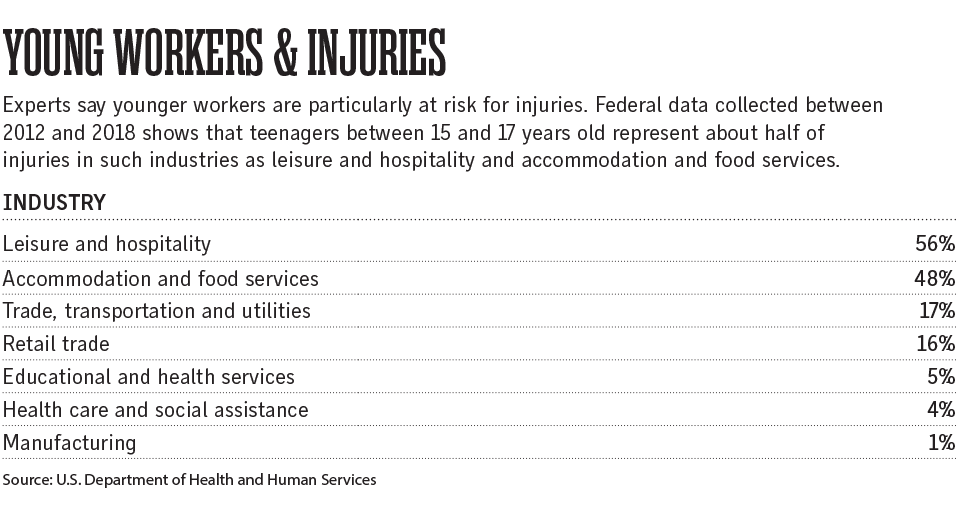
Beginning this month, the DOL is offering webinars for employers, parents and young workers regarding federal child labor regulations. Seema Nanda, solicitor of the DOL, said in a statement to Business Insurance that “child labor protections apply in all states, and no state has the ability to limit these provisions.”
“The Department will vigorously enforce child labor protections in all states and is closely monitoring state action in this area,” she said.
Labor law experts say the renewed focus is timely but not new.
“There are a lot of regulations out there that have been on the books obviously for over 60 years, and certainly they haven’t really changed dramatically,” said Ray Perez, Atlanta-based attorney in the safety and health practice group at Jackson Lewis P.C.
While OSHA dictates workplace safety regulations for all workers, the Wage and Hour Division addresses safety for workers younger than 18. The division lists several duties prohibited for younger workers for safety reasons. “A lot of these minors don’t know the law (and) they don’t have the ability to contact anyone to file complaints,” Mr. Perez said.
Scott Hecker, Washington-based senior counsel with Seyfarth Shaw LLP, said there’s “tension” between federal and state approaches to the issue, as “certain states are rolling back or loosening up some of the restrictions for child or teen labor based on the tightness of the labor market.”
“It’s hard for employers to toe those lines, to be aware of the obligations under both federal and state (systems),” he said.
Complicating workplace safety is the seasonality of some younger workers, said Jennifer Maclachlan, Sandwich, Massachusetts-based member and past-chair of the American Industrial Hygiene Association’s Committee on Teen Workplace Health and Safety. She said safety training for both employers and employees is the No. 1 issue.
Employers “just don’t think about it. They’re just so busy,” Ms. Maclachlan said. “I’m on Cape Cod, Massachusetts, and our population triples during the summer, and people get so busy and a lot of these businesses are seasonal. And I think they just think, ‘I’m going to train this teen worker to do the job,’ and they don’t incorporate safety into it.”
Mr. Fairfax, of the National Safety Council, said the number of regulations from different entities — state and federal — can be confusing for employers.
“Some of them, legitimately, aren’t aware,” he said, adding that family businesses tend to fall in this category. For example, owners of agriculture or manufacturing businesses can employ their own children “although they can’t use any heavy equipment,” he noted.
“A lot of it’s just a lack of understanding and a lack of information,” he said.
Greg Ripple, a Chicago-based shareholder in the labor & employment practice at Vedder Price P.C., said employers that aren’t paying attention to guidelines — especially now — are more at risk than ever.
“They need to have a system in place where they are making sure that those minors and the company are complying with both the (federal) industrial rules and state rules and making sure they have that kind of compliance and training,” he said.
WORK PROHIBITIONS
Under U.S. Department of Labor guidance, workers 15 and under are prohibited from:
- Working in most occupations involving transportation, construction, warehousing, communications and public utilities.
- Working in mining; workplaces where goods are manufactured or processed; in freezers or in meat coolers.
- Operating or tending any power-driven machinery, except office machines.
- Working in baking operations.
- Sign waving or door-to-door sales activities.
- Working from ladders or scaffolds.
Workers under the age of 18 may not perform duties deemed “hazardous” by the DOL, including:
- Operating most machinery, including in bakeries, woodworking, construction, paper manufacturing, metalworking, and meat and food processing.
- Driving a motor vehicle or working as an outside helper on motor vehicles, with some exceptions for 17-year-olds.
- Forklift operations.
- Mining.
- Manufacturing of brick, tile and related products.
- Wrecking, demolition and ship-breaking operations.
- Roofing operations.
- Trenching and excavation operations.

Editorial: Utilization review revisions needed
State efforts to impose additional restrictions on workers compensation-related medical treatments raise questions about the role of medical utilization reviews that need to be addressed to keep all sides working together and focused on the key goal of the comp system: healing injured workers.
Medical benefits represent the largest component of workers compensation costs and, given medical inflation trends, containing those costs is a major concern for workers comp payers. Utilization review is one of the main tools that the comp sector has used to curb runaway medical costs, but, as we report on page 24, physicians are increasingly bristling at the oversight.
The reviews, which have been in use for decades, are usually conducted by medical professionals, including other physicians, who review a patient’s medical records and treatment plans to determine whether the prescribed treatment is necessary and appropriate.
State laws and regulations add another dimension to the process by imposing features such as medical treatment utilization schedules and closed-drug formularies that require prior authorization before prescriptions can be filled — features that were often put in place during the opioid crisis.
For doctors confident in their abilities and judgment, the process can be onerous and slow down the treatment of patients, possibly worsening their conditions. A physician on the ground in front of the injured patient, the argument goes, is uniquely positioned to make the best choices for the patient’s ultimate welfare.
Indeed, the expertise of highly trained medical professionals is vital for the safe and efficient treatment of patients, but with about one million physicians in the United States inevitably there is going to be a range of opinions, and escalating costs of medical treatments can’t be ignored.
Comp payers have a responsibility to make sure they are not overpaying for care, but they also need to ensure that their review requirements are reasonable and practicable, especially if they are denying coverage for a treatment or test that a doctor views as important or essential.
To solve the problem, it is imperative that doctors, workers comp insurers and claims managers work together to resolve any differences as to how medical treatments are approved and monitored. Engaging in more collaborative decision-making processes and revising utilization review policies to better reflect the needs of injured workers should be embraced. Maybe regulators need to take note.
Ultimately, the goal of everyone involved should be to create a system that prioritizes the needs of injured workers while also ensuring that resources are being used in the most effective and efficient way possible. This requires the acknowledgment of sometimes dueling perspectives, and an understanding of how every party involved in the process plays a vital role in seeing that injured workers receive timely, high-quality care.

Get creative with accident-prone new workers: Panelists
Workers with less than one year experience in their job represent 30% of an employer’s workers compensation claims, prompting the need for “robust onboarding and ongoing training,” a risk management executive at a temporary staffing company said Tuesday.
Susan Shemanski, Jacksonville, Florida-based vice president, risk management, at Adecco Employment Services Inc., spoke Tuesday during a panel session on the future of safety at Riskworld, the Risk & Insurance Management Society Inc.’s annual conference in Atlanta.
“We are seeing a lot of unskilled or deconditioned workers, and all of this is really leading to more injuries,” Ms. Shemanski said. “We have to have robust onboarding and ongoing training.”
Adecco uses “gamification” training, which Ms. Shemanski described as anything involving human behavior, motivation and leader boards versus traditional classroom training. Employers with bigger budgets can use virtual reality — training forklift drivers using ocular glasses and video gaming, for example — and those with smaller budgets can turn a training topic into a quiz game like “Family Feud,” she said.
Such engagement leads to greater information retention: 80% versus traditional classroom training where workers recall 15% of what they are taught, Ms. Shemanski said.
Wearables measuring unsafe conditions, such as poor lifting and ergonomics issues, can also promote safety early, said Shanna Levesque, Charlotte, North Carolina-based Southeast practice leader and senior vice president at Marsh LLC.
“I’m a firm believer that traditional safety and risk management models certainly still have their seat at the table, and they can still produce great results, but what I saw from my perspective with the wearable technology is that we were able to get the insights faster than if we were just going through that visual observation method,” she said.
Management buy-in can be a concern with such initiatives,
according to the panelists, who said the technology solutions need time to work.
“When we started all the technology, I probably went back to my CFO every week for six months,” Ms. Shemanski said. “Once you start doing all these things you’ll see the savings; you just really have to keep going back and having the conversations.”