Kentucky legalizes medical marijuana | Business Insurance


Kentucky Gov. Andy Beshear on Friday signed a bill legalizing medical marijuana, making the state the 38th in the U.S. to allow doctors to recommend the alternative treatment.

S.B. 47 applies to patients with cancer, severe pain, epilepsy, multiple sclerosis, muscle spasms or spasticity, chronic nausea or cyclical vomiting, post-traumatic stress disorder or any other medical condition or disease that the Kentucky Center for Cannabis deems appropriate.

Doctors will need to be certified to recommend cannabis for their patients. 


Source link

Tennessee roofing company cited after worker’s fatal fall through skylight


The U.S. Occupational Safety and Health Administration has cited a Tennessee-based roofing contractor following the death of an employee who fell through a skylight at a Florida airport hangar.

OSHA said Friday it cited Morrison, Tennessee-based Porter Roofing Contractors Inc. for four serious violations and proposed $53,797 in penalties in connection with the Oct. 25, 2022, incident in which the roofer fell through a skylight at Peter Prince Field in Milton, Florida. The roofer died four days after the 25-foot fall. 

OSHA alleges the company failed to regularly inspect job sites, materials and equipment; exposed workers to electrical, struck-by and fall hazards; and failed to report a work-related employee hospitalization within 24 hours.

Porter Roofing, which has locations in Florida, Georgia and Tennessee, has 15 days to contest the citations and proposed penalties.


Source link

First responder comp cancer presumptions set to expand as more states consider reforms


Lawmakers in several states are seeking to expand workers compensation cancer presumptions for firefighters, pointing to research linking firefighting activities with more types of cancer, and the latency period for cancer development. 

Since the beginning of 2023, numerous states filed legislation that would either expand the types of cancers considered presumptive occupational injuries for first responders such as firefighters, expand the pool of covered first responders, or both.

While lawmakers are addressing cancer in first responder comp, industry researchers are also examining the issue. The Florida-based National Council on Compensation Insurance issued a report last month highlighting cancer and other presumptive occupational injuries in workers comp among firefighters and other first responders. 

Firefighters are considered high risk for cancer due to workplace exposure to carcinogens, including toxins from fires, diesel fumes from idling vehicles and chemicals from firefighting gear, according to the American Cancer Society.

It’s why presumptions for firefighters suffering from cancer are increasingly common, and an annual topic for state and federal lawmakers going back to 2001, experts say. 

“If it hadn’t been for 9/11, we’d probably still be fighting this battle,” said Terrence Hannigan, general counsel to the Firefighters Association of the State of New York, which represents volunteer firefighters. Numerous first responders in lower Manhattan developed lung cancer or other cancers after the attacks, which in some cases were alleged to have been linked to their exposure to toxic debris at the site of the Twin Towers. 

In December 2022, President Joe Biden signed into law the Federal Firefighters Fairness Act, which created the presumption for federal firefighters.

In January, Virginia lawmakers introduced Senate Bill 906, which would add thyroid and bladder cancers as presumptive cancers for firefighters in comp. 

Other states that have introduced similar first responder presumption legislation since the start of the year include, but are not limited to, Missouri, Montana, Nebraska and New Hampshire.

In January, Nebraska lawmakers introduced a bill making cancer an occupational disease for firefighters and New Hampshire lawmakers filed similar legislation stating that all types of cancers would be recognized as presumptive diseases for firefighters. 

Also in January, a bill was filed in Missouri that would add more cancers to the list of presumptive diseases for many different first responders. 

And in March, Montana legislators filed a bill that would add cervical cancer after 15 years, lung cancer after four years, and testicular cancer after 10 years as presumptive occupational diseases for firefighters. 

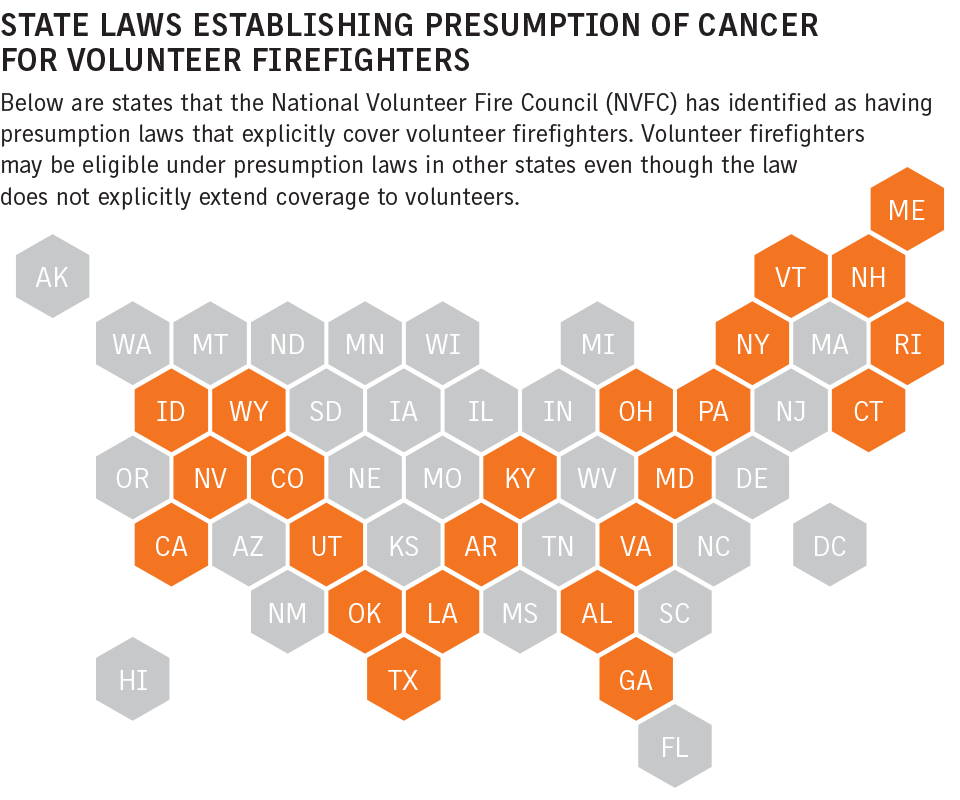
Existing state presumptions vary — more than two dozen states have them in place in some form — and not all who fight fires qualify and not all types of cancers are included. State legislatures have been working to expand benefits to volunteer firefighters (see related story). 

In Pennsylvania, cancer presumptions were pushed hard for years by career firefighters, but it was volunteers who “drove it through” given the “significant political clout” held by volunteer departments, said Paul Leonard, retired manager of Upper Dublin Township, Pennsylvania and a longtime volunteer firefighter. 

As manager, Mr. Leonard was aware that expanding cancer presumptions could mean increased claim activity and higher employer costs, and he worried about expanding presumptions for volunteers. 

But claim costs didn’t materialize as envisioned, he said. 

“It was not as bad as I originally thought,” Mr. Leonard said, adding that most of the comp cancer claims were filed by career firefighters.

Paul Cornell, director of trusts for Harrisburg, Pennsylvania-based PennPRIME, a Pennsylvania municipal insurance pool, though, said presumptions have led to increased claims and higher costs. Insurers traditionally opposed expanding cancer presumptions because of employer cost and because there was “no clarification for non-fire related cancers,” he said.

It is considered difficult for employers to rebut firefighting cancer presumptions due to a 2018 Pennsylvania Supreme Court decision that created a high employer burden for rebuttal (see related story). 

Pennsylvania State Sen. Frank Farry, who was majority chair of the Fire and Emergency Services Caucus during much of his career in the state House of Representatives, sponsored a firefighter cancer presumption bill that was vetoed by former Gov. Ed Rendell in 2010. Similar legislation was signed by Mr. Rendell’s successor a year later.

Colleen Kopp, who was Mr. Rendell’s secretary of legislative affairs at the time, said the governor opposed the measure because of financial concerns.

“You couldn’t put a fiscal note on how much this legislation would cost local governments,” Ms. Kopp said. “They would be the ones who are paying these claims in their insurance policies.” 

Mr. Farry said there’s no denying cancer is linked to firefighting: “These things aren’t random.”

Many synthetics found in common household items can cause fires to burn hotter and faster, “but they also put out a lot more toxins,” he said. 

Bruce Spidell, actuarial committee liaison with the Boca Raton, Florida-based National Council on Compensation Insurance, said cancer presumptions for firefighters vary by state, with some listing specific presumptive cancers and others including cancer generally. 

“The exact way it’s going to be rebutted will differ by state,” he said. “Every state is unique.”

Mr. Spidell, who coauthored a report in February about firefighting and first responder comp benefits, said medical research “kind of conflicts with itself” as far as what causes different types of first responder cancers. 

“I think the data’s still a mixed bag, which is one of the difficulties we cited,” he said. 

“Presumptions probably started out with firefighter cancer and many states have expanded it to different first responders and different diseases besides cancer,” Mr. Spidell said. 

Greg Jakubowski, a fire protection engineer with Breinigsville, Pennsylvania-based infrastructure and logistics company Buckeye Partners LP, said one possible reason for the recent increase in comp cancer presumptions could be per- and polyfluoroalkyl substances, or PFAS.

The toxic compounds have been found in firefighting foam and protective gear, and many in the fire service believe increased cancer rates could be due to years of working with the chemicals. 

“People didn’t know about the hazards of the foams potentially causing cancers,” Mr. Jakubowski said. 

Litigation over the foam is playing out in federal court, with numerous injury suits consolidated into one multidistrict litigation docketed in South Carolina.



Source link

Volunteer firefighters question consistency of coverage


Volunteer firefighters who get injured or sick on the job were not always afforded the same types of workers compensation benefits as their paid counterparts, but much has changed over the years with many states now recognizing presumptive occupational injuries for volunteers. 

Comp presumptions still vary by state, however, and not everything is created equal when it comes to volunteer firefighting. 

“There’s not parity, which is the fundamental problem,” said Terrence Hannigan, general counsel to the Firefighters Association of the State of New York. 

New York volunteer firefighters who get sick on the job petition for comp benefits through the long-standing Volunteer Firefighters Benefits Law, not the state’s comp statute, Mr. Hannigan said.

“It’s essentially a fraternal twin,” he said. “It’s almost identical to comp but it’s its own structure. The language used in the statutes is very similar.”

Paid firefighters covered via the comp law, though, can often collect more money than volunteers. 

And it wasn’t until 2006 that lung cancer was added as a presumptive occupational injury for volunteer firefighters. Until that point, “you had a huge battle to demonstrate causation,” he said. 

In 2018, Mr. Hannigan said, New York enacted a separate law covering other cancers for all firefighters.

“There was pushback from local governments other than fire districts to not include additional coverages in the VFBL,” he said.

Mr. Hannigan said volunteer firefighters in New York continue to push for legislative reform that would put their benefits on par with career firefighters. 

“Right now, we don’t have that,” he said. 

In Virginia and Pennsylvania, volunteer firefighters are essentially considered “employees” for purposes of collecting benefits, with volunteers covered under the respective states’ comp statutes. 

“Why would anybody work and go out and fight fires if they weren’t covered,” Bryn Athyn, Pennsylvania, volunteer fire chief Kenneth Schauder said on the importance of comp presumptive eligibility for volunteers.

Mr. Schauder, who also serves as mayor of Bryn Athyn, Pennsylvania, said volunteer firefighters should be treated the same as paid firefighters since they do the same job. 

In Virginia, volunteer firefighters are now comp eligible for cancer, but it wasn’t always that way, said State Sen. Jeremy McPike, himself a longtime volunteer firefighter. 

“The barrier was so high, yet the data time and time again … kept piling up,” he said. 

Today, at least 23 states have cancer presumptions for volunteer firefighters, according to the National Volunteer Fire Council. 


Source link

Tough to fight cancer claims


Rebutting firefighter cancer presumptions can be difficult for employers, many of which are self-insured and face difficulties in proving toxic exposures did not cause a firefighter’s cancer.

In early March, the Fifth Circuit Court of Appeal in Louisiana determined that the state’s Office of Worker’s Compensation was wrong to dismiss a claim by a veteran firefighter who sought comp benefits after being diagnosed with lymphoma.

The firefighter alleged his diagnosis of the rare form of cancer was tied to his firefighting activities during the past three decades. 

The appeals court ruled that the employer did not offer sufficient evidence to rebut the presumption under state comp law that the firefighter’s cancer is an occupational disease. 

The ability for an employer to rebut cancer presumptions in firefighter workers compensation cases varies depending upon jurisdiction.

In Pennsylvania, a 2018 state Supreme Court ruling that serves as controlling case law set the burdens of proof in such cases and made it more difficult for employers to rebut cancer claims.

“Let me put it this way, you can try (to rebut),” but employers will likely lose, said Paul Cornell, director of trusts for PennPRIME, a municipal insurance pool.

“Either you got (cancer), or you don’t, and if you’ve got it, you’re covered,” he said. 

Greg Jakubowski, senior fire protection engineer with Breinigsville, Pennsylvania-based Buckeye Partners, said cancer can have a long latency period, and firefighters exposed to carcinogens during years on the job might not develop the disease until years later. 

Because of this, Mr. Jakubowski said he understands why insurers might question whether a cancer diagnosis relates to firefighting activity or other lifestyle choices, especially since rebutting cancer presumptions for first responders like firefighters is a high burden to overcome for Pennsylvania employers. 

“I get the insurance company perspective saying, ‘why should we have to pay. The guy smoked for 20 years, it’s his own fault,’” he said.

Still, most states have a process for employers to rebut presumptions, and injured employees still must show that their cancer was tied to work-related activities and not lifestyle choices, like smoking. 


Source link

Comp sector explores physical medicine options


As the workers compensation industry takes strides to limit opioid prescriptions and avoid invasive surgeries, hands-on physical medicine is getting more attention than ever. 

Physical medicine — an umbrella term for physical therapy and other services that aim to rehabilitate injured workers — is increasingly seen as an early investment in patient care, with outcomes that can reduce recovery time off following an injury, experts say. 

Although, in some instances extensive physical therapy can lead to higher costs, an analysis shows. 

“We’re seeing opioid use going down, we’re seeing surgical rates going down, and we’re seeing therapy utilization going up,” said Brian Peers, King of Prussia, Pennsylvania-based vice president of clinical services and provider management for MedRisk LLC, which manages physical medicine services for injured workers.

MedRisk’s recent industry trends report describes physical medicine as “conservative care” that can cost more up front but pay dividends through lower overall treatment and workers comp. 

In 2022, MedRisk continued to see a lower rate of surgery on claims involving physical therapy, a downward trend it began documenting in 2015 when just under 25% of claims involving physical therapy included a surgery component. In 2021 and 2022 that figure hovered at 16%.

Early manual therapy — a type of physical therapy — for injured workers with lower back pain was associated with lower utilization of medical services, lower medical and indemnity payments, and shorter disability, according to a September 2022 study by the Workers’ Compensation Research Institute.

Using data from 18 states representing a majority of U.S. comp spending, the Cambridge, Massachusetts-based institute found an average medical cost of $4,192 for lower back pain claims with early manual therapy, 27% lower than that for similar claims with late manual therapy.

Researchers also found that workers receiving manual therapy within two weeks of traditional physical therapy needed fewer MRIs, 30.3% versus 43.4%; received fewer opioid prescriptions, 18.6% versus 23.3%; and had fewer pain-management injections, 12.6% versus 16.5%.

And the average indemnity payment per claim was 28% lower when manual therapy was initiated early and the average temporary disability duration per claim was 22% shorter.

The move to more physical medicine was a natural progression in workers compensation, experts say.

“In health care, the push to minimize the footprint of opioids created a void, and the question became what would fill it,” wrote Michael Hough, assistant vice president of managed care for Sedgwick Claims Management Services Inc., in an email. 

“Physical therapy has been a constant staple within the health care landscape, but the movement away from passive therapies — like opioid utilization — has given physical therapy an opportunity to better entrench itself.”

Effective physical therapy involves early intervention, adequate treatment time and attention to detail, experts said. But there are pitfalls and concerns, too. 

A separate analysis of physical medicine services released by WCRI in February found claims with “extended” physical medicine use had higher overall medical costs, higher indemnity payments and a longer duration of temporary disability. A lack of coordination between providers was the likely cause of the costly extended care, the report said. 

Severity indicators also predict extended physical medicine use, according to WCRI. For example, claims with nerve involvement were 2.4 times more likely to have extended physical medicine use relative to similar cases without neuropathic conditions. Workers with at least one comorbidity were 1.8 times more likely to have extended physical medicine visits. There’s also an element related to mental wellness (see related story). 

Dr. Scott Cherry, chief medical officer for The Woodlands, Texas-based Axiom Medical Consulting Inc., said evidence-based care is essential when it comes to physical therapy. More isn’t always better, and one size fits all doesn’t always work, he said.

“It’s important to have a good sense of getting accurate information about each injury on a case-by-case basis, and then also getting a good assessment of severity. From there, you can kind of see what’s the most evidence-based approach to each type of injury,” he said. “There can be overuse of physical therapy when it’s not indicated, or if it’s not effective.”

Continuing physical therapy if it isn’t helping can hinder recovery, said Michelle Despres, Jacksonville, Florida-based vice president of physical therapy at One Call Care Management Inc. 

“If somebody’s low back is hurting, often it’s chronic. … They’ve probably tried many things, and many things haven’t resolved their problem,” she said. “They’re coming into physical therapy, and they’re not getting better. Then it’s just one more on the list of things that didn’t work. We’re setting a person up to sort of affirm in their mind that they’re never going to be better.”

Patient buy-in and communication are also essential, Ms. Despres said. 

If a patient isn’t improving, it’s important to determine the reason, she said.


Source link

Therapists at forefront of connecting patients’ physical, mental wellness


The number of injured workers self-reporting anxiety and depression jumped “significantly” between 2019 and 2020 and had not yet returned to pre-pandemic rates in 2022, according to an industry trends report released in February by MedRisk LLC. 

In 2019, 24.4% of injured workers reported they had anxiety, 19.8% reported depression, and 14.8% reported symptoms of both; in 2022, 30% reported they had anxiety, 23.5% reported depression and 20.5% reported both, according to MedRisk.

The report also found that, in general, injured employees reporting anxiety and/or depression have a 7% higher utilization of physical therapy than those who do not report these conditions. 

Brian Peers, King of Prussia, Pennsylvania-based vice president of clinical services and provider management for MedRisk, said the nature of physical therapy work — hours spent with patients in treatment — could be at the root of the connection between mental wellness and physical medicine. 

“Therapists are positioned well to have the types of conversations that lead to uncovering these things,” he said. 

Kate Farley-Agee, Plainfield, Illinois-based vice president of network product management for Coventry, an Enlyte Group company, agreed that physical therapists are often on the front lines of gauging overall wellness. 

“Physical therapists are seeing them more often than a doctor typically … and they can see the progress as they’re going through that whole process and figure out if there’s something else going on,” she said. 

A physical therapist’s notes are another portal to understanding mental factors, according to Michelle Despres, Jacksonville, Florida-based vice president of physical therapy for One Call Care Management Inc.

“We use predictive analytics. We have a machine learning model that actually uses artificial intelligence to read through the notes and look for key words and phrases that indicate there could be a psychosocial component to this individual’s recovery,” she said. 


Source link

Unlicensed labor broker pleads guilty to comp insurance fraud


An unlicensed New York labor broker pleaded guilty Wednesday to two felony counts of insurance fraud and fraudulent practices in connection with a scheme to evade paying workers compensation insurance premiums.

Salvador Almonte Jr. engaged in what prosecutors called an “extensive insurance fraud scheme” that resulted in the evasion of more than $1 million in premiums and that left more than a hundred construction workers underinsured.

Mr. Almonte, who will be required to pay $500,000 in restitution as part of the guilty plea, is scheduled to be sentenced in May.

According to authorities, Mr. Almonte admitted that he ran the scheme between January 2015 and late 2018, during which time he made false representations to insurers, including the New York State Insurance Fund, to secure workers comp insurance coverage at reduced prices.

Mr. Almonte told insurers his workers were performing tasks such as cleaning or interior carpentry when in reality they were engaged in high-rise superstructure construction projects, according to prosecutors.

He also refused to cooperate with the New York State Workers’ Compensation Board after injured workers submitted comp claims, prosecutors stated.


Source link

Oregon OSHA dials back COVID protection requirements


In line with updated public health guidance from the Oregon Health Authority, the Oregon Occupational Safety and Health Division announced Thursday that it will rescind its COVID-19 safety requirements for all workplaces and employer-provided housing on Monday.

Yet in order to rescind the rules, Oregon OSHA says it must first implement a temporary rule to suspend the COVID-19 requirements, giving it time to adopt a rule that makes the rescission of COVID-19 requirements permanent.

In September 2022, Oregon OSHA had removed many of its COVID requirements – including indoor use of facial coverings – for general workplaces and employer-provided housing while keeping such measures in place for health care settings.

Oregon OSHA says its current move to fully rescind its COVID-19 requirements, including for health care settings, will further align the division with the state’s most recently updated guidance and additional stakeholder feedback.

Also, Oregon OSHA will implement rule changes to its existing protective work clothing provisions to allow workers to still wear a facial covering if they choose at the cost of the employer.


Source link

Florida framing contractor again cited for workplace safety violations


The U.S. Occupational Safety and Health Administration Thursday announced it cited a Florida framing contractor over safety violations, marking the sixth time since 2021 that the company has faced similar allegations.

OSHA said it proposed $82,500 in penalties against Fort Walton Beach, Florida-based Panhandle Guest Design Inc. after citing the company for two repeat violations for failing to ensure workers had adequate fall protections while performing roofing activities.

The citation followed an OSHA site inspection in October 2022, during which inspectors said the contractor also failed to provide employees working with pneumatic nail guns with proper eye protection and failed to ensure workers wore hard hats.

The contractor was also cited for not properly training workers on the safe operation of powered industrial trucks.

The initial inspection leading to the citations was on Oct. 6, 2022, but inspectors undertook two subsequent inspections at other Florida worksites about three weeks later, during which three repeat violations and two serious violations for similar infractions were identified, according to OSHA.

The company, a residential framing contractor incorporated in January 2021, has 15 days to contest the latest citations.

It was previously cited – twice in October 2021 and once in September 2022 – for similar safety violations involving fall hazards and lack of eye and face protection, according to OSHA.


Source link

Exit mobile version