States put social workers to task in comp


Several states are taking steps to address shortages of qualified mental health professionals in workers compensation by making it simpler for licensed clinical social workers to help injured workers. 

California enacted a law in 2022 clearing the red tape for licensed clinical social workers to treat in the workers compensation system, and New York, after passing a law in 2020 that cleared some hurdles, is considering legislation that would modify the requirements. 

Maryland lawmakers for the second year in a row are considering a bill that would allow licensed clinical social workers to treat injured workers. Under existing law, Texas allows licensed clinical social workers to assist with vocational rehabilitation.

The term social worker is often misinterpreted, which may explain why more states haven’t caught on to the trend of letting them treat injured workers, experts say. 

“When people think of social workers, they often think of case managers — those in child welfare or hospitals, or helping with applications for various services,” said Sarah Hathaway, a Grand Rapids, Michigan-based licensed clinical social worker and director of behavioral health for Axiom Medical Consulting LLC, which provides services for the comp industry. 

“We do all of that. But social work is a much broader field,” she said. “We can diagnose and provide therapy. With the field approaching 200,000 nationwide, social workers are critical to improving access to treatment.”

Mark Debus, Chicago-based clinical manager of behavioral health with Sedgwick Claims Management Services Inc., said the move toward permitting licensed clinical social workers to treat under workers comp makes sense, as they can manage many of the same issues typically handled by psychologists.

“Licensed clinical social workers have as much post-graduate experience as licensed psychologists in New York,” he said. “They have to meet a certain level of supervised clinical expertise, basically, and direct treatment. It’s similar to that of the licensed psychologist requirement.”

California is another state where many of the requirements for both fields are similarly stringent, according to Marcia Schwartzman Levy, a Larchmont, New York-based licensed clinical social worker in private practice and past president of the New York chapter of the National Association of Social Workers. Both states have “some of the strictest requirements for becoming a licensed clinical social worker,” she said. 

Ms. Schwartzman Levy spent much of her career working in public hospitals in New York, including as a trauma unit clinical supervisor. The connection between physical injury and mental injury has been well-established, she said, pointing to literature going back to 2001 regarding injuries and the “biopsychosocial model,” a term now widely used in workers comp circles. 

“I deal with bereavement, which is not just bereavement of death in the larger sense; loss of function is a form of bereavement,” Ms. Schwartzman Levy said, adding that linking mental issues and physical injuries has long been a part of what licensed clinical social workers are called on to do. “The biopsychosocial model is at the core of our belief system and training,” she said.

A major difference in the professions of licensed clinical social worker and psychologist is pay. “Just look at the fee schedules,” said Mr. Debus, who called social workers “underpaid.”

The Centers for Medicare and Medicaid Services’ fee schedules, on which many workers compensation fee schedules are based, has clinical social workers’ reimbursements at 75% of what is paid to a psychologist, according to a 2021 report by the National Association of Social Workers. 

Jennifer Cogbill, Frisco, Texas-based senior vice president of GB Care with Gallagher Bassett Services Inc., said many psychologists are unwilling to work at the Medicare rates, which has led to a shortage of medical professionals in the workers comp field. Licensed clinical social workers could help make services more available to injured workers, she said. 

“The advantage is there is a wider network of professionals they can tap into,” she said.


Source link

Moves help close gap in mental health provider shortages


Provider shortages in mental health are a major issue that extends beyond workers comp, experts say. 

The Health Resources and Services Administration, which tracks available providers, says 37% of the U.S. population lives in areas with mental health provider shortages and that the country needs an additional 6,398 mental health providers to fill the gaps. 

“Many people find it hard to access behavioral health treatment for a variety of reasons … (and) while the increased use of virtual services through the pandemic has been a positive shift, wait times for treatment have only worsened in many ways,” said Sarah Hathaway, a Grand Rapids, Michigan-based licensed clinical social worker and director of behavioral health for Axiom Medical Consulting LLC. “Caseloads are completely full.”

The shortages are what drove the policy changes in California in 2022, according to proponents. 

“There’s a shortage across the board, across the country in behavioral health (providers),” said Julian Roberts, Atlanta-based president and CEO of the American Association of Payers, Administrators and Networks, which supported the California bill.

“If there is an opportunity to expand access, as long as they can work within the scope of the workers compensation program, we are definitely advocates and are willing to put our resources on that expansion,” he said. 

Part of the cause of the shortage is that “many mental health providers — including psychiatrists, psychologists, and social workers — are reluctant to treat injured workers in the work comp system because of perceived difficulty of getting paid, which actually doesn’t fit with my experience,” said Les Kertay, a psychologist and senior vice president of behavioral health with Axiom Medical in Chattanooga, Tennessee. 

Mr. Kertay noted “there is a problem with mental health providers being well-trained in providing psychotherapy, but by and large not having training in issues related to return to work or evaluating occupational capacities.” 


Source link

Updating medical fee schedules takes balance


Medical inflation is a top concern in workers compensation this year and adjusting medical fee schedules may be one way to address rising costs, although the appetite for change is limited, comp experts say. 

While some states have introduced legislation to overhaul their schedules, variations in costs among states illustrate the complexity of the issue, they say. 

Forty-four states and Washington, D.C., have workers comp medical fee schedules.

While the fee schedules are intended to curb medical costs, George Furlong, chief strategy officer for Sarasota, Florida-based medical bill review company Accuro Solutions, described a balancing act. 

“If you have no fee schedule your provider costs are very high,” he said. “If your fee schedule is low, you’re starting to lose providers.”

Most fee schedules pay doctors what they would receive through private insurance or Medicare, Mr. Furlong said, and many states’ fee schedules are based on Medicare (see related story).

Raji Chadarevian, executive director of actuarial research for the Boca Raton, Florida-based National Council on Compensation Insurance, co-authored a report released last month that showed that during the past decade, non-fee schedule states saw doctor fees grow at a faster rate than the national average. 

“In general, non-fee schedule states tend to reimburse the same service at a relatively higher amount,” Mr. Chadarevian said.  

States without physician services medical fee schedules are Indiana, Iowa, Missouri, New Hampshire, New Jersey and Wisconsin. Some of these states have pharmacy, hospital and ambulatory surgery center fee schedules.

BI 0323 10A

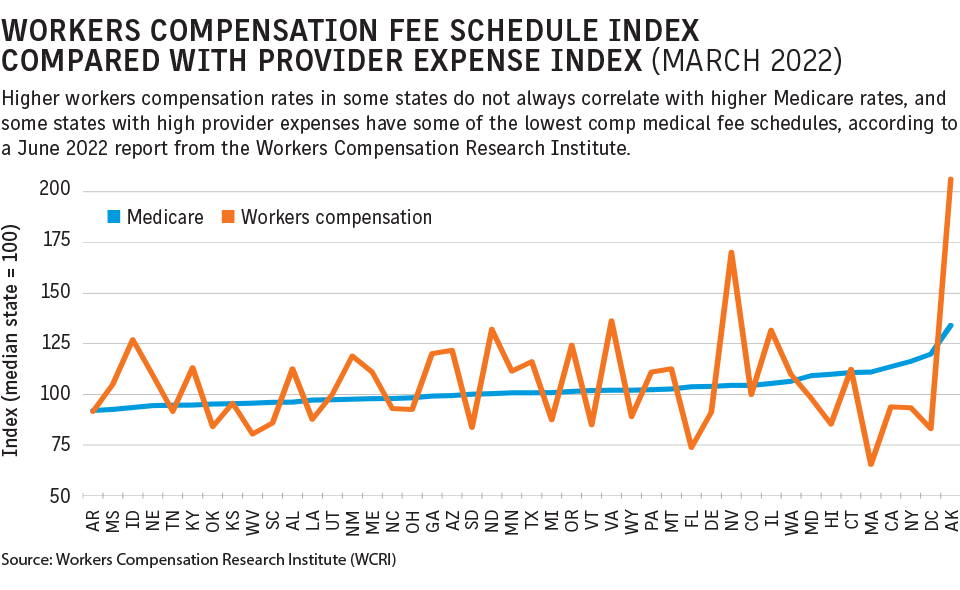
Many states have amended their fee schedules since 2019, according to a June 2022 Workers Compensation Research Institute report. Many update their fee schedules in accordance with laws that require fee schedules to be re-examined, but changes vary.

Maryland, New York, Pennsylvania and Texas had double-digit percentage increases between 2019 and 2022.

While a majority of states have fee schedules, the percentage paid compared with Medicare varied from 5% below in Massachusetts to 163% above in Nevada, the WCRI report said. 

States with some of the highest provider expenses — including California, Hawaii, New York and Massachusetts — had some of the lowest fee schedule reimbursement rates in the country. 

Some stakeholders are calling for change.

“I think you’ve got to go back to, what’s the purpose of the fee schedule?” said Kent Spafford, who is a board member of the American Association of Payers, Administrators and Networks and also on the WCRI Disability and Medical Management Program Advisory Board. “Designed properly, a fee schedule should provide enough incentive for a provider to treat an injured worker with a high quality of care.”

Fees for different medical services can affect injured worker outcomes, said Jason Beans, CEO and founder of Chicago-based Rising Medical Solutions, which provides medical cost containment services to comp insurers and employers.  

Professional services fee schedules that get “too aggressive” in trying to keep fees low could mean fewer physicians treating comp patients, he said. 

“In Illinois, it took forever to get a fee schedule, and, even when we got it, it wasn’t very aggressive,” Mr. Beans said of the fee schedule implemented in 2011. 

Illinois lawmakers in January introduced House Bill 1548, which would void existing fee schedules after Aug. 31, 2024, and require the Workers’ Compensation Commission to establish new fee schedules by Sept. 1, 2024. 

It’s unclear whether employers in states without schedules pay more in total costs. 

In Wisconsin, where there is no fee schedule, “employees have more control over their treating physician, which might contribute to higher medical costs,” said Griffin Murphy, policy analyst with the Washington-based National Academy of Social Insurance. “If employees get better treatment when they have control over their treating physician, however, higher medical costs might be offset by lower indemnity benefits and better return-to-work outcomes.”

An attempt to institute fee schedules has been viewed as interfering with employer rights and causes “significant opposition,” Mr. Murphy said. 

Other mechanisms could work, according to Mr. Murphy, who said that with rising medical inflation, insurers charge higher comp premiums. Employers can increase workplace safety measures and lobby state legislators to heighten standards for comp claim approval, he said.

“Both of these may effectively reduce claims and thus serve as protection against increasing medical fees,” he said.  

Fee schedules are effective when they recognize market prices and are updated to reflect changes in medical treatment or billing practices, Mr. Chadarevian said. 

Mr. Beans said “fee schedules have to be written in a way that they do not create negative incentives, to either limit access to care or to change treatment patterns … or billing patterns,” he said. 


Establishing rates varies by state  

States with medical fee schedules in workers compensation typically base their rates on Medicare, a reimbursement strategy that reflects problematic past systems and modern-day constraints, experts say. 

Many states lack the funds to undertake the research necessary to devise fee schedules that are “meaningful for their particular state,” hence the reliance on basing schedules on Medicare, said Kent Spafford, a board member of the American Association of Payers, Administrators and Networks and the Workers Compensation Research Institute’s Disability and Medical Management Program Advisory Board.

Mr. Spafford said medical inflation, a top comp industry concern, should be cause for updating medical fee schedules. 

Medicare, because it is subject to budgets and political maneuvering, does not necessarily change its rates based on medical inflation, he said. 

Stacy Jones, senior research analyst with the California Workers’ Compensation Institute, said California hasn’t seen significant medical treatment fee schedule changes recently and that the “basic medical treatment fee schedule is very straightforward.” 

Many states’ fee schedules, including California’s, were historically based on the average cost of medical services but this led to problems, she said, which is why many states now base fee schedules on Medicare. 

Fee schedules were historically based on “usual and customary” physician charges, but that definition created issues in many states since what providers charged and what they were actually paid for didn’t always equate, Mr. Spafford said. 


Source link

Appeals court holds salon in contempt for ignoring NLRB order


A federal appeals court has held a salon in contempt for ignoring a National Labor Relations Board order in a case involving the wrongful termination of an employee who spoke out about COVID-19 workplace safety measures.

The U.S. Court of Appeals for the Seventh Circuit on Monday held Haven Salon + Spa, Inc. in contempt and ordered the Muskego, Wisconsin-based business to pay a $1,000 fine plus $150 for each day next week that the business continues to be in noncompliance.

The daily fines are set to increase by $100 after next week if the business continues to ignore the order.

The case involves Katherine Rehm, who claims she was fired in May 2020 after raising concerns that her employer was not doing enough to protect workers against COVID-19.

Ms. Rehm claimed the business further retaliated against her by threatening legal action after she complained to the National Labor Relations Board.

An administrative law judge determined that the termination was unlawful, recommending that the NLRB order the business to compensate Ms. Rehm for lost pay and other expenses, offer to rehire her, notify her that it would remove references to her unlawful termination from her employee file and take other remedies.

The NLRB requested that the appeals court step in when the business failed to comply with the order.

The court found that the business has still not complied with NLRB requirements to remove the termination references from Ms. Rehm’s employee file, to post a notice of employee rights at its store locations, and to file a sworn certification with the board attesting to its compliance.

The appeals court ruled to hold the business in contempt after the company “intentionally” ignored numerous petitions and orders in the case, from both the NLRB and the court itself. 


Source link

Lack of coordination of care for injured workers results in more rehab costs


Less coordination of care was found to be a factor in injured workers who relied on “extended” physical rehabilitation post-injury, according to a study released Wednesday by the Workers Compensation Research Institute.

According to WCRI, physical medicine services are commonly used in treating workers with lower back pain and other musculoskeletal injuries, and in recent years, there has been an increase in the frequency of claims receiving physical medicine services. After adjusting for the differences in severity and other factors, WCRI found that claims with extended physical medicine use had higher overall medical costs, higher indemnity payments and a longer duration of temporary disability.

Most treatment guidelines for low back pain address initial physical medicine care, leaving subsequent care ordered by providers over a longer period of time at the discretion of the employers or payers, according to the study, which pegged several factors as increasing the likelihood of extended services.

The most important factors are related to the involvement of multiple providers in care, suggesting that better coordination between providers could result in less visits, according to WCRI.

Severity indicators also predict extended physical medicine use. For example, claims with nerve involvement were 2.4 times more likely to have extended physical medicine use relative to similar cases without neuropathic conditions. Workers with at least one comorbidity were also 1.8 times more likely to have extended physical medicine visits, according to WCRI.

Practice patterns also made a difference in predicting the likelihood of having extended physical medicine use, as WCRI found that if a claim already had 15 or more visits during the initial six weeks of physical medicine care, the claim was twice as likely to have extended physical medicine use compared to a claim with fewer than 15 visits within six weeks.

WCRI also found that a worker’s characteristics had a “small influence” on the likelihood of having extended physical medicine use. For example, younger male workers were less likely to have extended physical medicine use while workers aged 55 or older had an increased likelihood of having extended physical medicine use. 


Source link

Jewelry company cited for exposing workers to eye injuries


A Texas jewelry metal-plating finishing company has been cited by the Occupational Safety and Health Administration for allegedly failing to keep employees protected against potentially severe eye injuries.

OSHA on Tuesday announced citations against El Paso, Texas-based Arizona Traders Co. for 12 serious violations after workplace safety inspectors in September 2022 found employees were exposed to harmful chemicals, such as corrosive acids, that could lead to permanent eye injuries.

OSHA proposed $292,693 in fines, and the company was given 15 days to contest the citations.

The company is accused of failing to provide required eyewash stations or showers in areas where workers face risks associated with using hydrochloric acid, nitric acid and ferric chloride.

Inspectors also found obstructed exits and electrical hazards, as well as improperly stored acetylene and oxygen cylinders, at the business, OSHA stated.

Additionally, the company is accused of failing to establish and implement written respiratory protection and hazard communication programs.

OSHA similarly cited the business over claims that it failed to protect employees against eye dangers in September 2011 and August 2012.


Source link

Employer reporting, physician assistant comp bills filed in Oregon


Oregon legislators have introduced bills to require timely reporting of injuries by employers and to permit physician assistants to treat injured workers in comp cases.

House Bill 3467, filed Tuesday, would require employers to report to their insurers any workplace injuries that may result in the filing of workers comp claims within five days after the employer becomes aware of the injury. Failure to do so could result in employers having to reimburse insurers for any penalties related to the delay.

There would be a reporting exception in cases where workers require no medical treatment or if they only require onsite first aid that does not result in further evaluation.

House Bill 3412, also filed Tuesday, would add physician assistants to the list of medical professionals who are permitted to treat injured employees in workers compensation cases.

Both bills were introduced on first reading Tuesday and then sent to the desk of the House speaker for further action.   


Source link

States look to expand first responder comp cancer presumptions


Lawmakers in numerous states are seeking to expand the list of cancers and other illnesses that first responders are presumed to have contracted on the job for workers compensation purposes, but the costs associated with the measures are hard to quantify, experts say.

Lack of data on first responder claims and the long latency periods associated with the diseases are among the factors that complicate the process.

More than a dozen states have introduced bills this year that would add different types of cancers to lists of presumptive occupational injuries for first responders such as police, firefighters and emergency medical services personnel. It’s a legislative trend seen in years past, as more states seek to expand benefits.

The National Council on Compensation Insurance on Feb. 16 released a report analyzing recent statutory changes and proposed measures regarding occupational illnesses such as cancer among first responders, an issue that affects firefighters more than other services.

“The nature of employment for firefighters generally differs from that of other first responders and, as such, the risk of contracting certain occupational diseases may differ between firefighters and other first responders,” the report states.

Complicating the issue further, firefighter cancer presumptions are rebuttable in many states, allowing comp payers to argue that the disease was not job-related, and the issue of whether volunteer firefighters are afforded the presumptions like their paid counterparts depends on the state.

The report says quantifying comp system costs is difficult because many firefighters work for self-insured municipalities, which are not required to report data to the NCCI, many occupational diseases among firefighters and other first responders have long latency periods, and studies linking certain diseases with the workplace draw different conclusions.

Cancer presumptions for first responders vary by state, said Bruce Spidell, NCCI actuarial committee liaison and coauthor of the report. Some, such as New Hampshire, have general cancer presumption provisions, while others, such as Montana and Idaho, outline specific types of cancer that are considered presumptive.  

Regardless of how cancers are classified, actuaries see cancer presumptions as having the potential to increase comp claims.

“In these cases, we know that the directional impact is going to be upward,” Mr. Spidell said.

Numbers on claims frequency and costs are difficult to come by, however, due to reporting issues, he said.

Meanwhile, some states are also considering expanding the pool of eligible workers.

Virginia State Sen. Jeremy McPike is primary sponsor of Senate Bill 1038, which would expand cancer presumptions to state police arson and bomb investigators.

The measure has passed both houses of the state legislature and has been sent to Gov. Glenn Youngkin for his consideration.

“The data is showing more (cancer) linkages to the profession,” Mr. McPike said.

Mr. McPike said his bill was inspired by the fact that investigators with the Department of State Police were not covered by certain cancer presumptions even though their work involved exposure to potentially cancer-causing agents, for example working at locations such as shuttered meth labs during law enforcement investigations.  


Source link

Hollywood graphics engineer’s battery lawsuit reinstated


A California appeals court reversed a trial court’s dismissal of a 2018 battery lawsuit filed by a fired Hollywood graphics engineer, ruling his claims were not preempted by the state’s workers compensation exclusivity rule.

In a decision filed Thursday, the California Court of Appeals, Second District, ruled Iman Sadeghi, former vice president of engineering at Pinscreen Inc., sufficiently pleaded claims for battery and intentional infliction of emotional distress.

Mr. Sadeghi said that on Aug. 7, 2017, the day he was fired by Pinscreen, he was accosted and physically restrained after a supervisor instructed workers to stop him on his way out of the building and forcibly retrieve his company laptop.

Mr. Sadeghi said in the lawsuit that he suffered eye injuries and a dislocated shoulder in the incident.

The trial judge ruled Mr. Sadeghi, who worked on the movie “Tangled” at Walt Disney Animation Studios, failed to plead his case for battery, invasion of privacy and intentional infliction of emotional distress and that the civil claims should have been barred by the state’s workers comp exclusivity rule.  

The appeals court overturned the lower court, citing an exception to the exclusivity rule that addresses workplace injuries caused by “willful and unprovoked” physical acts of aggression by employees. It also noted that the injuries did not occur in the course of his employment.

The court ruled that Mr. Sadeghi sufficiently pleaded his claims for battery and intentional infliction of emotional distress but not for invasion of privacy.


Source link

‘Rust’ producers agree to $100K settlement after workplace death


Rust Movie Productions LLC has agreed to a $100,000 settlement with the New Mexico Environment Department’s Occupational Health and Safety Bureau over workplace safety citations that were issued following the on-set death of cinematographer Halyna Hutchins in October 2021.

Ms. Hutchins was fatally shot on Oct. 21, 2021, when a live round was shot from a revolver being used as a prop gun by actor Alec Baldwin during a rehearsal on the movie set.

Director Joel Souza was also injured during the incident but survived.

OHSB issued citations against the production company in April 2022, which were subsequently appealed. Settlement negotiations followed.

On Friday, the New Mexico Occupational Health and Safety Review Commission publicized the settlement agreement, which states that the production company agreed to an amended penalty of $100,000, which was decreased from the $136,793 in fines that were originally proposed.

As part of the agreement, the company must pay the penalties within 30 days.

The agreement contains a provision stating that agreeing to the fines is not an admission of guilt and cannot be used as evidence in any further civil litigation that may arise from the incident or in the ongoing criminal proceedings tied to the fatality.

When the workplace citations were announced last April, OSHB said that investigators determined that the production company’s management knew that firearm safety procedures were not being followed on the movie set and that the company “demonstrated plain indifference to employee safety by failing to review work practices and take correction action.”

The company was issued a willful-serious citation along with the civil penalty, which OSHB said is the highest level of citation and maximum fine allowable by New Mexico law.  


Source link

Exit mobile version