Social workers could bridge mental health gap in comp care


Two states are taking steps to address shortages of qualified mental health professionals in workers comp by authorizing licensed clinical social workers to treat injured workers.

California enacted a law in 2022 clearing the red tape for social workers to treat in the workers compensation system, and New York, after passing a law in 2020 that cleared some hurdles, is considering legislation — A.B. 1014 — that would modify the requirements. Workers comp regulations in a third state, Texas, allow licensed clinical social workers to assist with vocational rehabilitation.

Mark Debus, Chicago-based clinical manager of behavioral health with Sedgwick Claims Management Services Inc., said the move toward permitting licensed clinical social workers to treat under workers comp makes sense, as they can manage many of the same issues typically handled by psychologists.

“Licensed clinical social workers have as much post-graduate experience as licensed psychologists in New York,” he said. “They have to meet a certain level of supervised clinical expertise, basically, and direct treatment. It’s similar to that of the licensed psychologist requirement.”

California is another state where many of the requirements for both fields are similarly stringent, according to Marcia Schwartzman Levy, Larchmont, New York-based past president of the New York chapter of the National Association of Social Workers and a licensed clinical social worker in private practice.

Both states have “some of the strictest requirements for becoming a licensed clinical social worker,” she said.

Ms. Schwartzman Levy spent much of her career working in public hospitals in New York, including as a trauma unit clinical supervisor. The connection between physical injury and mental injury has been well-established, she said, pointing to literature going back to 2001 regarding injuries and the “biopsychosocial model,” a term now used widely in workers compensation.

“I deal with bereavement, which is not just bereavement of death in the larger sense; loss of function is a form of bereavement,” Ms. Schwartzman Levy said, adding that linking mental issues and physical injuries has long been a part of what licensed clinical social workers are called on to do. “The biopsychosocial model is at the core of our belief system and training,” she said.

A major difference in the professions of licensed clinical social worker and psychologist is pay. “Just look at the fee schedules,” said Mr. Debus, who called social workers “underpaid.”

Medicare, on which many workers compensation fee schedules are based, reimburses clinical social workers at 75% of the physician fee schedule, which varies by state, according to a 2021 report by the National Association of Social Workers. By comparison, psychologists are reimbursed at 100%.

Jennifer Cogbill, Frisco, Texas-based senior vice president of GB Care with Gallagher Bassett Services Inc., said many psychologists are unwilling to work at the Medicare rates, which has led to a shortage of medical professionals in the workers comp field. Licensed clinical social workers could help make services more available to injured workers, she said.

“The advantage is there is a wider network of professionals they can tap into,” she said.


Source link

States push expansion of PTSD benefits in comp


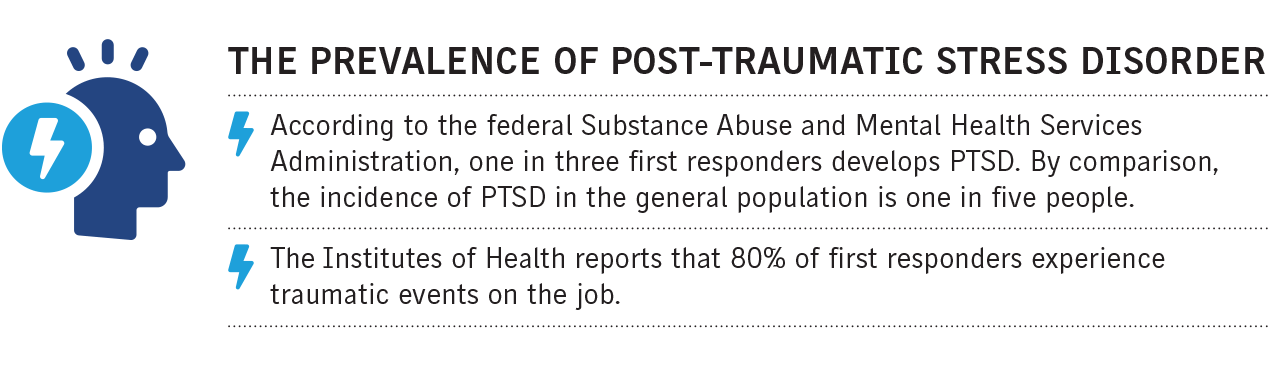
Nearly a dozen states as of late January had introduced legislation to expand or enhance workers compensation benefits for employees who suffer mental injuries by presuming they are suffered in the course of work. 

“The trend will continue,” said Brian Allen, Salt Lake City-based vice president of government affairs, pharmacy solutions, for Mitchell International Inc., a subsidiary of Enlyte Group.

Most of the bills apply only to first responders and propose changes to coverage for post-traumatic stress disorder, yet three separate bills filed last month in Virginia would expand the definition of mental injury beyond PTSD to include anxiety and depression for first responders. Two bills introduced in Connecticut would expand PTSD presumption to all workers who witness a “qualifying event” such as a death. A similar bill last year failed to gain traction. 

Connecticut and Virginia also last month introduced bills that would expand the definition of first responders to include dispatchers. Connecticut lawmakers are also considering separate bills that would add several classes of workers to its PTSD presumption, including volunteers, police technicians, dive teams, K-9 search and rescue personnel, and video technicians who review and process police body camera footage. 

Last year saw a similar surge in legislation aimed at making it easier to claim comp for mental injuries, with mixed results suggesting a slowing down of successful bills. In 2022, only three states enacted changes after more than 60 bills were introduced, according to two separate analyses by the National Council on Compensation Insurance. Optum Workers’ Comp and Auto No-Fault in 2021 published findings that over half of states had made changes to mental injury coverage in workers compensation since 2018.

Among the concerns of those who oppose such legislation are unknown costs. 

Bruce Spidell, NCCI’s assistant actuary, said data on PTSD presumption claims is “scarce” and that each state’s presumption parameters are different, making it challenging to predict claim activity. “Every single (law) is different and there’s just not really a benchmark,” he said. “We just don’t know how much this is going to cost.” 

Police and fire departments are typically self-insured, adding to the difficulty in gathering data on costs, he said.

The issue hit a roadblock for that reason in 2022 as California lawmakers aimed to expand a 2020 PTSD presumption law — set to expire in 2025 — to include dispatchers and several other classes of emergency response personnel.

California Gov. Gavin Newsom, in a Sept. 29, 2022, letter to legislators on why he would not sign such a bill, said that “expanding coverage of the PTSD injury presumption to significant classes of employees before any studies have been conducted on the existing class for whom the presumption is temporarily in place could set a dangerous precedent that has the potential to destabilize the workers compensation system going forward, as stakeholders push for similarly unsubstantiated presumptions.”

 Mr. Allen said the uncertainty surrounding cost is the top issue. “You always try to look to figure out if we make this policy change, what is it going to look like five years from now, 10 years from now. What’s the upside? What’s the downside?”

The way many current laws are written, most first responders would qualify for coverage if they are diagnosed with PTSD, he said.

“Potential for abuse” is another issue, Mr. Allen said, referring to the possibility of PTSD claims being filed by those who are already retiring, resulting in higher benefits. 

While opposition to such bills has typically been easy to come by, few municipal groups are speaking out. Calls and inquiries to several state groups that advocate for cities and other jurisdictions seeking comment were not returned. 

Michelle Gowdy, executive director of the Virginia Municipal League, wrote in an email that the organization “continues to monitor this issue, but we are not in a position to comment at this time.” 

The mental health of first responders is “a real issue out there,” Mr. Allen said. “The question is how do we approach it? How do we deal with it? What’s the appropriate way to cover it?”

Another key issue is that many of the laws and proposals stipulate that a first responder must experience a “qualifying event” to gain access to benefits. 

While the language differs state to state most include witnessing or responding to death, including events involving multiple fatalities, and crimes and accidents involving children — all of which are events frequently experienced by first responders, said Mr. Allen, a former police officer.

And while the laws clear red tape for obtaining benefits for PTSD, many are rebuttable, and this issue is starting to show up in the courts.

The Minnesota Supreme Court on Dec. 21, 2022, ruled that a sheriff’s deputy is entitled to a presumption that his post-traumatic stress disorder is an occupational disease since he presented a diagnosis of PTSD, even though his employer offered a competing diagnosis of a “major depressive disorder.”

A Florida appellate court on Nov. 30, 2022, ruled that a police officer who filed a PTSD claim after responding to a school shooting was eligible for benefits because, while the incident happened before the 2018 change in state law that allowed such claims, his disability didn’t begin until he was placed on administrative leave months after the law was enacted.

The ruling, which would clear the way for similar claims filed based on qualifying events that occurred before the change in law, would expand eligibility to events that took place before 2018, said Robert Grace, a partner with Tampa, Florida-based law firm Bleakley Bavol Denman & Grace. 

“I do believe the court got it right,” he said of the case.


Mental health bills weighed

Several states this year are considering legislation that would help manage the mental health of first responders. 

Indiana lawmakers are considering a bill that would create a state-funded program to provide unspecified income and mental health services to first responders who have been involved in “a qualified critical incident” and would cover those who are diagnosed with post-traumatic stress disorder. The state is also considering a bill that would provide a first responder with 48 hours of leave immediately following a qualified critical incident.

In Missouri, lawmakers have proposed the First Responder Mental Health Initiative Act that would grant full access to behavioral health care services and treatment as “responsive to the needs of the individual and the professions of police officers, firefighters, emergency medical technicians, 911 dispatchers, and paramedics.” 

In Florida, a bill would require an “employing agency of a first responder to pay for certain licensed counseling.” 

Nebraska lawmakers are working on legislation to provide reimbursement for mental health examinations and resilience training for first responders.

And in Utah, lawmakers are seeking to expand access to mental health services — already provided to employed and retired first responders — to the spouses of retired first responders.


Source link

Approach to attorneys fees varies widely in comp


The cost of litigating workers compensation claims remains a concern in the industry, but there have been few court rulings overhauling costs and limited legislative efforts on the issue of attorneys fees. 

One recent case in New Jersey, however, has attracted attention. 

In December, a New Jersey appellate court reversed an attorneys fee award in a case brought by an injured golf course worker. 

The panel said a judge erred in approving the large fee award since considerations of reasonableness, and not a blanket 20% of the award, should have been the guiding factor, even though 20% attorneys fees are permitted in New Jersey. 

In this case, the attorneys representing the injured worker were awarded 20% of the $164,577 award on the permanency aspect of the case, which amounted to $32,915 in fees.

Permanency in New Jersey deals with the loss of bodily function. Medical bills and lost wages make up the other aspects of comp in the state. 

The judge also awarded claimants attorneys fees of $78,000 on temporary disability benefits and medical benefits, bringing the total fees to $110,915. The appeals panel reversed the awards.

Garzon v. Morris County Golf Club was not precedential, so comp judges are not bound by it, but it generated interest, according to legal experts.

“It’s going to be discussed in the legal community,” said comp defense attorney John Geaney, co-chair of the workers compensation practice at the New Jersey law firm Capehart Scatchard, PA. “It’s something that other judges might look at. It’s persuasive.” 

The awarding of attorneys fees in comp cases varies between jurisdictions, though caps are similar in many states. Many hover around 20% of the total award, although payment responsibility varies and most are contingency agreements.

In New Jersey, defendants pay 60% of attorneys fees in cases that settle, with the other 40% coming out of the total award, according to Richard Rubenstein, managing partner of Livingston, New Jersey-based Rubenstein, Berliner & Shinrod LLC.

In some states the entire fee is deducted from the injured worker award. 

“The judge in Garzon failed to make a distinction between a contingency case and an hourly case,” Mr. Rubenstein said. 

“We’re not allowed to charge hourly,” he said. “We’d be committing an ethical infraction. They’re asking us essentially to keep our hours when we can’t charge for them.”

Can legislation help clarify matters? Some experts are not sure there’s enough movement. 

Laura Kersey, executive director of regulatory and legislative analysis for the Boca Raton, Florida-based National Council on Compensation Insurance, said the organization has tracked approximately 60 bills addressing this topic in the past five years. Few have been successful. 

This legislative session only two states so far have introduced bills addressing attorneys fees. 

In Tennessee, House Bill 82 would cap fees at 20% of the first 450 weeks of an injured worker’s award.

New York Assembly Bill 337 includes a revision of what claimants attorneys can submit as a claim for legal services connected to medical treatment. 

Judges in various jurisdictions have also ruled on the attorneys fees issue. 

Adam Levell, senior legal counsel for NCCI, said that since 2018 the council has reported on 13 cases decided by judges in nine states, with varying outcomes.

In California, there have been “a number of cases to determine the value of the attorneys’ work,” said Alan Gurvey, a Sherman Oaks, California-based applicants attorney with Rowen, Gurvey & Win. There hasn’t been “any real headway in many years in increasing fees for the applicant attorney,” he said. 

California stands out from other states in that claims administrators are required to pay the fees of claimants attorneys if the defense conducts the worker’s deposition, said Sara Widener-Brightwell, general counsel for the California Workers’ Compensation Institute. Those fees are set at about 15%, according to Mr. Gurvey.

“That is probably fairly unique to California,” Ms. Widener-Brightwell said. 

Kaitlyn Files, a claimants attorney running a practice in Levittown, Pennsylvania, said one controversial case in Pennsylvania was Neves v. WCAB (American Airlines), a 2020 appeals court decision determining claimants attorneys can be awarded a 20% fee on medical benefits in comp cases in addition to the wage loss portion.

What the decision left open for interpretation is who will pay the medical portion, since claimants attorneys fear it may be the responsibility of the injured worker, she said. 

“There’s been somewhat of an upheaval in how each specific law firm would choose to address this issue,” Ms. Files said. 

In Florida, the comp sector continues to experience confusion over the attorneys fee cap issue following court rulings, according to legal experts. 

“Some judges think there is no fee cap, some judges think the word ‘reasonable’ is the fee cap, and some judges think there is a fee cap,” said David Langham, Florida’s deputy chief judge of compensation claims. “We don’t know the answer.” 

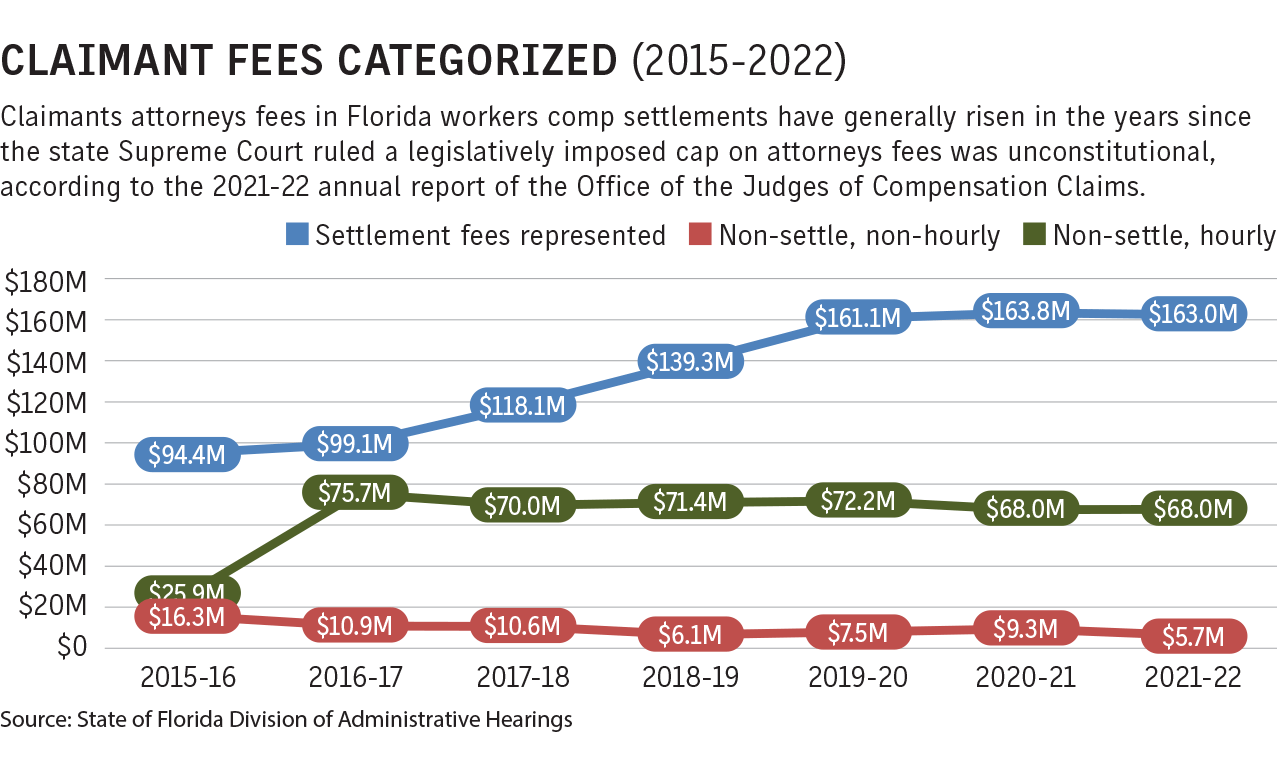
The confusion stems from the 2016 Florida Supreme Court case of Castellanos vs. Next Door Co., a ruling that threw out statutorily imposed fee caps. 

The decision brought back a previous system of awarding reasonable attorneys fees via judicial approval, not through statutes enacted by legislators. 


Court decisions bar some state legislatures from capping charges

Some states limit what legislatures can do with regard to attorneys fees.

In 2020, a Florida workers compensation judge approved a more than $1 million attorneys fee award in a case involving a worker who had suffered brain injuries. 

The fee, a little more than 25% of the total $3.9 million award, drew attention due to its size.  

The award came four years after the Florida Supreme Court ruled in Castellanos v. Next Door Co. that the state’s statutory cap on attorneys fees was unconstitutional.

Justices determined fee caps should be decided by the judiciary, not legislators. 

“My understanding is that it is uncapped as of this moment,” George Townsend, a Virginia-based attorney and president of the Workers’ Injury Law & Advocacy Group, said regarding Florida. 

Similarly, he said, Alabama and Utah also eliminated statutory fee caps because of court rulings that reached a similar conclusion. 

In 2016, the Utah Supreme Court, in Injured Workers Association of Utah v. State of Utah, found that the judiciary, not the legislature, could regulate the practice of law, including setting attorneys fees. 

The Alabama Supreme Court issued a similar decision in Nora Clower v. CVS Caremark Corp. the following year. 

In Florida, the Castellanos ruling initially resulted in a proposed 14.5% workers comp insurance rate increase and caused issues for employers, said Carolyn Johnson, vice president of government affairs for the Florida Chamber of Commerce in Tallahassee.

“(Employers) definitely see the upward pressure that having uncapped attorney fees has had on the system,” she said.

Ms. Johnson said work has been done to try and recap attorney fees legislatively, but “we just have not been able to do that.” 



Source link

Cumulative trauma claims costs add up


Injuries to body parts that are caused by repetitive motion, frequent exposure to sounds, chemicals or even vibrations are among the most perplexing in the workers compensation sector.

Claims arising from cumulative trauma injuries, such as carpal tunnel syndrome, tendinitis and hearing loss, will likely rise given the aging workforce and an overall trend toward litigation, comp experts say. 

How states address cumulative trauma injuries varies significantly, with some states — as well as some courts — tending to be sympathetic to workers, employer lawyers say. Employers have won some significant legal victories, though. 

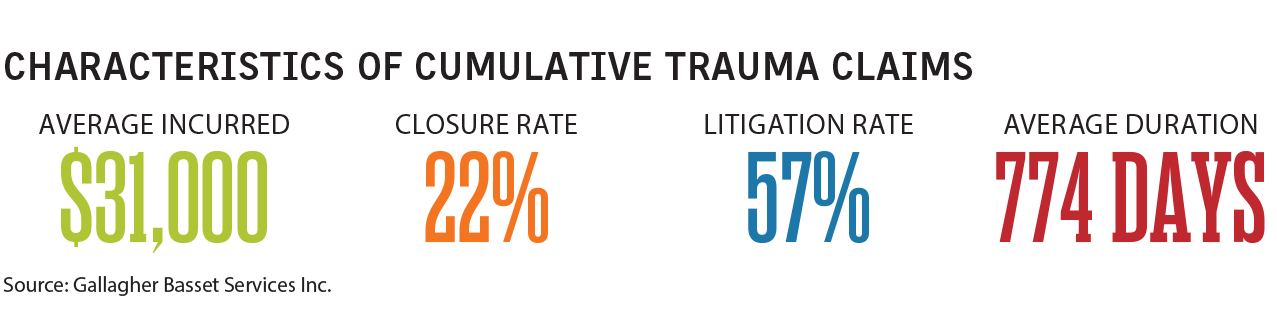
Concerns over cumulative trauma injuries stack up: Sometimes there is little or no objective medical evidence that proves causation or degree of injury; many claims are litigated, adding to costs and often taking several years to close; return to work is frequently not a given or a goal, because some of the claims are filed post-employment. 

“It’s easy to know when a rock falls on somebody’s head —what the cause was, the circumstances that led to it —and you are able to identify it as work-related and what the injuries were,” said Bert Randall, principal at Franklin & Prokopik P.C. in Baltimore. “But with cumulative trauma claims, those claims arise over a long period of time (and) are much more problematic.”

Liberty Mutual Insurance Co. in 2022 released a report on the top 10 costliest workers compensation claims that said overexertion, other exertions and awkward postures — typical issues associated with musculoskeletal cumulative trauma — account for more than 28% of costs to the system. 

“That’s what we are talking about,” said Craig Karasack, Fort Lauderdale, Florida-based product director of ergonomics and manufacturing technology at Liberty Mutual. Cumulative trauma is “a bit of a challenge because it’s very obvious when somebody falls and hurts themselves, or you know when something sharp comes in contact with the body because it’s immediate. The challenge with these types of injuries that we’re talking about is that the damage is done over time.” 

 “Cumulative trauma is on the horizon and is something we have to pay close attention to,” said Steve Bennett, Washington-based assistant vice president for workers compensation programs and counsel for the American Property Casualty Insurance Association. 

“As the population gets older, and there’s a chance of having more of these claims, there’s also the issue whether or not they’re work-related or part of general everyday life,” he said. “These claims can be pretty expensive and become a large cost driver if they get out of hand.” 

The industry is seeing a rise in cumulative trauma injuries, said Neil DeBlock, Schaumburg, Illinois-based vice president, workers compensation claims, for Zurich North America. 

The profile of an average worker is also contributing to the challenge, according to Jennifer Cogbill, Frisco, Texas-based senior vice president of GBCare with Gallagher Bassett Services Inc. 

“We see an aging workforce with people with more physical health challenges,” she said. “We may not be as fit and healthy as we were 20 to 30 years ago, and some of those preexisting health issues will contribute to complications, pain and the opportunity for a cumulative trauma claim.” 

Most states allow workers to be awarded comp benefits for some cumulative trauma injuries, although the definitions and guidelines vary, according to the Workers’ Compensation Research Institute, which issued a state-by-state analysis in 2022. 

Virginia’s law, for example, covers only hearing loss and carpal tunnel syndrome. Florida has no statutes on cumulative trauma claims, meaning none are prohibited. In several states, including Oregon and Tennessee, injuries must be primarily caused by the work performed, leaving room for interpretation. 

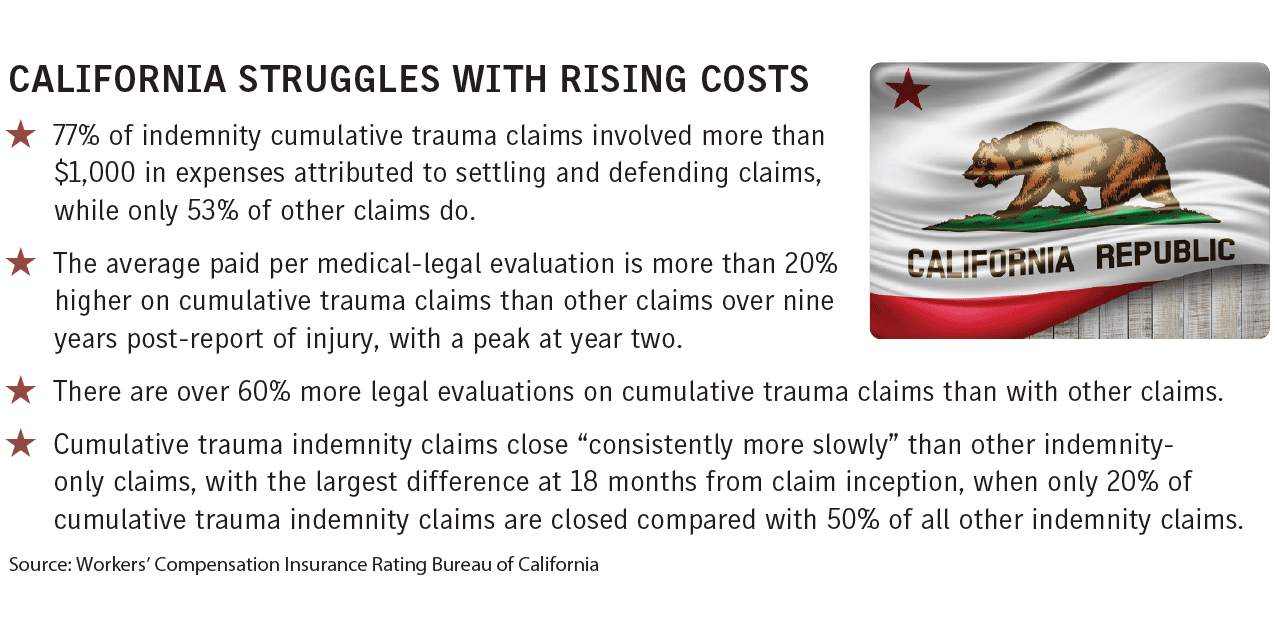
In California — dubbed by several experts as experiencing a “phenomenon” of cumulative trauma activity — 60% of workers comp claims are cumulative in nature, according to a 2022 analysis by the Workers’ Compensation Insurance Rating Bureau of California. 

Any changes to laws are usually slow, according to experts who say most states take a worker-friendly approach. 

As of late January, only one state legislature in its current session has proposed tightening the law permitting such injuries. Oklahoma lawmakers are considering a bill that states the “date of injury for cumulative trauma shall be the last date of injurious exposure prior to the filing date of the Employee’s First Notice of Claim for Compensation,” which must be filed within six months after the first distinct manifestation of the disease or cumulative trauma or within six months after death.

Illinois in 2022 aimed to limit exposure with a bill that would have restricted conditions under which repetitive or cumulative trauma is compensable, providing “that gradual deterioration or progressive degeneration of the body caused by aging is not compensable as repetitive or cumulative trauma.” That bill died in committee. 

Meanwhile, state courts are divided on the issue. 

In California, most outcomes are worker-friendly or would require so much in medical-legal expenses that insurers will likely settle in some cases, according to attorneys. Some state courts, aligning with state laws, have been less likely to rule in favor of the worker. 

The Louisiana Supreme Court in 2021 ruled that a 30-year-old fireman did not qualify for permanent partial disability due to hearing loss he suffered after years of exposure to loud noises because state law requires hearing loss for disability purposes be “solely due to a single traumatic accident.”

An appeals court in Ohio granted summary judgment to United Airlines Inc. in a case involving a flight attendant who alleged a cumulative trauma injury resulted from repeated chemical exposure from an in-flight air freshener because the worker failed to prove causation, in line with parameters set by state law.

Conversely, the Supreme Court of Kentucky in 2021 reversed earlier rulings that dismissed a cumulative trauma claim filed by a retired nurse suffering from “crippling injuries” to her neck, back and hands due to her alleged failure to provide a reasonable notice of her injury. The state high court ruled that the lower courts misapplied a 2018 law that established time limits on injury reporting. 

The same court in 2021 also granted compensability — again, over the issue of time the claim was filed — to a Ford Motor Co. plant worker who suffered injuries to her neck and spine because of repetitive-motion duties going back to 2007. The worker testified that she had performed the same task 300 times per day. 

Such claims are often litigated over causation, timing, comorbidities, and other factors, according to industry experts, who say early intervention and prevention are key. 

“There’s a willingness among a lot of commissioners and judges to find that, even if there are comorbidities present, if there is a part of it that is work-related, they’re sympathetic to that,” said Mr. Randall of Franklin & Prokopik.

Cumulative trauma cases are “very difficult to win” for employers, said Nathan Levy, Atlanta-based partner with Levy, Sibley, Foreman & Speir LLC, adding that in Georgia, “you’ve got to show that this occurred pretty much somewhere else.”

Suspected fraud is also a factor, given the nature and timing of some injuries — post-layoff filings are common — and the lack of clear medical evidence, experts say. California, in particular, has gained notoriety for much post-employment claim activity.

“Like everything, there’s extremes on both sides, and somewhere in the middle we’re supposed to take care of the diligent worker,” said Jeffrey Adelson, general counsel and co-managing shareholder at Adelson McLean APC in Newport Beach, California. 

“I just don’t think the legitimately injured workers should be thrown out and lose an opportunity to get what they deserve … because of others,” he said.


Source link

Acting on ergonomic advice can reduce injuries


Some cumulative trauma claims are preventable, according to loss control experts, who say workplace safety, automation and sound ergonomics are among the best risk management practices to keep workers on the job without pain or overuse injuries.

Such technologies and best practices are not new, have helped lower claim frequency overall in workers compensation and have the potential to curb repetitive trauma injuries, they say. 

“We’re continuing to try to get our customers to understand the risk factors that contribute to this type of human trauma disorders and have risk mitigation strategies in place to help stop them in the first place,” said Woody Dwyer, director of loss control and certified professional ergonomist with AmTrust Financial Services Inc. in Hartford, Connecticut. 

One step is to know your workers, processes and injury data, said Kim Pfingstag, Memphis, Tennessee-based manager, occupational care & recovery, in the global risk management department of International Paper Co.

“There’s a way to look at our data and identify where we’ve got opportunities to prevent injuries,” she said, adding that data can lead to improved communication between departments and work sites. 

From there, employers can better “understand that there is an opportunity to do things like ergonomic assessments, or just simple things like rotating workers so that they’re not doing the same job duties continuously, or letting them have more breaks,” she said. “Even ask employees to offer suggestions for how they might do this better.” 

Craig Karasack, Fort Lauderdale, Florida-based product director of ergonomics and manufacturing technology at Liberty Mutual Insurance Co., said a better understanding of work processes is helpful in prevention. “Our tenet is to look at the work design,” he said. 

Not following through on mitigation strategies is a common pitfall, said Mike Milidonis, Freeport, Florida-based national manager, ergonomics and employer services, for Genex Services, a Enlyte LLC company. 

For example, he said, companies can order an ergonomic evaluation, receive recommendations for equipment that might help an individual, and yet not purchase that equipment.

“That’s the worst thing because you know there’s a problem and nothing ever happens,” he said. “And the person is just going to continue down that discomfort road until it gets into that work comp side, or possibly disability.” 

Not understanding a worker’s history is another concern, said Neil DeBlock, Schaumburg, Illinois-based vice president, workers compensation claims, for Zurich North America.

“Many years ago, people worked at one employer for their entire career and currently that doesn’t happen any longer; they go from employer to employer to employer,” he said. “In some jurisdictions it’s the last employer, the last carrier that is stuck with the entire (cumulative trauma claim) and you don’t know what the worker was doing in their prior employments, and that works against you.”

Investigating a worker’s prior employers is helpful, he said. 

According to attorneys, this can involve checking Occupational Safety and Health Administration logs to examine a company’s record of lost-time injuries and frequency. 

Another tip is to create detailed job descriptions that provide guidelines on such factors as the weight of materials a worker should handle. Employers should also keep documentation of such rules and practices, Mr. DeBlock said.


Source link

Collaboration with workers, early claims support critical to recovery


When a cumulative trauma claim is filed with an employer the approach should be much the same as with all claims, experts say: If the claim is accepted, worker advocacy is often the best medicine. 

“Injured worker advocacy and support early in the cycle of the claim is critical,” said Jennifer Cogbill, Frisco, Texas-based senior vice president of GBCare with Gallagher Bassett Services Inc.

The advocacy approach typically involves supporting the worker with improved communication and guidance — the aim is to establish a collaborative relationship instead of one that might be deemed adversarial, according to experts.

“If a worker is presenting with pain, and they’re not sure where to go, we want them to come to us to help them, as opposed to feeling like they need to seek out an attorney to give them the best options on the recovery,” she said. 

Employers should establish a trusting relationship with workers and engage with them in the recovery process, said Tammy Bradly, Birmingham, Alabama-based senior director of clinical product marketing for Enlyte Group LLC. 

Ms. Bradly said most cumulative trauma injuries take time to heal, and that keeping in touch with workers can help go a long way in avoiding litigation. 

Dr. Mary Capelli-Schellpfeffer, Boston-based national medical director for workers compensation claims for Liberty Mutual Insurance Co., said that may include helping workers manage comorbidities or other factors outside of a claim. 

“The workers comp industry realizes that there are factors that are going to affect the claim,” she said, adding that better coordination of care between a worker’s current doctors and those treating the injury can help “remove a barrier to communication and assure that that injured worker’s total health is managed.” 


Source link

Missouri HVAC company cited over worker’s death


The Occupational Safety and Health Administration has cited a Missouri heating, ventilation and air conditioning company for three serious and two repeat violations after an apprentice technician was electrocuted at a job site last summer.

OSHA proposed $197,642 in penalties against Kansas City-based U.S. Engineering Service, a subsidiary of U.S. Engineering Company Holdings, following the electrocution of the fourth-year apprentice on Aug. 24, 2022.

The worker died after coming into contact with energized parts while repairing HVAC equipment at University Academy, a college preparatory charter school in Kansas City.

OSHA inspectors said the company failed to de-energize equipment and prevent it from unintentionally starting during repair or maintenance work. The agency also said the company failed to identify the personal protective equipment needs of employees at contracted sites.

OSHA also said the company allowed a damaged extension cord to be used at the worksite.

The company paid fines in a separate case after OSHA cited it for similar violations following a July 2021 fatality.

The company has 15 days to contest the latest citations and proposed penalties.


Source link

Utah bill proposes firefighter comp cancer presumption


A legislative proposal in Utah would amend the existing workers compensation law to create a rebuttable presumption for cancer diagnoses in firefighters and would require the state Division of Industrial Accidents to conduct a study regarding cancers typically associated with firefighting.

The measure, Senate Bill 159, which was introduced Monday, modifies the circumstances under which firefighters are presumed to have contracted certain types of cancer during the course of their employment.

The presumptive cancers outlined in the bill are cancers of the pharynx, esophagus and lung, and includes mesothelioma.

Under the bill, both volunteer and career firefighters diagnosed with one of these types of cancer are presumed to have contracted the disease in connection with their employment.

The study in the bill requires the Division of Industrial Accidents to look into whether other cancers not mentioned in the legislation could also be contracted by firefighters in the course of their job.

The division would have to provide a report to the Senate Business and Labor Interim Committee summarizing the results and offering legislation recommendations before Nov. 30.

The bill would also modify requirements for calculating add-on fees in workers compensation claims. 


Source link

Connecticut contractor cited in fatal trench collapse


A Connecticut demolition contractor is facing proposed fines of $375,021 after the Occupational Safety and Health Administration alleges the July 22, 2022, death of a worker during a trench cave-in arose from apparent workplace safety failures.

Manchester, Connecticut-based Botticello Inc. exposed the deceased worker to deadly hazards as he worked to connect drainage piping at a residential development construction site in Vernon, Connecticut, according to OSHA.

The company was cited for three willful violations after OSHA inspectors said the company failed to provide legally required safeguards to prevent trench collapses, including failing to ensure the 135-foot-long trench offered sufficient means of egress allowing employees to exit safely.

Botticello was cited for similar violations in November 2015, according to OSHA. At the time, inspectors said the company failed to provide safeguards designed to protect workers from potentially deadly trench cave-ins.

OSHA said after the previous citation the company should have already been aware of the dangers in exposing workers to unprotected trenches.

The company has 15 days to contest the citation. 


Source link

Illinois lawmakers to consider fee schedule changes, formulary


The Illinois Workers’ Compensation Commission would be required to establish a new medical fee schedule and implement a closed drug formulary, under legislation introduced Monday.

H.B. 1548 would render all current medical fee schedules inoperative after Aug. 31, 2024, and establish new reimbursement rates based on Medicare percentages. The bill would also require annual updates to the fee schedule starting Sept. 1, 2025, that would be equal to exactly half the increase in the Consumer Price Index.

H.B. 1546 would require the commission to adopt an evidence-based drug formulary by Sept. 1. The bill does not direct the commission toward any current formulary.

Also drug-related, H.B. 1544 would establish payment conditions for compound drugs, stating that such prescriptions for more than a one-time, seven-day supply would be payable only if there are no readily available commercial products and the active ingredients each have a National Drug Code number and are components of drugs already approved by the U.S. Food and Drug Administration.

WorkCompCentral is a sister publication of Business Insurance. More stories here.


Source link

Exit mobile version