Burden of proof shifts to employers


Presumption laws vary by state, with some states allowing mental injuries to be included in a claim only if there is a physical injury, and some only applying to first responders with post-traumatic stress disorder, such as police officers, firefighters and, in some states, emergency medical personnel. 

The purpose of presumption laws, now in more than a dozen states, “is to remove the stigma associated with filing a psychiatric injury claim for post-traumatic stress disorder,” said Vicki Lindquist, partner in the Oakland, California office of Laughlin, Falbo, Levy & Moresi LLP. “The goal is to help get these claims accepted and to give people the treatment they need, to recover sufficiently to get back to their work and to their lives,” 

The laws are typically directed towards firefighters and police officers, “because they are the protectors of our communities, and they are also, more than the general public, exposed to a lot of trauma and tragedy,” she said. 

While presumption laws did have the intended effect of encouraging people to file claims, the claims are not always accepted. “The presumption itself does not require the employer to accept it,” Ms. Lindquist explained. “But because it basically removes the claimant’s burden of proof, for an employer to deny these claims, they must have some information that would suggest the injury would not be related to their work.”

The pandemic has also added fuel to claim activity, said Omar Behnawa, managing partner of the Anaheim, California office of Laughlin, Falbo, Levy & Moresi LLP. In the case of COVID-19, he said, “if there is an outbreak in the workplace and someone tested positive within a two-week period, it’s presumed you contracted the virus through work. And there are psych claims filed because of it.”

He added that “medical examiners are giving credence to some allegations with the pandemic and the stresses people are having to face just going back to the workforce.” 


Source link

Lyme disease offers clues on long COVID, but claims experience limited with both


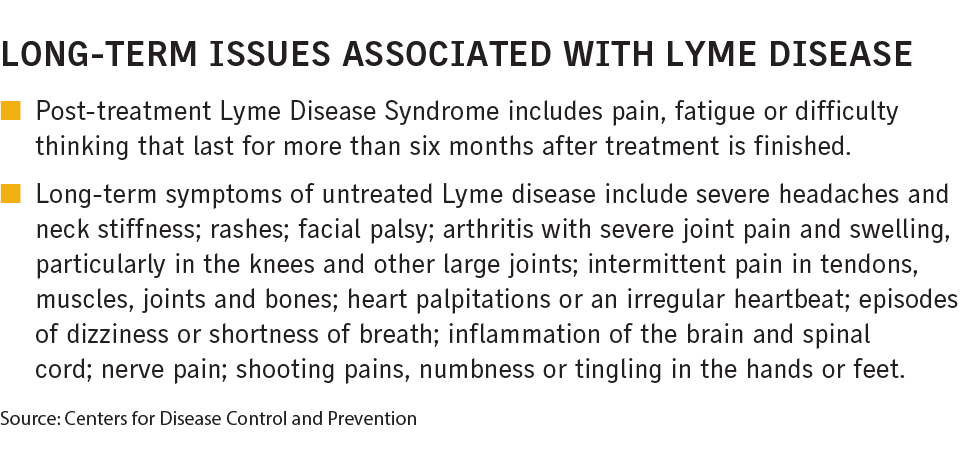
Long-term issues with Lyme disease and COVID-19 infections are strikingly similar, and much can be learned from a disease that stems from a tick bite, medical experts say.

Symptoms of Lyme disease and COVID-19 have been described as equally debilitating and mysterious.

Long COVID is “similar to a Lyme disease type of situation, where you’re seeing not just one condition,” but possibly neurological, pulmonary and cardiac impacts, said Jennifer Laver, a partner in the Mount Laurel, New Jersey, office of comp defense firm Weber Gallagher Simpson Stapleton Fires & Newby LLP. “There are multiple layers, so it’s a lot more complicated than normal” workers comp claims, Ms. Laver said.

In March 2020 — before some 20 states passed COVID-19 presumptions — Ms. Laver began drawing comparisons between COVID-19 and Lyme disease to explain how a COVID-19 infection might be compensable in workers comp, based on occupations and likely exposure to the pathogens. 

However, despite the similarities, Lyme disease in comp “is very rare and only a few states allow for it. It’s not something we see,” said Mark Walls, Chicago-based vice president of client engagement at Safety National Casualty Corp. 

Lyme disease was briefly in the spotlight in workers comp in April when New York lawmakers attempted to make it a compensable illness. That bill died in committee, as was the case in other states that attempted to create a presumption over the past few decades. For example, West Virginia legislation on the subject failed to advance in 2010. 

California has had a presumption in place since 2002 for certain first responders, such as those working in areas where they are exposed to ticks, and for state Conservation Corps members.

While Lyme disease is compensable in some cases if the worker can show he or she was bitten by a tick at work, data and case management experiences are hard to come by, even in a presumption state such as California, according to experts. And the workers comp industry has little to go on in comparing Lyme disease and long COVID in terms of claim management and outcomes. 

BI 1122 06B

“It’s the same problem for all of these long-tail diseases,” said Lorraine Johnson, Los Angeles-based CEO of the advocacy group LymeDisease.org and principal investigator for its research arm, MyLymeData. 

“The medical system does a pretty good job of handling acute illness — something that’s easy to diagnose, easy to treat and then they send you on your way — but they do not do a good job with chronic diseases, or with a long-tail illness that persists after an infection. And that’s the situation here,” she said, adding that the lack of medical experience leads to a lack of understanding when it comes to insurance coverage such as workers comp and disability. 

Lyme disease often goes undiagnosed, as there are no “good” medical markers for the long-term issues associated with it, and the availability of medical specialists attuned to the disease is scant, Ms. Johnson said.

The U.S. Department of Health and Human Services estimates that cases go underreported by a factor of 10, and LymeDisease.org, in a study published this year, found that 86% of the reason a Lyme disease sufferer’s treatment is delayed is due to “inadequate physician education.” 

Whether attention to long COVID could lead to interest in Lyme disease remains to be seen, experts say. 

“COVID changed everything,” said Brian Allen, Salt Lake City-based vice president of government affairs, pharmacy solutions, for Mitchell International Inc., a subsidiary of Enlyte Group, which provides workers comp services.

Historically, it’s been common for Lyme disease claims in workers comp to be denied on the premise that a person can be bitten by a tick anywhere, experts say. 

Several large workers comp insurers declined to speak on the issue, as did many third-party administrators.

State data is not readily available. Connecticut, a Lyme disease hot zone and one of the few states that tally occupational exposure, reported just 45 work-related tick bites that led to Lyme disease in 2021. The Maine Department of Labor last reported on Lyme disease in 2011, when there were 32 occupational cases; historically, the highest total reported in the state was 83 cases in 2006. 

The lack of occupational illness claim activity likely stems from prepandemic reasoning, when infectious diseases were typically not covered for most workers outside of a hospital setting, experts say. That was before 2020 when a wave of states passed COVID-19 infectious disease presumptions that the industry had argued were flawed, as in many cases the virus could be contracted anywhere. 

In 2016, a letter written by a Miami Beach, Florida, city manager made headlines when, referring to two denied claims for the then-common Zika virus contracted by two police officers, he called on the officers to provide proof that they contracted the virus while on duty and said they must “identify the specific infected mosquito” that caused their illness.

Referring to the relationship with Lyme disease and similar illnesses, Glenn Shor, an adviser for the National Council for Occupational Safety and Health and a lecturer and researcher with the Center for Occupational and Environmental Health at the University of California at Berkeley, said, “How do you determine whether it’s an occupational exposure that would be eligible for workers comp?

“It’s a situation that is case by case and where you’ve got to have the evidence of the exposure, the right occupation, where that exposure could have taken place. … I don’t think you’re ever going to know it’s 100% related to work, because people can be exposed, just like with COVID, in many places.”

Workers comp claims that are denied rarely wind up in the courts, often because of a lack of medical evidence, experts say. When cases are litigated, the results are mixed.

In 2021, an appeals court in New York denied compensability on “insufficient medical evidence” for a security guard who filed a claim for Lyme disease six years after being bitten by two ticks while out on patrol. Conversely, in 2013, that same appeals court ruled that a construction worker’s Lyme disease was compensable, as he had been working in a wooded area and “voluminous” medical evidence connected a 2008 tick bite to his muscle weakness and eventual total disability. 

Also in 2013, an appeals court in New Jersey ruled that a park service worker’s Lyme disease was compensable as she patrolled areas where ticks were and often pulled ticks off her clothing. 

“It’s always been case by case,” said Steve Wurzelbacher, Cincinnati, Ohio-based manager of the U.S. Centers for Disease Control and Prevention’s Center for Workers’ Compensation Studies at the National Institute for Occupational Safety and Health. Data on Lyme disease is “pretty rare and we haven’t had much that’s been published in the review literature,” Mr. Wurzelbacher said.


Data starts to emerge on ‘mysterious’ condition

The mystery of long COVID continues to baffle health care providers and the workers comp industry, though recent data and experience are shedding some light, according to experts. 

The National Council on Compensation Insurance reported in October that 24% percent of COVID-19 workers compensation claimants have or have had long COVID. Overall, 20% of non-hospitalized and 47% of hospitalized workers with admitted COVID-19 claims developed long COVID, according to the Boca Raton, Florida-based ratings agency. 

NCCI relied on claims data extending through the first quarter of this year for claims with accident dates between March 2020 and June 2021. The data “does not fully reflect the potentially longer-term impacts of long COVID,” NCCI said. 

It marked the first time the ratings agency studied an infectious disease such as COVID-19, and long-term issues that extend beyond the study years will continue to be a focus, NCCI actuary Robert Moss said.

“This long COVID issue … is so mysterious, and there’s nothing to compare it to,” Mr. Moss said. 

The report highlighted the number of medical specialties involved in caring for a patient with long COVID, which comprise more than 150 medical codes associated with the diagnosis and are grouped into eight symptom groups. The most common, in order, are pulmonary and cardiovascular, followed by neurological, systemic, endocrine, autoimmune, mood disorders and sleep disorders. 

Mary Meagan Campbell-Pittman, a Dallas-based senior case manager for Genex, an Enlyte Inc. company that helps manage care for workers comp patients, has two long COVID patients in her caseload. Her patients see several specialists to manage issues that are pulmonary and cardiovascular in nature, and frequent scans are prescribed to monitor the physical effects of the virus, she said. But some symptoms are subjective, adding to the complexity of managing the disease, she said.

These “symptoms were not really able to be proven,” such as fatigue, mental strain, forgetfulness and brain fog, she said. 

“COVID is very strange in how it acts with someone; you can be doing very well, and you can be on a positive trajectory of healing and improving, and then you could have a really bad day and you take three steps back,” she said. 


Source link

Predominant cause at issue as mental health claims rise


Mental health-related workers compensation claims continue to rise, many fueled by the COVID-19 pandemic, relatively new presumption laws countrywide that broaden workers compensation eligibility for post-traumatic stress disorder and other mental injuries, and greater awareness of mental health issues, experts say. 

Yet traditional mental injury claims can and are being defended, as legal experts report a rise in such claim activity among those who, unlike first responders in some states, are not provided a presumption.

Michael Gaston, associate at Cipolla, Calaba, Wolman and Bhatti in Long Beach, California, said “there are certain hurdles that the injured worker must get over to find it compensable.”

The first issue considered is predominant cause, or “when the doctor examines the applicant, he must take into consideration the alleged injury, and any other potential psychological contributors,” Mr. Gaston said.

This involves digging into the applicant’s past. “If the applicant was abused or killed someone or was divorced, anything that could cause psychological instability has to be considered,” he said. 

The doctor then decides whether the cause of the psychological disability is due predominantly to the incident, or if the injured worker does not meet predominant cause. “If the applicant can’t meet predominant cause, there’s no psych claim,” Mr. Gaston said.

If predominant cause is met, he said, the employer still has several defenses that can be applied. One is the six months rule: “If the injured worker hasn’t worked for the company for at least six months, a psyche claim cannot be filed against the company,” he said.

There is also a post-termination defense. If the applicant files a claim after being fired, “There are rules about whether there was evidence before being fired, and whether they reported it,” he said. “It’s possible that the claim can be dismissed if it’s filed post-termination.” 

Probably the most common defense is called the good faith personnel action, he said, which says that an employer or supervisor is allowed to do their job despite allegations that an adverse action caused a worker mental injury. 

“Say I’m a supervisor. I tell you to do your job and work harder to improve,” Mr. Gaston said. “However, I’m such a jerk that you file a claim for psychological injury.” Assuming predominant cause is met, the question becomes whether the actions taken by the employer were personnel actions done in good faith, he said.

To determine this, the supervisor’s reasons for his or her actions must be known — such as whether the worker was underperforming. “If those two burdens are met, then regardless of whether the applicant suffered psychological disability, it would not be compensable,” he said.

However, “if I make fun of you because of your gender or ethnicity, those are not personnel actions,” he noted, adding that, “If the employer is hiding behind personnel actions to retaliate against the injured worker and the worker can show that, obviously it’s not done in good faith.”


Source link

Poultry processing facility in contempt over failure to pay OSHA fines


A federal court has found that a poultry processing facility in Pennsylvania ignored U.S. Occupational Safety and Health Administration sanctions and is in contempt over failure to pay $162,359 in fines over safety violations, the agency announced Friday.

Birdsboro Kosher Farms Corp. was cited for “numerous safety hazards, including willful, serious and repeat violations” two separate 2016 safety and health inspections at the Birdsboro, Pennsylvania, poultry processing facility. The citations included violations related to federal lockout/tagout, hearing conservation and personal protective equipment standards.

The company contested the citations with the Occupational Safety and Health Review Commission. Following a full hearing on the citations’ merits, an administrative law judge affirmed the initial citations in 2019, a decision that later became the commission’s final order.

Birdsboro Kosher Farms petitioned the U.S. Court of Appeals for review, and the Secretary of Labor filed a cross-application for enforcement. In 2020, the Court of Appeals denied Birdsboro’s petition for review and granted the secretary’s cross-application for enforcement. The court ordered Birdsboro Kosher Farms to abate any unabated violations from the citations, submit abatement documentation to OSHA and pay the remaining penalties.

Birdsboro ignored the court’s order, failing to pay the penalties or provide abatement certification. A subsequent OSHA inspection revealed violations of some of the same standards underlying the court’s 2020 order and enforcement decree, according to OSHA.

In response, the Secretary of Labor filed a petition on March 18, 2022, for judgment of civil contempt. The court granted the petition and ordered Birdsboro to pay the outstanding penalties of $162,369 plus interest and fees or agree to a payment plan, and certify abatement of the violations, all within 20 days. Failure to comply will subject Birdsboro to sanctions the court deems necessary to compel compliance with its judgment.


Source link

State COVID emergency expires, workplace safety protocols still in place


Washington state COVID-19 emergency orders put in place by Gov. Jay Inslee during the pandemic ended Monday, and the state’s Department of Labor and Industries released a statement stating that “employers must continue taking precautions to prevent the spread of the virus.”

Among the general safety requirements and guidance still in place: every employer must assess their specific workplace for COVID-19 hazards and take steps to prevent employee exposure based on that assessment; workers who have tested positive for COVID-19 should be kept out of the workplace for at least five days; and health care workers and others providing care to or working near someone known or suspected to have COVID-19 should wear appropriate, fit-tested and respirators that meet federal standards, according to the department.

The department also said rules in place under the state Health Emergency Labor Standards Act also remain in effect as long as there’s a national COVID state of emergency. The law prevents employers from retaliating against high-risk employees who seek accommodation from exposure and requires employers to notify their workers when exposure to COVID-19 happens and to report outbreaks to L&I at any company with more than 50 workers.


Source link

CNA profit halves in third quarter


CNA Financial Corp.’s third-quarter profit fell by 50% from the year-earlier period to $128 million on the back of investment losses, the insurer reported Monday.

CNA posted an $85 million net investment loss, compared with a $19 million gain in last year’s third quarter.

The investment loss includes “losses from fixed-income securities as a result of portfolio repositioning, and a $35 million non-economic loss related to the expected novation of a coinsurance agreement in our life and group segment and associated funds withheld embedded derivative,” CNA said in its earnings statement.

Gross written premium in its core property/casualty operations increased 3.9% to $3.37 billion. CNA’s combined ratio improved to 95.8% from 100% in the same period last year.

On a conference call with analysts discussing the results, CEO Dino Robusto said CNA is seeing stronger exposure-related premium from inflation-sensitive lines such as workers compensation, property and general liability. “We feel good about renewal dynamics,” he said.


Source link

Tile maker faces $1.2M in penalties after serious worker injuries


A vinyl tile manufacturer in Fostoria, Ohio, is facing $1.2 million in proposed penalties after a seventh worker in five years suffered severe injuries when caught in a machine the employer failed to lock out, the U.S. Occupational Safety and Health Administration announced Thursday.

An April 2022 incident at the NOX US LLC plant is the latest in a string since February 2017, when OSHA placed the plant in its Severe Violator Enforcement Program.

OSHA said the company continuously fails to follow required machine safety procedures regarding ensuring workers are not in danger when machines are activated, and that since 2017 the company also recorded at least 13 serious injuries at the plant caused by exposure to burn and amputation hazards.

The April inspection found that the injured worker’s finger was first caught in a rotating spindle on a plastic winding machine, and then their body was pulled around the machine’s spindle. The worker suffered multiple severe injuries that required surgery, according to OSHA, which cited the company for eight willful violations, one repeat violation and six serious violations, and one other-than-serious violation, for exposing workers to machine hazards, lacking personal protective equipment and failing to train their workers on safety hazards and precautions. 

The company has 15 days to contest the citation.


Source link

The BI Top 10: Week of Oct. 24, 2022


Third-quarter earnings reports from major insurers and analyses from Marsh and Risk Strategies point to more rate hikes ahead. Also of note: WTW’s CEO says the brokerage is looking to make acquisitions.


Source link

Ohio, OptumRx dispute whether settlement reached


Ohio Attorney General Dave Yost on Tuesday announced a settlement with OptumRx that calls for the pharmacy benefits manager to repay the state $15 million in prescription drug overcharges assessed to the Ohio Bureau of Workers’ Compensation.

Yet a spokesman for the Irvine, California-based company, which disputes the allegations, said a settlement had not been reached.

“We continue to dispute his allegations and are honored to have delivered access to more affordable prescription medications for the Ohio Bureau of Workers’ Compensation and Ohio taxpayers,” the spokesman wrote in an e-mail to Business Insurance.

Mr. Yost’s office has not responded to requests for comment.

The state’s lawsuit against OptumRx alleges the company overcharged the bureau $15.8 million between 2015 and 2018; it asserts that the company failed to manage the costs of generic medications in accordance with contractually agreed-upon discounts for injured workers.

In November 2019, the state filed an amended complaint alleging that OptumRx breached its contract by applying an incorrect reimbursement rate to certain claims for generic drugs and failing to achieve a target reimbursement rate for certain pharmacy claims during a two-year contract extension.


Source link

Father and son charged in alleged workers comp scheme


The owners of a pair of commercial cleaning companies have each been charged with five felony counts of insurance fraud after a California Department of Insurance investigation found they allegedly underreported $12 million in employee wages and payroll to save on workers compensation insurance premiums.

Edgardo Cabrales Sr. and his son, Edgar Cabrales Jr., owners of San Jose-based Pine Building Maintenance and Network Facility Management, allegedly only secured workers comp insurance coverage for a “fraction” of their employees at both companies, resulting in $4.2 million in lost premiums, the department said in a statement issued Thursday.

The Santa Clara County District Attorney’s Office is prosecuting the case.


Source link

Exit mobile version