Addressing the psychosocial in comp essential, faces hurdles


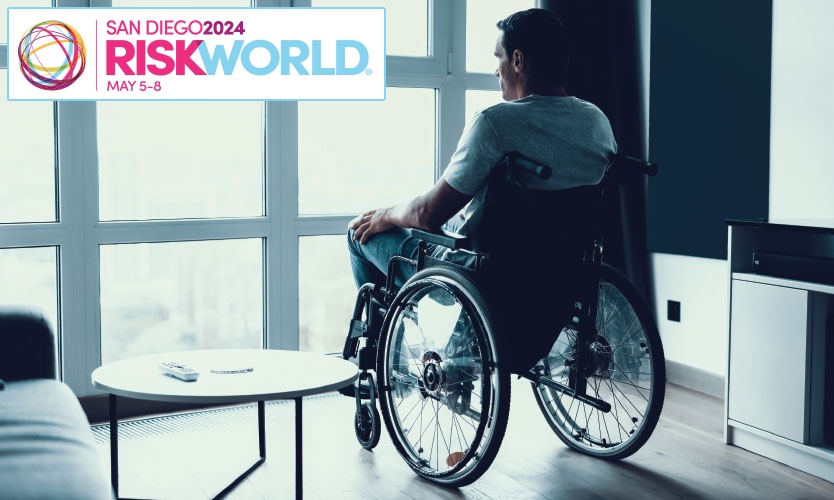
SAN DIEGO — One of the biggest predicters of mental issues arising in a workers compensation claim is pain, according to several experts who say claims handlers must deploy strategies to help injured workers with how they are feeling.

A topic Tuesday at Riskworld, the Risk & Insurance Management Society Inc.’s annual conference, experts said that data is helping the industry better understand that tackling the issue early results in fewer costs overall, and that the link between pain and the mind is clear.

Optum Inc.’s 2023 workers comp claims data showed that 10.1% of drugs prescribed to injured workers addressed behavioral health conditions — and such conditions often run alongside pain, said Tron Emptage, Westerville, Ohio chief clinical officer for Optum.

“We know that chronic pain can lead to many mental health conditions; it can impact the activities of daily living,” Mr. Emptage said. 

And pain “interferes with their recovery process pretty early,” said Jean Feldman, Oldsmar, Florida-based senior director of managed care for Sentry Insurance, which has developed models that guide claims handlers on when to intervene, all based on data collected that showed injured workers do better when mental health is addressed.

The interventions, she said, have been “unusual,” such as providing several mental counseling sessions for injured workers early in the claim or using virtual reality technology to help the injured worker with anxiety or depression — two issues Sentry found have crept into claims as early as 45 days post-injury.

On counseling, Ms. Feldman said industry skeptics have seen the approach as dangerously too close to “creating a psych claim,” referring to the complications that arise in workers comp claims with a mental injury, but that at least one group of stakeholders have endorsed the idea: defense attorneys.

“They said, you are really tackling this head-on,” she said of a group that often sees complicated claims creep into litigation, often as the result of unaddressed psychosocial issues.

Panelist Dale Schultz, director of risk management for the hospital system Valleywise Health in Phoenix, said resistance to addressing psychosocial issues early in a claim is common, but that seeing better financial outcomes has been beneficial in driving change, he said.

“We were investing more in administering the claims and we ended up with better outcomes,” he said.  



Source link

Commercial baker cited over worker’s disabling injuries


The U.S. Occupational Safety and Health Administration on Monday said it cited a commercial baking company after a worker suffered “disabling injuries” at a Sun Prairie, Wisconsin, plant in October 2023.

OSHA cited St. Cloud, Minnesota-based Pan-O-Gold Baking Co. for two “repeat” violations, six “serious” violations and two “other-than-serious” violations, and proposed $262,953 in penalties, after an employee was injured while adjusting a sensor in a bread pattern forming machine.

The exact nature of the injuries was not given.

OSHA said Pan-O-Gold failed to train employees on proper lockout/tagout procedures, didn’t provide adequate machine guarding, failed to require the use of hand protection, and did not immediately log and report the worker’s injuries.

OSHA said it also investigated the company in 2019 following worker amputation and laceration injuries at the same Sun Prairie facility.

Pan-O-Gold, which produces bread products for retail, commercial and food service use under various brands, has 15 business days to contest the citation and proposed penalties. 


Source link

Missouri roofer cited over fall hazards


The U.S. Occupational Safety and Health Administration said Tuesday that it cited a Missouri roofing contractor after inspectors found employees exposed to fall hazards five times in seven weeks.

OSHA cited St. Louis-based 13 Construction & Pro Services LLC for six “willful” and 20 “serious” violations, and proposed $258,063 in penalties, following inspections at six Wentzville residential work sites in October, November and December 2023.

Employees were found working at heights greater than six feet without fall protection and the company didn’t have a “competent person” inspect and evaluate job site hazards daily during construction, OSHA said.

The employer also permitted unsafe use of ladders, didn’t ensure that employees wore head protection, and didn’t require the use of eye and face protection while using pneumatic nail guns, the agency said.

13 Construction & Pro Services has already contested the citation and proposed penalties before the Occupational Safety and Health Review Commission.


Source link

Focus on core values improves comp disability outcomes: Risk manager


SAN DIEGO — To address weak links in disability management following a workplace injury, employers should look inward for ways to improve outcomes and return to work, according to a risk manager for a Texas manufacturer.

Overhead Door Corp., a multistate manufacturer of industrial doors and walkways, realized two years ago that, at some sites, more than half of its workers comp claims wound up in litigation, said Andrew Shay, risk manager for the Lewisville, Texas-based company.

“We were developing some unfavorable claim trends, and there was an adversarial nature that we were starting to develop,” Mr. Shay said Monday during a session on holistic disability management at Riskworld, the Risk & Insurance Management Society Inc.’s annual conference in San Diego.

The first step was creating core values for the organization; one of those was “our people are our greatest strength,” he said of the about-face the company made to improve outcomes.

The company then hired an “advocacy person,” whose job is to support injured workers and their families.

“When someone is injured… the first person that they hear from is somebody that works for the corporation. It’s not an attorney. It’s not the adjuster,” Mr. Shay said. “The mentality behind this is that we’re going to take care of our people better than any insurer can take care of our people.”

He cited the case of a 62-year-old man who suffered a fractured skull while at a remote worksite and needed surgery in a city hours away. Overhead Door’s advocacy professional stayed in contact with the family and provided a place for them to stay for the three days he was in the hospital.

“He returned to work, light duty, six weeks later, full day 12 weeks later, and he’s still an employee,” Mr. Shay said. “That had (permanent total disability) written all over it. … It was just the right thing for us to do as an organization. … We started doing these things right and better.”

Overall, Mr. Shay reported that the company has seen a 12% reduction in the duration of comp claims, a 19% reduction in legal costs, a 16% reduction in lost days, and a 40% decrease in work restrictions.


Source link

AI simplifies process for comp claims


SAN DIEGO — An overseer of workers compensation for the large grocery chain Wegmans Food Markets said AI, which typically stands for “artificial intelligence,” translates into “assisted intelligence” for his company, which saw litigation rates go from 40% to 22% among workers in high-risk distribution centers thanks to insurtech products put to work in recent years.

Using a program that mines employee emails, medical notes, claims handler notes, and phone calls, Wegmans knows that an “injured worker has expressed that they do not feel that they are recovering properly” and thus scores high on risk and needs intervention, Brian Trick, Wegmans’ Rochester, New York-based director of claims services, explained during a session Monday at Riskworld, the Risk & Insurance Management Society Inc.’s annual conference.

Mr. Trick displayed a screenshot of the app that assesses the injured worker’s mindset, engagement and employment status.

“Assisted intelligence for our claims team assists them to do their job,” he said. “It’s not going to replace them or do their job. It helps them to review volumes of medical records and has the ability to collect from different data sets and provide information.”

Workers can also gain improved access to treatment and better engage with the claims handler, Mr. Trick said.

“It really helps us get the best outcomes in lightning speed,” he said. “It doesn’t take us six days to authorize treatment. It can happen in real time.”

Tyler Kennedy, Boston-based lead developer for Gain Life Inc., which provides AI services in the comp industry, said no AI model is perfect, and that a human is needed to address program shortcomings. AI can misinterpret findings, for example, he said, using a grid featuring alternating close-up photos of a blueberry muffin and that of a chihuahua that an AI program couldn’t decipher to prove his point.


Source link

Emergency services set at 250% of Medicare in Florida


Florida Gov. Ron DeSantis on Thursday signed a bill that requires workers compensation payments for emergency services that aren’t subject to a maximum reimbursement allowance be set at 250% of what Medicare pays for the same service.

H.B. 989 would direct the Department of Financial Services to contract with an actuarial firm to set payments for emergency services and care at 250% of the Medicare amount. The rate dictated by H.B. 989 would apply to all emergency services unless there is already a maximum reimbursement amount for the service or if the cost is set in a contract.

A comprehensive bill, H.B. 989 also adds leave time and retention requirements for a program that provides a one-time cash payout of $25,000 for firefighters who contract cancer in the line of duty. Full-time firefighters with five years of experience can select the case payout in lieu of pursuing comp benefits for specific types of cancers.

WorkCompCentral is a sister publication of Business Insurance. More stories here.


Source link

Ohio high court rules against worker with incomplete paraplegia


The Ohio Supreme Court on Thursday upheld a determination that a worker with incomplete paraplegia was not entitled to a loss-of-use award for his legs because he retained at least some ability to walk.

Billy Ottinger was working for B&B Wrecking & Excavation Inc. when he injured his spinal cord in a fall from a roof in June 2018.

The Bureau of Workers’ Compensation allowed Mr. Ottinger’s claim for multiple injuries, including incomplete paraplegia, as he regained some sensation following emergency spinal surgery but was unable to walk.

With time, Mr. Ottinger gained the ability to walk greater distances and could eventually walk 200 feet with the help of a walker. In January 2019, Mr. Ottinger filed a motion asking the BWC to consider the medical documentation in his claim file, and “the fact that his claim is allowed for ‘paraplegia.’”

A nurse then conducted a review of the case and submitted a report that incorrectly stated that Mr. Ottinger’s claim had been accepted for paraplegia. The BWC granted the motion for loss-of-use compensation and he received $186,400 for each leg. A district hearing officer vacated the BWC’s order and denied Mr. Ottinger’s request for compensation for the loss of use of the legs.

In July 2019, an independent medical examination reported that Mr. Ottinger was ambulatory, though weak, and able to walk independently for short distances. A staff hearing officer affirmed that decision.

WorkCompCentral is a sister publication of Business Insurance. More stories here.


Source link

Riskworld community service project to deliver essentials to families


The community service project at the Risk & Insurance Management Society Inc.’s Riskworld annual conference in San Diego will provide clothing and other everyday essentials for families in the area through the nonprofit Sharia’s Closet.

The project, sponsored by ESIS Inc., a unit of Chubb Ltd., will involve conference participants assembling hygiene kits for children, teenagers and adults, a project coordinated by HandsOn San Diego, a local nonprofit.

Established in 2013, Sharia’s Closet says it has supported nearly 50,000 individuals, helping build self-esteem and self-identity and empowering them to succeed in school and on job interviews and to overcome adversity.

The hygiene kit assembly station will be on the second floor of the San Diego Convention Center on May 6 and 7. All registered Riskworld attendees are invited to participate.


Source link

Riskworld: Cheryl Berman Q&A | Business Insurance


Cheryl Berman is risk manager at Brady West Inc., a specialty subcontractor working mostly on commercial projects in Southern California, and president of the San Diego Chapter of the Risk & Insurance Management Society Inc. She recently spoke with Business Insurance Assistant Editor Louise Esola about how she made risk management her career and what issues are facing risk managers today. Edited excerpts follow.

How did you end up in risk management?

I have been in the building industry my whole career. I started out on the operations side when the company that I was working for was going to spin off from our holding company. We had to get our own insurance, and nobody knew anything about it because it had been procured by somebody else. A broker took me under her wing and we would go to lunch once a month. And I took courses.

What makes a good risk manager?

Understand how your company operates so that you can better serve them.

What are some of the big issues facing risk managers?

Universally of concern are cyber, finding and retaining talent, and, in our industry, supply chain is big.

On cybersecurity, what’s up and coming?

Insurance programs are becoming more common, but they’re kind of expensive. And you can have an insurance policy, but if you have a breach the money is still not going to keep you from having your business disrupted. This is where artificial intelligence comes in. Artificial intelligence looks at your traffic and your cyber, and if they see anomalies then they investigate. You can’t possibly have somebody doing that for you 24 hours a day. Investing in something that will prevent a breach from happening in the first place.

In workers compensation, what are some issues of concern?

Our workers have a very physical job, and we have an aging population. And we have the issue of recruiting and retaining. We have a lot of people that are new to the industry. Not that they’re not trained, but it takes awhile for muscle memory and things of that nature. So, in our younger population, we have a frequency issue, but it’s minor, and they’re able to bounce back and go back to work. On the aging worker side of it, if they get injured, often it’s something that is very prolonged.


Source link

Exit mobile version