Virginia governor signs bill revising timeframe for comp bill payments


Virginia Gov. Glenn Youngkin on Thursday approved legislation revising the timeframe for workers compensation insurers to either pay, or contest, bills for services submitted by health care providers in injured worker cases.

House Bill 205 says payment for health care services that an employer doesn’t deny or contest must be made to providers within 60 days of receipt.

The new law states that if a portion of a claim is contested or denied, an employer or its workers comp insurer must notify providers within 45 of receipt of the bill.

The law also permits interest to be applied in cases where uncontested bills are not paid on time.


Source link

Shot teacher suit can go to trial, bypass comp: Appeals court


A Virginia appellate court has declined to intervene in a lawsuit filed by a former elementary school teacher who was injured after being shot by a 6-year-old in January 2023, allowing the case to move forward in civil court and not the workers compensation system.

The Virginia Court of Appeals on Friday dismissed a pretrial appeal by the Newport News School Board, which argues a $40 million lawsuit by former teacher Abigail Zwerner should be barred because of workers comp exclusivity.

The school board sought to keep the case in the workers comp system. A trial judge previously permitted the case to go to trial.

Friday’s appeals court decision paves the way for a January 2025 trial start date.

The school board, which contends workers comp is the appropriate process to compensate Ms. Zwerner for her injuries, said Friday’s decision was not unexpected.

“We knew … that the Court of Appeals granting our petition at this stage of the litigation was a long shot,” said Anne Lahren, an attorney with Virginia Beach-based Pender & Coward P.C. who represents the school board.

Ms. Lahren said the case will likely be appealed to the Virginia Supreme Court and that the high court will “ultimately rule that Ms. Zwerner’s workplace injuries fall under the exclusive jurisdiction of Virginia’s Worker’s Compensation Act.”


Source link

Medical costs for injured workers outpaced overall cost increases nationwide


Increases in costs for medical visits under workers compensation slightly outpaced overall physician services cost increases reported nationwide since 2017, according to data released Monday by Enlyte LLC. 

Enlyte, which provides services for injured workers, analyzed its medical bill review professional services data for trends in workers compensation payments from first quarter of 2017 through the end of the third quarter of 2023.

It found that physician charges per unit — or per procedure performed — increased by 11%, outpacing physician charges in the Bureau of Labor and Statistics Consumer Price Index increase of 8% during that same time period, according to the report.

Researchers noticed mixed trends for workers compensation medical payments in several “high volume” states, with New York trending the highest, a 12% increase spurred on by increases in fee schedule payments for injured workers. California saw costs rise 8% over that same time period, at par with overall physician costs increases for the country. Falling behind that figure, Florida saw a 7% increase in workers comp medical payments and Texas a 3% increase, according to the data.


Source link

Healthy eating seen as aid to treating injuries


What an injured worker eats has become a talking point for workers compensation claims handlers as they explore the intersection of nutrition and injury recovery. 

Proper nutrition “is something that we identified because if there’s poor nutrition, they’re not going to recover as quickly or as well, especially if they’re having a surgery,” said Dr. Adam Seidner, Hartford, Connecticut-based chief medical officer at Hartford Financial Services Group Inc.

The discussions over nutrition branched out from worker advocacy models in workers comp — where there’s more interaction between injured workers and claims handlers on issues that may not be directly related to a claim but could affect the outcome. 

“We know that proper nutrition is a key governor of health,” said Dr. Teresa Bartlett, Troy, Michigan-based managing director, senior medical officer, at third-party administrator Sedgwick Claims Management Services Inc. It’s especially important for the aging workforce, which already faces delayed recovery, she added.

BI 0424 02ANutrition is “one of the key factors that determines if someone will age well, if their bones are healthy, if their muscles are healthy,” she said. “We know that if you’re having a surgery, just like the fact that you shouldn’t be smoking because you won’t recover adequately, if you’re not getting proper nutrition your bones and your skin will not heal properly.” 

More recently, the issue of social determinants of health — how such factors as access to healthy food, income and education can affect health outcomes — has contributed to the discussion over nutrition. 

“It’s being looked at in a number of different ways — food insecurity, for instance,” Dr. Seidner said. “Do people understand what they should be eating? (It’s) not just portion control but the quality of food.” 

Talking about nutrition “is part of our educating them,” said Linda Summerlin, Avon, Indiana-based assistant vice president of national case management services with Gallagher Bassett Insurance Services Inc., which has a handout it provides to workers and claims handlers that provides nutrition advice. 

“Obesity is one comorbidity that leads to or contributes to other conditions, and good nutrition education is important for aiding in healing and just ensuring the overall well-being of the person,” she said.

Gallagher Bassett’s document includes a list of foods that would hinder recovery and those that would promote healing, such as proteins, which aid in building and repairing muscle, and vegetables, which contain vitamins and minerals that can speed healing. Typically, it’s when they are injured that workers are seeing such facts on nutrition and the connection to healing for the first time, Ms. Summerlin said.

Those working in the nutrition field say it’s common for people to be late in understanding the role of food in recovery, and there’s a growing interest in such factors as inflammation, a component of injury, and how food can help alleviate symptoms that lead to increased pain and delayed recovery. 

The advice is to “steer clear of processed foods because processed foods tend to cause inflammation in the body … which could actually slow down or inhibit one’s healing,” said Melissa Eboli, a nutritionist in New York who runs her own business providing meals to those in recovery.

For comp patients it’s common to talk about avoiding processed and easy-to-access fast food, especially because such high-calorie foods can lead to weight gain while a worker is in recovery — another complicating factor if the patient is not as active as he or she once was, according to Dr. Bartlett. 

“When someone is off work or they’re frequently in pain they eat foods that make them feel happy, or the comfort foods, and they’re also moving much less than they were by going to work every day, and therefore they tend to gain weight,” she said.

Irene Opoku-Acheampong, a clinical dietitian who works with patients at Atlanta-based Emory Healthcare, said a decrease in mobility causes the risk of entering “a vicious cycle” of trying to get proper nutrition when access to healthy food may be limited. 

Physically, weight gain can slow recovery and increase claims costs by “deconditioning the worker,” Dr. Bartlett said. “And, so, when they go back to the job there is a higher risk for more injury and illness because they’ve gained weight and they’re not in shape. They’re huffing and puffing and struggling to keep up with what they used to do every day.” 

Mental issues can also be at play, Ms. Opoku-Acheampong said. “If we’re not eating properly, it may lead to exacerbation of depression or anxiety, or maybe even the manifestation for someone who hasn’t had those symptoms or that diagnosis before,” she said. 

Healing at macronutrient level crucial

Macronutrients, elements in foods such as protein and vitamins that help build tissue, comprise a growing field of interest in treating patients in injury or surgery recovery. 

“When you injure any kind of tissue — hard tissue like bone or soft tissue muscles, tendons, ligaments, cartilage — your body needs nutrients to regrow itself,” said Dr. Jason Winkelmann, a naturopathic doctor and chiropractor who treats chronic pain patients at his practice True Health Natural Pain Clinic in Arvada, Colorado.

“We have really taken that (knowledge) for granted because if you break an arm, we can put a cast on it and in six weeks take the cast off and your arm is healed. We don’t think about what is going on at the biochemical level to heal those tissues. It’s protein, it’s fat, it’s vitamins and minerals that are the building blocks that your body uses from the food that you eat to heal and make new tissues when they’re damaged and injured.”

Nutritionist Beth Wyman, who works independently in Albany, New York, said focusing on protein alone is often helpful enough for some. 

“If you’ve got a torn ligament and you need to be able to rebuild that tissue … you need those amino acid building blocks in protein in order to do that. And so your protein needs go up when you’re trying to recover.” 

To add to the simplicity, New York-based nutritionist Melissa Eboli said it’s the “notion of eating the color of the rainbow; so you eat a myriad of fruits and vegetables,” in addition to protein.


Source link

Heat-related claims rise with climate change


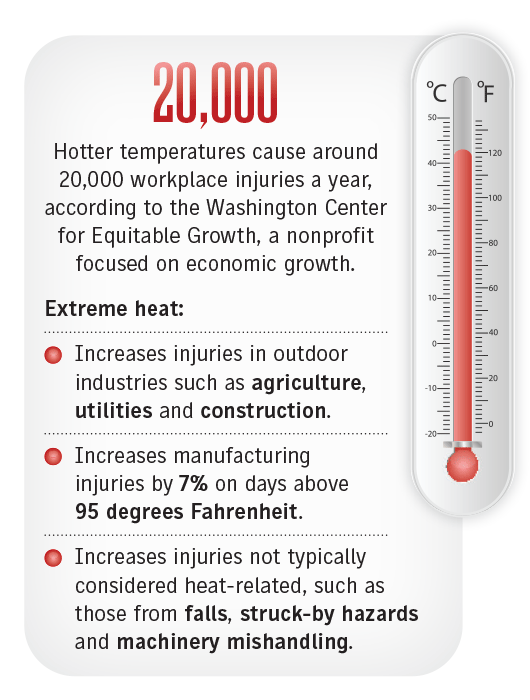
Rising temperatures are causing problems for workers in industries such as construction, warehousing and transportation, and heat-related workers compensation claims are increasing as a result, experts say.

As more claims are submitted, claims professionals are stepping up investigations to determine whether they are compensable.

Safety advocates, meanwhile, are urging the U.S. Occupational Safety and Health Administration to finalize a workplace safety standard that addresses the potential for heat-related injuries (see related story below). 

Heat-related workplace risks are expected to increase, as insurers “across the country have identified climate change as an emerging concern,” said Patrick Coate, an economist with the Boca Raton, Florida-based National Council on Compensation Insurance, which is researching the connection between weather severity and increased worker injuries. 

Insurers manage heat-related workers comp claims much like other injury claims, with investigations of causation and early treatment. 

“When people are fatigued (from heat), they tend to not think correctly, they tend not to act correctly, and that results in injuries,” said Dennis Tierney, Norwalk, Connecticut-based national director of workers compensation claims for Marsh LLC. 

Older workers or those with comorbidities may tire quicker or have a stronger heat reaction, Mr. Tierney said.

“Obviously, when these claims come in, we’re investigating them. We’re making sure they’re compensable,” he said. 

Claims investigations include reviewing medications a worker is taking that could exacerbate heat issues, experts say.
BI 0424 05AInsurers must also determine whether activities prior to an injury, such as excessive alcohol consumption, could have made a worker more susceptible to heat injuries, said Joe Paduda, Plainfield, New Hampshire-based principal with Health Strategy Associates, a workers comp consultant.

If a contributing factor did precipitate an injury, though, “the reality is this happened at work,” Mr. Paduda said. 

“If they die of heat or they die during a heat event” it’s likely it will be a considered a work injury, he said. 

More frequent heat waves are raising concerns about heat-related illnesses for a wide variety of employers across the U.S. 

“The severity of just about every (heat) claim seems to be going up,” said Kevin O’Sadnick, St. Louis-based senior risk control manager for Safety National Casualty Corp. 

Southern states tend to grapple more frequently with workplace heat illnesses and injuries as temperatures in that region increase. But experts say heat can affect employees anywhere — even indoors, such as in manufacturing facilities that lack proper climate control. 

Climate change is also leading to more heat-related injuries in northern states, Mr. Tierney said. 

Heat illnesses can include heat stroke, heat exhaustion, heat syncope — or dizziness and fainting — heat cramps, heat rash and rhabdomyolysis, which is a breaking down of muscle tissue. Heat stroke is the most serious and has the most potential to be fatal, according to the U.S. Centers for Disease Control and Prevention. 

Instances of workplace fatalities caused by heat include an August 2023 case in which a UPS driver died from heat stroke in Texas, and another UPS driver died from what was believed to be heat stroke in June 2022 in California.

There were 36 confirmed work-related deaths due to environmental heat exposure in 2021, the most recent year for which statistics are available, according to the U.S. Bureau of Labor Statistics. 

Exposure to heat can have long-term effects. 

It can cause workers to develop illnesses such as acute kidney disease and chronic kidney disease that could ultimately complicate workers comp claims, said David Bonauto, a research director with the Washington State Department of Labor and Industries. 

Heat can increase the absorption of chemicals in a person’s body, which could affect farmworkers who are exposed to pesticides, he said.

Most heat-related workers comp claims occur within the first two weeks of employment, suggesting new workers are at higher risk because they haven’t yet been acclimated to the work and environment, Mr. Bonauto said. 

States lead way on heat safety standards

Absent a federal heat standard, employers often look to state safety rules and other best practices to reduce heat-related work risks.

As the U.S. Occupational Safety and Health Administration continues the rulemaking process for a federal health and safety standard addressing workplace heat, five states — California, Colorado, Minnesota, Oregon and Washington — have standards, which generally call for regular water and rest breaks for workers during certain weather conditions. 

In February, the American Society of Safety Professionals published a voluntary consensus heat standard for the construction and demolition industries. It offers guidance on protecting workers, explains how to acclimate them to high temperatures and offers training for employees and supervisors.

“We’ve got to do things like provide water, shade, train employees to ask for help,” said Jeff Rush, workers compensation program manager for the California Joint Powers Insurance Authority in La Palma, California, a public risk pool. “Let’s get the employee hydrated; let’s do what we can to get them out of that heat environment.” 

Some construction companies use wearable technology as a risk mitigation tool, noted Kevin O’Sadnick, St. Louis-based senior risk control manager for Safety National Casualty Corp. The devices can monitor body heat and activity to help ensure workers don’t become overheated. 

Employers should involve workers in heat illness prevention efforts, said Marcy Goldstein-Gelb, co-executive director of the Somerville, Massachusetts-based National Council for Occupational Safety and Health. She suggested that employers have a health and safety committee that includes workers to identify heat-related hazards.




Source link

Editorial: Healthy diet forms core of recovery


Claims professionals have done much to restrain workers comp costs over the past several years. Early reporting of claims, return-to-work programs, building safety cultures, closely monitoring prescriptions, and various other strategies have been implemented to slow the increase in costs.

But as workers compensation claims costs continue to rise, many in the industry are looking for other ways to pare back expenses. As we report on page 4, an offshoot of another comp claims strategy — the promotion of the so-called workers advocacy model, where companies take a more empathetic approach to comp claims — has led to growing interest in improving the eating habits of injured workers to help them recover speedily.

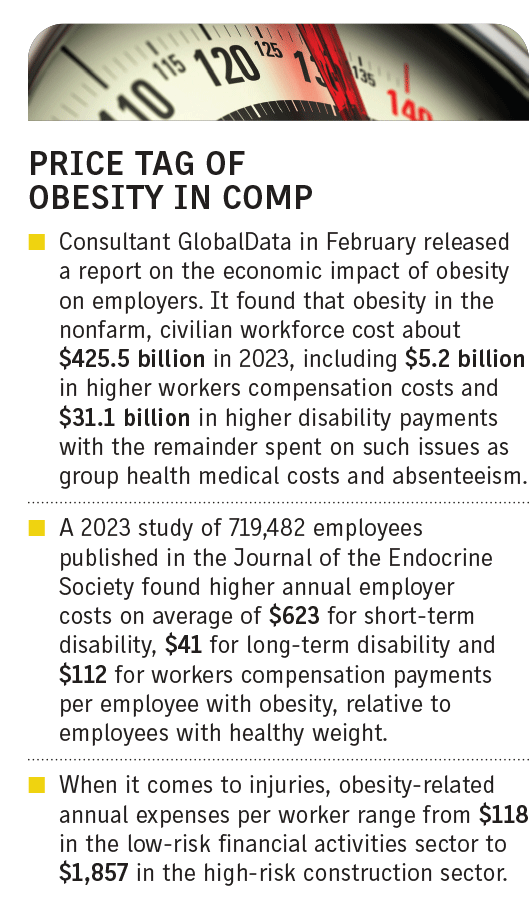
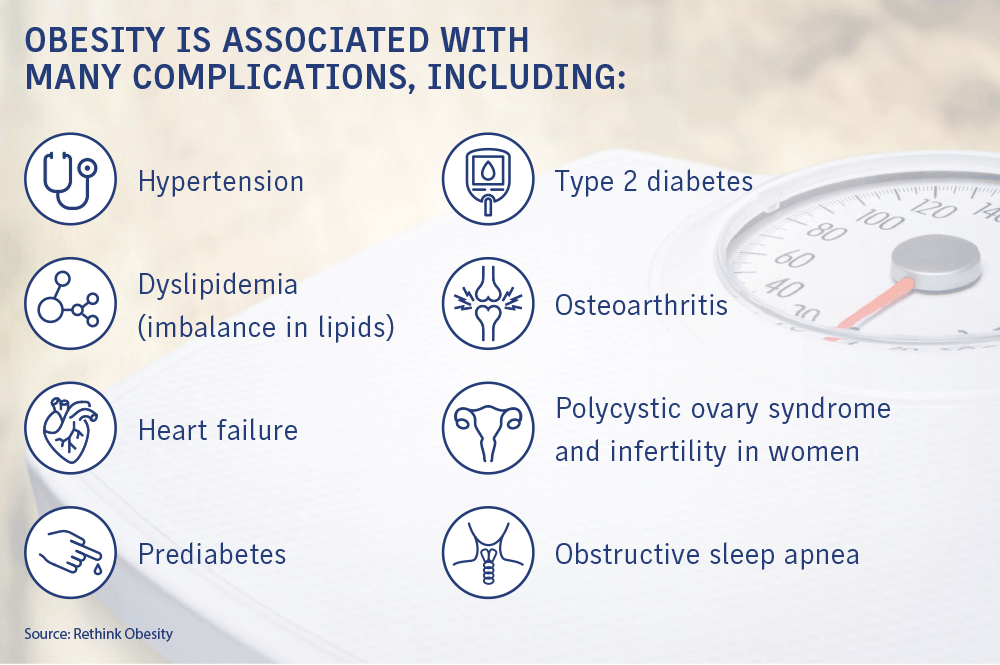
Obesity has long been recognized as a comorbidity that complicates comp claims and directly increases costs. But better nutrition does more than reduce the likelihood of a difficult claim; it can promote healing and make workers more physically resilient, medical experts say. And recent studies have suggested that avoiding ultra-processed foods can also improve brain health, possibly putting workers in a better frame of mind to deal with their injuries.

Assessing the nutritional value of what you eat, though, can be a moving target as researchers come up with new findings or look at studies from a different angle — remember when red wine was bad for you, then good for you and then bad for you again, depending on whether you were concerned about heart disease or cancer? But there is plenty of advice, such as the benefit of eating plenty of fruit and vegetables and going easy on certain fats, that has widespread support among nutritionists. 

Communicating that advice to injured workers can start before they suffer an accident by providing nutritious food in work environments and literature on what makes up a healthy diet. Employers can also proactively promote healthy eating to injured workers and support them with meal plans and dietary guidelines. 

BI 0424 09

Some employers may want to go even further and provide financial incentives such as gift cards to health food stores or vouchers that can only be redeemed for nutritious food, in the hope that the initial expense is more than compensated for by a reduction in claims costs and the benefit of getting injured workers back to work more quickly. 

Encouraging injured employees to eat healthy, though, requires subtlety and respect for boundaries. Cultural and religious dietary restrictions clearly must be considered, as well as unrelated medical conditions. More than that, though, diet is a personal choice, and it’s one thing for an employer to offer helpful advice and another for a manager to badger a worker into eating or not eating certain types of food. You can lead a worker to the salad bar, but you can’t make him eat.


Source link

OSHA issues final walkaround rule allowing employee representatives


The U.S. Department of Labor on Friday announced a final rule clarifying the rights of employees to authorize a representative to accompany an Occupational Safety and Health Administration compliance officer during an inspection of their workplace will be published in the Federal Register on Monday.


The Occupational Safety and Health Act gives the employer and employees the right to authorize a representative to accompany OSHA officials during a workplace inspection. The final rule is “consistent with the law” and clarifies that workers may authorize another employee to serve as their representative or select a nonemployee, according to a statement. 


For a nonemployee representative to accompany the compliance officer in a workplace, they must be reasonably necessary to conduct an effective and thorough inspection, according to a statement.


“Consistent with OSHA’s historic practice, the rule clarifies that a nonemployee representative may be reasonably necessary based upon skills, knowledge or experience,” the department said.


Such experience may include knowledge or experience with hazards or conditions in the workplace or similar workplaces, or language or communication skills to ensure an effective and thorough inspection.


The rule goes into effect on May 31.


Source link

Virginia governor vetoes comp bill loosening burden for injured workers


Virginia Gov. Glenn Youngkin vetoed on Thursday a proposed change to the state’s workers compensation system that would have made it easier for workers who suffer falls to prove their injuries were work-related.  

House Bill 974 would have permitted injured employees to satisfy their burden of proof that a fall is work-related through circumstantial evidence, testimony of others and other evidence.

Under current law, claims for compensation involving injuries from falls are presumed compensable unless the presumption is overcome by a “preponderance of competent evidence to the contrary.”

In his veto message, Gov. Youngkin said the legislation created a “disproportionate imbalance in favor of one party,” and that employees seeking workers comp benefits for unexplained falls would have been able to rely on “circumstantial evidence and hearsay.”

The governor said current law provides a “balanced approach to workers compensation.”   


Source link

Exit mobile version