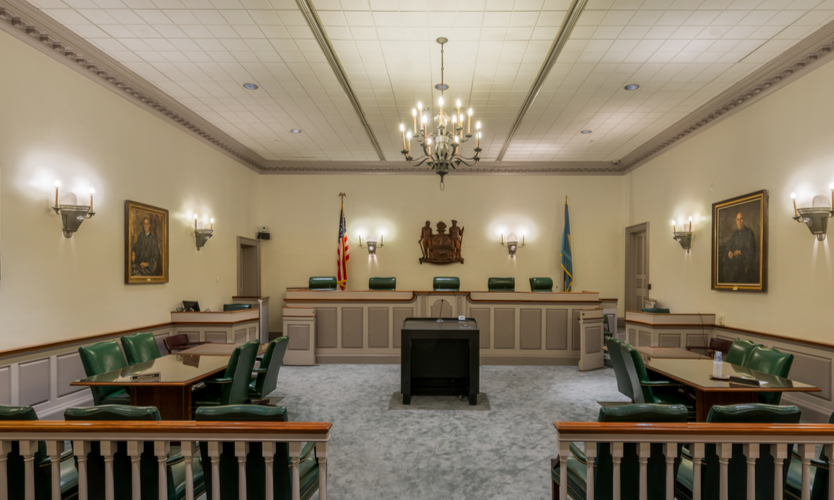
Medical practice didn’t have standing to sue insurers: Court


An orthopedic practice didn’t have standing to sue a group of Liberty Mutual Holding Co. Inc. insurers over a workers compensation insurance coverage denial to patients because a medical code used by the insurers was discontinued prior to the litigation, the Delaware Supreme Court ruled Monday.

The high court overturned a Superior Court ruling awarding summary judgment to First State Orthopaedics, which sued the insurers for denying coverage to its patients. The practice had sought a declaration that a billing code used by the defendants violated the Delaware Workers’ Compensation Law because it didn’t provide a proper coverage denial explanation.

The Supreme Court said the insurers’ alleged failure to correct past medical invoices using the previous billing code couldn’t give the plaintiff standing to sue because the declaratory judgment sought was in effect corrected through the already-amended billing code.

The case is Employers Insurance Company of Wausau v. First State Orthopaedics P.A.


Source link

Insurers concerned about 2024 comp outlook: NCCI


Workers compensation executives are worried about the economic and financial state of the system moving into 2024, with rate adequacy, medical inflation and the shifting workforce among some chief concerns, the National Council on Compensation Insurance reported in its annual survey of key industry stakeholders.

The results of the survey, which were announced Monday by the Boca Raton, Florida-based NCCI, function as a “barometer of industry sentiment and helps NCCI determine which topics become the focus of our research and analysis,” NCCI President and CEO Bill Donnell said in a statement.

Workers comp insurance executives surveyed expressed concerns about the steady decline in rates and loss costs and other risks to the long-term health of the system, the NCCI stated.

The industry is also worried about the effect of rising medical costs and increasing wages and workplace risks in an age of telecommuting, gig workers and an aging workforce.

While insurers expressed concerns about market profitability, the NCCI said its data shows a strong and healthy workers comp system. It said it expects to see a 2023 combined ratio under 100, which would mark the 10th consecutive year of underwriting profitability.

Executives surveyed said emerging challenges to the workers comp system include the expansion of marijuana legislation, the effects of artificial intelligence and climate change.

Survey responses came from 101 workers comp leaders. 


Source link

Judge wrongly dismissed employer’s petition over medical payments


An Alabama appellate court said a trial judge wrongly dismissed a petition by a casino to be relieved of liability for future medical treatment for a worker who said injuries from a 2018 motor vehicle accident exacerbated work injuries she suffered 10 years earlier.

The Alabama Court of Civil Appeals on Friday reversed a Macon Circuit Court decision denying a petition by Shorter-based VictoryLand casino seeking to end its responsibility for paying medical expenses for employee Patricia Dianne Arnold.

Ms. Arnold injured her back at work in 2006 and filed for workers compensation benefits in 2008.

VictoryLand ultimately agreed to pay for Ms. Arnold’s medical care.

In 2018, Ms. Arnold was injured in a motor vehicle accident, after which she sued the at-fault party. The case was later settled.

VictoryLand argued that it shouldn’t be responsible for future medical payments because the successive injuries related solely to the car accident. A trial judge dismissed the company’s petition.

The appeals court said the trial court erred because it never explained its decision to deny the employer’s petition, which is necessary before an appeals court can render judgment.  


Source link

Commercial insurance rates rise 5.6% in Q4


U.S. commercial insurance rates rose 5.6% on average in the fourth quarter and 4.6% for all of 2023, insurance exchange MarketScout Corp. reported Friday.

Commercial property insurance rates again saw the biggest increase at 8.3%, followed by commercial auto, up 7%.

In other major lines, umbrella/excess rates were up 6.7%, general liability rates increased 5.3%, professional liability rates rose 4.7%, and directors and officers liability rates were up 2.7%.

Workers compensation rates were flat.


Source link

Beef processor faces $274K in penalties following serious hand injury


The U.S. Occupational Safety and Health Administration said Friday it cited a Nebraska beef processor after an employee suffered a serious hand injury at the company’s Omaha plant in June 2023.

The Nebraska Beef Ltd. worker caught a finger in a forklift attachment; part of the finger was amputated three weeks after the incident.

OSHA cited the company for two willful and 11 serious violations and issued $274,569 in proposed penalties.

The agency said the company had unsafe working conditions, improperly trained forklift operators, and failed to isolate energy during service and maintenance of dock levelers.

Nebraska Beef, which processes and distributes beef to grocery stores, wholesale distributors and restaurants, has 15 business days to contest the citation and proposed penalties.  


Source link

Appeals, trial courts wrongly allowed untimely comp claim evidence: High court


The Iowa Supreme Court ruled Thursday that a lower appeals court and a trial court both wrongly permitted untimely evidence to be submitted in a workers compensation claim brought by an injured Serta/National Bedding Co. LLC employee.

The state high court vacated a Court of Appeals decision in a case brought by Lorri Hagen, who was injured at work in February 2017 when a 350-pound cart rolled over her foot.

In 2019, after a physician determined she had reached maximum medical improvement, Ms. Hagen filed an arbitration petition seeking workers comp benefits from Serta and its insurer, Safety National Casualty Corp.

During the arbitration proceedings, Ms. Hagen missed a deadline to submit evidence certifying her expert witnesses, and Serta argued it would be prejudiced if the late evidence was permitted.

A deputy workers comp commissioner ruled the exhibits should be excluded, and the workers comp commissioner agreed.

A trial court overturned that determination, ruling the late evidence submittal might not be prejudicial. The Court of Appeals affirmed that decision.

In vacating the lower court decisions, the state Supreme Court wrote that the workers comp commissioner has the “ultimate responsibility for deciding cases in an expeditious and timely manner,” and the courts should “not infringe upon a decision that is well within his prerogative.”

The high court remanded the case to the workers comp commissioner for further proceedings.   


Source link

Washington state lawmakers file bill to improve return-to-work outcomes


Lawmakers in Washington state Thursday filed legislation designed to improve return-to-work outcomes for injured workers.

House Bill 2127 would make various changes to the state’s workers compensation law dealing with temporary disability in cases where workers may be able to return to work with modified duties.

Among other things, the measure would make employers eligible to be reimbursed for an injured worker’s wages for light duty or transitional work for a maximum of 120 workdays within a 12-month period. The current maximum is 66 days.

The legislation would also raise the maximum wage subsidy paid to employers per worker to $25,000, from the current  $10,000.

The legislation would also provide funding for training returning injured workers.


Source link

Indiana bill would assist first responders with PTSD


Indiana lawmakers are again considering a bill to assist first responders suffering from post-traumatic stress disorder.

H.B. 1118, slated to be read Monday, would establish a state-funded first responders mental health wellness fund and program. The fund would provide up to 10 days of compensation and mental health services for first responders diagnosed with PTSD who do not qualify for workers compensation.

Current state law requires that a first responder also suffer from a physical injury to qualify for mental health services. H.B. 1118 would only require a PTSD diagnosis and proof that the first responder had attended to a “qualified critical incident,” defined to include witnessing death or a serious injury.

The Indiana legislature considered similar legislation in 2023.


Source link

Ohio public employers’ comp rates drop in 2024


The Ohio Bureau of Workers’ Compensation on Thursday announced that public employers will pay an average of 3.9% less in workers compensation retroactive Jan. 1.

The rate reduction was made possible by declining injury claims and relatively low medical inflation costs by Ohio’s counties, cities, public schools and other public taxing districts, according to a statement.

Since 2011, the overall reduction in public employers’ rates is 57.2%, according to the BWC.


Source link

Exit mobile version