Amputations lead to citation, penalties against Wisconsin foundry


The U.S. Occupational Safety and Health Administration said Tuesday that it cited a Wisconsin foundry after two employees suffered amputation injuries 11 days apart.

OSHA announced it cited Marinette-based Waupaca Foundry Inc. after the two workplace incidents, which occurred in April and May, respectively.

Both workers were using grinders to trim parts during a casting process and moving them through conveyors when they each suffered partial finger amputations.

OSHA cited the company for two repeat and six serious violations and proposed $234,385 in penalties.

The company, OSHA said, failed to properly verify and test its energy control procedures and didn’t train employees on appropriate machine servicing and maintenance.

OSHA also said the foundry lacked adequate machine guarding.

The company has 15 business days to contest the citation and penalties.  


Source link

Brown & Brown agrees to sell four TPAs to Davies


Brown & Brown Inc. announced Tuesday it has agreed to sell four third-party administrator companies to London-based claims management company Davies Group Ltd.

Terms of the deal, set to close in December, were not disclosed.

The companies to be acquired by Davies are: American Claims Management Inc.; Preferred Governmental Claims Services, a claims management business specializing in Florida public entities; USIS Inc., a supplier of managed care services and a TPA for workers compensation and liability claims; and ICA LP, an independent property adjusting company.

All 600 employees at the four companies will join Davies, Brown & Brown said in a statement.

The broker also said it is establishing a long-term commercial relationship with Davies to enhance brokerage and programs operations.


Source link

State high court to decide whether billing agencies are comp ‘providers’


The Pennsylvania Supreme Court agreed last week to hear what experts are calling a unique case involving a medical billing agency that is suing workers compensation insurers over nonpayment for prescription medications in injured worker claims.

The case centers around a dispute between Oviedo, Florida-based Elite Care RX LLC, the billing agency, and several comp insurers.

The Pennsylvania Superior Court, an appellate court, in May ruled in Elite Care RX LLC v. Premier Comp Solutions LLC, that the case could be litigated in civil court because the suit contains claims of unjust enrichment, fraud and civil conspiracy. The insurers argued the matter is a dispute over fees and should come before the Pennsylvania Bureau of Workers’ Compensation because of comp exclusivity.

The defendants in the suit are Premier Comp Solutions LLC, Laundry Owners’ Mutual Liability Insurance Association, Lackawanna Casualty Co., BrickStreet Mutual Insurance Co. and UPMC Benefit Management Services Inc., which does business as UPMC Work Partners.

Elite Care RX says it is still owed more than $548,000 and counting for outstanding payments for the prescriptions.  

“For over five years now, these insurers have failed to pay anyone for medications provided,” Aaron Weiss, an attorney with Pittsburgh-based Zimmer Kunz PLLC, who represents Elite Care RX, said in an emailed comment.

Experts say the case is unique, as disputes over comp claims typically come before a comp appeals board and then, if appealed further, the Commonwealth Court, an intermediate appellate court that handles appeals out of the comp system.  

But in this case disagreements arose over whether Elite Care RX, a billing agency, is a “provider” under the comp statute that would make the matter exclusive to comp.

The case highlights the need for the Pennsylvania legislature to step in and clarify statutory language governing who is a comp provider, said Karl P. Voigt IV, a claimants attorney with Bechtelsville, Pennsylvania-based Prince Law Offices P.C.

“There is a real deficit in (Pennsylvania’s) workers comp law,” he said. “Every decade or more, the legislature steps in and makes amendments to the Workers’ Compensation Act, and it’s probably that time because things in general have changed.”

Mr. Weiss said the only reason provided by the insurers for nonpayment was Elite Care RX’s agency status.

“It’s a fascinating case,” said Brian Allen, Salt Lake City-based vice president of government affairs for Enlyte Pharmacy Solutions.

Mr. Allen highlighted past Pennsylvania legislation restricting physician prescription dispensing in comp, and he said this case appears to highlight a possible loophole to circumvent restrictions.

According to the lawsuit, injured workers can choose to have prescriptions filled through home-delivery pharmacy Patient Direct RX, after which medical providers buy back from Patient Direct the claims arising from the prescriptions, giving providers a right to then bill and collect from comp insurers.

Elite Care RX serves as the billing agent for the providers, ensuring their accounts receivable are properly paid.

“So, they (providers) are still making money on the drugs that they prescribe, they’re just not dispensing,” Mr. Allen said.

The question, he said, then becomes, does this process place the matter outside the realm of comp.

“I think that’s an interesting question for the court to answer, and I think that’s why the Supreme Court took it up,” Mr. Allen said.

To Steven Bennett, the answer is obvious: “It is clear that the medical providers’ claims for reimbursement in this proceeding relate to medical services provided pursuant to the laws and procedures of workers compensation,” said Mr. Bennett, Washington-based vice president, workers compensation programs, and counsel for the American Property Casualty Insurance Association.

Any issues related to payments and penalties “must be processed under the applicable workers compensation provisions and are not subject to civil actions,” he said.  

It was not yet clear when oral arguments in the case would be scheduled before the state Supreme Court.


Source link

Employers curbing pot use navigate bias laws


Managing or prohibiting marijuana use in the workplace is complicated by state and federal disability and privacy laws. 

Employers may fear running afoul of the Americans with Disabilities Act, which states that workers may not be discriminated against because of medical conditions, said Brian Allen, Salt Lake City-based vice president of government affairs for Mitchell Pharmacy Solutions, an Enlyte Group LLC subsidiary.

Ascertaining whether construction workers have medical marijuana cards can also be difficult because of protections under the Health Insurance Portability and Accountability Act.

It remains unclear whether information can be shared because marijuana remains illegal at the federal level, so the drug’s use may not be considered protected health information even in states where it is legal. 

Jenifer Kaufman, an Abington, Pennsylvania-based workers compensation claimants attorney, said employers would likely defer to state medical marijuana laws and state-level HIPAA equivalent statutes. 

Pennsylvania’s medical marijuana law, for example, states that employees who fail drug tests cannot perform jobs where they are in control of chemicals, work at great heights or within confined spaces, or deal with high-voltage electricity, Ms. Kaufman said. 

“Your (medical marijuana) card does not mean you don’t have to take a drug test like everyone else,” she said. “It’s not a get-out-of-jail-free card.” 

But it can be difficult for employers in states that legalized both medical and recreational marijuana to differentiate between workers with medical cards and those who use the drug recreationally, Mr. Allen said.


Source link

View from the top: Sri Sridharan, MedRisk


Sri Sridharan, who was named CEO of MedRisk LLC in September, joined the managed care organization as chief client officer in 2022 and was appointed president earlier this year. Prior to MedRisk, Mr. Sridharan spent several years at Marsh LLC and Gallagher Bassett Services Inc. in claims management and analytics. Business Insurance Assistant Editor Louise Esola interviewed him recently on new strategies to help injured workers recover and other trends to watch. Edited excerpts follow.

Q: What was your career trajectory into workers compensation? 

A: I did my master’s in industrial engineering and part of that is looking at safety, ergonomics and biomechanics. That resulted in joining Marsh in ergonomics consulting, and when you think about ergonomics it’s mostly focused on workers compensation. I grew up in India and you don’t know much about workers comp if you come from a country where that does not exist. So it’s pretty cool being in a role that has a broader purpose of helping people in need, helping people in pain, helping people going through a difficult phase of their life. So that was very attractive to me. 

Q: What do you like about what you do?

A: Being part of this industry where you get a phone call, when somebody is in need of getting back to their life, getting back to the kind of work they do, and we get to help them with the recovery process. We do that every single day. 

Q: The industry has moved away from medicating for pain, which may have enhanced the practices at MedRisk. What are some companywide goals? 

A: If you think about the workers comp trends, you see there’s a reduction in the use of opioids to manage pain, and there are also fewer surgeries. That accelerated during COVID because of the health care limitations we had at the time. 

Physical therapy has evolved to be more effective or equally effective and a noninvasive alternative, when compared to what we used to do before. 

We are even more focused on how we deliver the care that the patient needs. Each patient is unique based on where they live, the age group, that body part that is impacted; and then there are the psychosocial and behavioral, the comorbid conditions that exist.

How do we understand the unique nature of each of those to the patient? How do we make sure that they go to the right provider, who has expertise to help them? How do we make sure that we manage that episode of care from the initial evaluation to discharge so that we can engage with a provider and the adjuster at the right times? When and where do we see barriers to recovery? How do we leverage technology? How do you leverage data? That is the journey that we are going through right now.

Q: Where do data and analytics fit in?

A: Predominantly everything we do is driven by the data that we have. We process 6 million bills every year and we’ve been doing it for 27-plus years. That’s a lot of data that we have in our database. Each data point is helpful in thinking about which providers are effective in treating a lower back injury for a 36-year-old who lives in Chicago, for example. We have all the data on the providers to see who’s really good at delivering the best outcomes for that patient based on the patient characteristics.

We use data for scheduling the care providers and treatment. We have data on claim injury notes, where we leverage that to find that 10% to 15% of patients experience more barriers to recovery. We engage very early with those claimants and with those providers so that they can have an optimal recovery process. If you think about the entire work comp ecosystem, the physical therapy providers tend to spend the most time with the patient. That’s a lot of interaction with a patient and a lot of opportunity to understand everything outside of that injury: What is going on in your life? What is going on outside of this injury in your work? What are the barriers to recovery? We leverage that opportunity to make those insights available so that we can collectively work together as a team and get patients better.

Q: What are some of the challenges facing the industry as a whole? 

A: We have different functions across this industry. You have an adjuster, you have a scheduler, you have clinical experts. How do you make sure that everybody’s aligned on our core purpose of helping that patient get better sooner? Making sure everybody’s aligned, everybody’s focused, is something that we are working toward every day.

Q: What are some other top trends to watch?

A: You have fewer claims, but the claims that happen are more severe, more complex, more expensive, and need more expertise. This is not 100 easy claims. It’s going to be 20 really complex claims that need specialist expertise to help get the injured worker back to their pre-injury state. That’s something that we need to always think about in terms of how we are evolving as an industry to reorient ourselves on a medical recovery process rather than just a claims process.

Q: What improvements would you like to see in the comp industry? 

A: In this industry we have a lot of insights on the injuries, patient, providers, etc., but these are now siloed across various organizations that specialize in various solutions to help the injured employees get back to work and health. We will be significantly more effective in our objectives if we are able to work with each other on a more consistent basis. We are starting to see this more and more being shared and utilized, but we still have a lot of opportunities to continually improve our medical and cost outcomes.


Source link

Editorial: Pot disconnect threatens safety


The growing disparity between federal and state laws regarding the legality of marijuana has reached the point where it is a serious safety issue for many employers. 

It’s been more than 25 years since California legalized medical marijuana, starting a trend among states that was expanded to include the broad legalization of recreational pot for about half the U.S. population. There are now 38 states that allow medical marijuana and 23 that allow recreational marijuana. Washington D.C. permits both forms of usage. 

While it’s been 10 years since the federal government made clear it would not seek to interfere with state marijuana laws, that does little to alleviate the problem of employers seeking to ensure they obey all the laws they operate under and respect the rights of workers.

Federal legalization of marijuana seems unlikely in the near term, although some advocates hope the Biden administration may at least reschedule the drug so that it is no longer lumped in with the likes of heroin and LSD as a Schedule 1 drug.

Regardless of possible future changes, the confusion inhibits a coherent approach to national drug policy. As we report here, the issue is of particular concern in industries with high-risk occupations, such as the construction industry. 

When legal pot laws were first passed, employers were often advised to treat pot in a similar way to alcohol — while drinking off the clock might be legal, workers should not be allowed to turn up to work drunk. That seems like a nice analogy, but it falls apart when it comes to determining impairment. While there are well-established testing protocols to gauge impairment by alcohol for a worker involved in a workplace accident, a worker found with marijuana traces in his or her bloodstream may have taken the drug days or even weeks before. 

BI 1123 09

The dual system also confuses the issue of pre-employment drug testing. A worker might reasonably argue that a legal activity they indulge in in their own time is their own business. And given the current shortage of workers in many industries, employers might be inclined to agree. 

While drug test manufacturers are developing tests that they say will test for impairment, they are not yet in widespread use, and it will likely be awhile before they are accepted.

Until then, employers will have to deal with the problem themselves. There’s no panacea, but workplace safety policies that emphasize awareness of impairment and the need to report potential violations should be encouraged. In addition, employee communications should stress the importance of self-monitoring and disclosure in the interests of safety.

Maintaining a safe working environment is critical for employers, and finding a way to address marijuana impairment is an essential step toward achieving that goal. 


Source link

Perspectives: Workplace violence comp policies lacking, but we can drive improvement for all


Workplace violence represents a sizable and growing risk for employers and impacted employees. The numbers are staggering: Workplace violence costs employers more than $120 billion annually in claims, litigation, additional security, staffing, communications and other expenses, according to the National Institute for Occupational Safety and Health. And according to a Department of Justice study, almost 75% of victims reported some level of emotional distress following violent events, with nearly 40% experiencing moderate to severe trauma.

Today’s workers compensation policies may not adequately address workplace violence events, given the restrictions set in motion by insurance policies and state laws, but there is an opportunity for our industry to drive meaningful change.

Compensability within the workers compensation system following a workplace violence incident will vary based upon the event specifics and state. For example, an on-premises assault that occurs as a result of a personal motive, such as domestic violence, may not be compensable in certain venues. 

Each state’s statute defines who is eligible to receive benefits when an event occurs. Many states that allow for the compensability of mental health services limit statutory benefits to employees who have suffered physical harm during the event. A physically unharmed employee, such as an employee witness to workplace violence, is sometimes not eligible for mental health benefits in workers comp.

Some businesses purchase a separate workplace violence policy to add to their crisis response toolkit. In general, these policies focus on the wellbeing of a company’s employees following a violent incident in the workplace. Sublimit extensions may be available to include coverage for third-party expenses and loss of business income. These policies can also include crisis management expense coverage following an incident.

However, the availability of workplace violence coverage is not absolute. Some classes of business with a predisposition to increased workplace violence exposure may be excluded from underwriting consideration. These include law enforcement, security services and health care.

Further, standalone workplace violence policies are often written on a nonadmitted basis. As such, they are governed by state surplus line associations, which do not always permit certain terms and conditions. For example, Excess Line Association of New York guidance outlines coverage prohibited by the state’s Department of Financial Services for impacted employees under state statute: “A workplace violence/active shooter policy may include medical payments (including counseling), death benefits and/or funeral benefits for invitees, customers, and guests on the premises during a workplace violence incident. However … employees cannot be covered for these benefits under a workplace violence/active shooter policy.”

It is important to note that many businesses operate across state lines. As such, a position restricting available coverage for policyholders headquartered in that state also translates into a limitation of available coverage for the employees of that policyholder regardless of locale.

The workers compensation policy may be the best avenue to solve for the unique needs presented in the wake of workplace violence. However, there exists opportunity to effect change and elevate the industry through individual influence campaigns at the state level. 

This is already a focus in certain venues: California is one example of modeling local action through the combination of recently enacted Senate Bill 553, which provides employers with a blueprint for violence prevention, and existing statutory workers compensation benefits. With this approach, employee welfare is addressed at both pre-incident preparedness and post-incident statutory benefit levels.

While local efforts take place, our industry’s voice can be amplified at a national level by respected organizations such as the National Council on Compensation Insurance and the National Institute for Occupational Safety and Health. Their sponsorship of a more robust workers compensation/workplace violence offering would align with NCCI’s mission to “develop modern solutions that help support industry stakeholders and the workers’ compensation system” and NIOSH’s vision of “safer, healthier workers.”

Assuming statutes support doing so, the design of a workplace violence offering within the workers compensation policy would unify the two products as a more comprehensive crisis response offering. An extension of coverage afforded within the workers compensation policy is further enhanced by the involvement of our industry’s unsung heroes and arguably the policy’s greatest value proposition: major case claim adjusters.

Due to limitations of applicable statutes, it is not uncommon for a major case unit adjuster to be forced to stop short of facilitating a comprehensive and holistic resolution for the policyholder’s employees following a workplace violence event. By embedding within the workers compensation policy a workplace violence offering, the same adjuster would be empowered to more fully navigate the compensable, noncompensable and crisis response aspects of the claim. This would facilitate the seamless delivery of compassion, empathy and direction for the employer and impacted employees.

Those who suffer direct or indirect harm due to a violent act in the workplace are worthy of our concern. It is incumbent on us as an industry to develop solutions for these stakeholders.

Perhaps efforts are already underway by industry influencers to examine opportunities to advance the statutory workers compensation product to meet this moment. If so, all of us — brokers, insurers, clients— would benefit from learning how we can add our support to accelerate this effort.

If this work has not yet begun, there is no time like the present to consider how our industry can deliver meaningful restoration in these heartbreaking situations. At its core, the property/casualty industry supports policyholders in the darkest of times. It is the single best attribute — and responsibility — of our business, and one that instills pride in our purpose.

Our collective intent is to care for and restore the lives of the employees and businesses impacted by an event. It is my hope and intention that in the future, our industry can elevate to deliver this readily to policyholders. Industrywide solutions that help clients — and more broadly, society — in a time of crisis are something we can all get behind.

Specializing in workers compensation coverage issues, Debbie Goldstine is an executive vice president and U.S. casualty leader at Lockton Cos. LLC. She can be reached at dgoldstine@lockton.com.


Source link

Pain treatment becomes safer, more complex


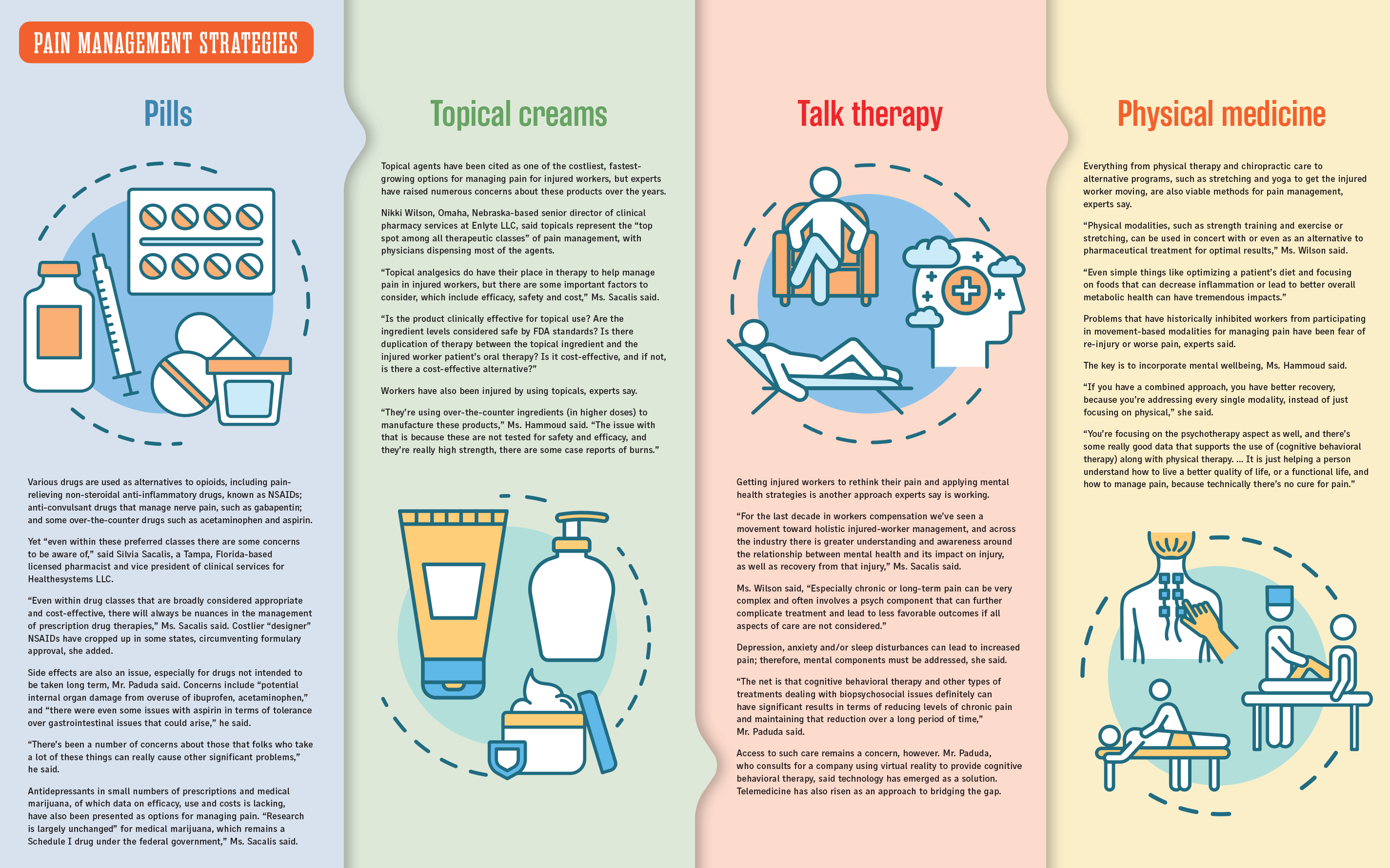
Data on workers compensation drug spending is clear: Opioid prescriptions and costs for injured workers have plummeted over the past 10 years as employers, claims managers and others aimed to greatly reduce dangerous pain medications in comp. 

Opioid utilization among injured workers declined 57.5% from 2016 to 2022, according to data gathered by myMatrixx, a Jacksonville, Florida-based pharmacy benefits manager and subsidiary of Express Scripts Holding Co. 

The workers compensation sector is still grappling with how best to manage the pain of injured workers without the powerful drugs, and several alternatives have emerged. Experts say some options are costlier than opioids, more experimental and come with concerns. But the industry is becoming accustomed to a multifaceted approach, and companies are working within injured workers’ abilities. 

“When you are addressing pain, you have to approach it with, What are the goals that we’re looking for? What is our end goal? Is the end goal going back to work, or is the end goal just quality of life? When you have a clear goal in mind the path becomes a little bit easier, and you’re not focusing so much on pain, you’re focusing on recovery,” said Reema Hammoud, Southfield, Michigan-based assistant vice president, clinical pharmacy, for Sedgwick Claims Management Services Inc.

The answer to pain management is typically “all of the above,” said Joe Paduda, Skaneateles, New York-based president of comp consultant CompPharma LLC. “Most patients who have some sort of chronic or post-acute pain are doing multiple things,” he said.

CLICK IMAGE TO ENLARGE

BI 1123 PAIN

OR CLICK HERE TO DOWNLOAD


Source link

Technology aids workers comp claims advocacy


Implementing advanced technology and frontline patient advocacy are neck and neck among the fastest-growing trends in workers compensation claims management, but the best results for patients often come from balancing the two, experts say. 

Improved access to data and more efficient communication should not be allowed to sterilize the claims management process, they say. 

By combining technology and a personal touch, claims managers can improve care and reduce the number of litigated claims. 

According to Chicago-based Rising Medical Solutions Inc.’s 10th annual benchmarking survey of claims executives, 78% of high-performing claims management organizations used one or more technology-based strategies to help injured workers in 2022, compared with 42% in 2019. The medical cost containment company surveyed 388 claims executives. 

Rising’s survey also pegged “soft skills” such as empathy and listening among the top trends for organizations (see related story below). 

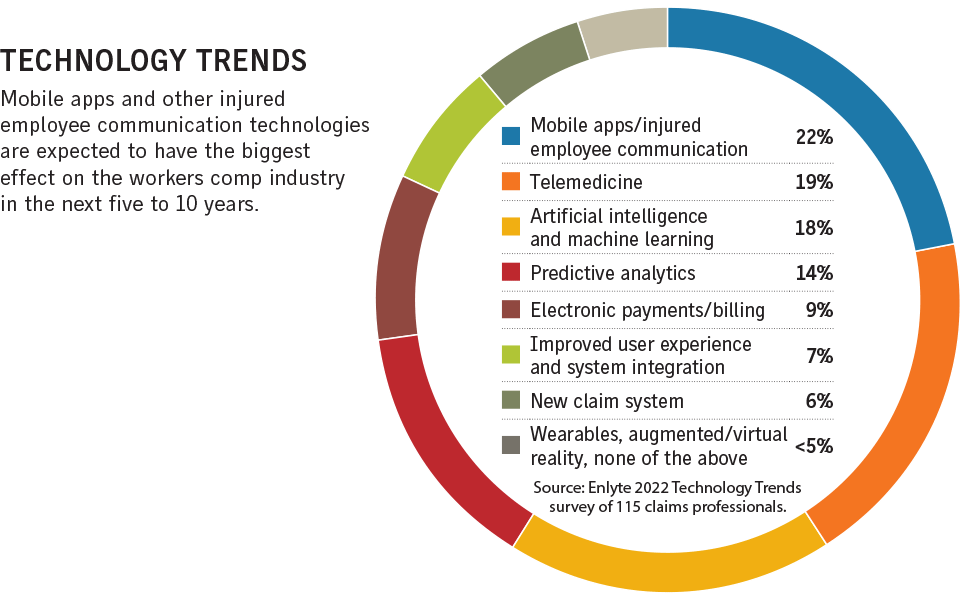
Technology is being incorporated throughout the workers comp claims process, said Rich Ives, Hartford, Connecticut-based vice president, business insurance claim, at Travelers Cos. Inc. 

“You’ve got technology now that’s coming along, whether you’re talking about digital apps, self-service tools, analytics, predictive modeling, artificial intelligence — you name it,” he said. 

Some experts have questioned whether the widespread introduction of technological tools is at odds with the emphasis on a more personal approach to claims management. 

“We would say, absolutely not,” Mr. Ives said. “We call that the difference between art and science; science being more on the technology side and art being on the application of personal skills to both engage with the injured employee and to take that personalized level of care and approach. Success lies in the ideal blend of both of those things.” 
BI 1123 05A

Automation in workers comp has helped free up claims professionals, who were previously saddled with mundane tasks, said Jeff Gurtcheff, Lawrenceville, Georgia-based vice president, enterprise comp services, at CorVel Corp. 

“Artificial intelligence is about returning time back to the claims professional so they can do those things that need the time to collaborate, communicate, show empathy, show compassion and be strategic,” he said. “We want to keep the human in the middle of this process.”

Alex Sun, CEO of Enlyte LLC, which provides workers comp services, said one of the main goals in workers comp is to shorten recovery time and speed return to work.

“That’s exactly what AI is built to do — save time and provide decision support,” he said. 

Technology-based tools such as predictive modeling allow claims organizations to compare claim outcomes based on similar data points, such as age, comorbidities and other risk factors, that could impede recovery. From there, claims managers can better help injured workers who meet a certain profile and better engage with them, experts said. 

Both trends help “produce a better outcome and solve challenges that we’ve not yet been able to solve,” Mr. Ives said. 

Mr. Sun said technology helps organizations prioritize resources. “The more we can expedite claims processing, the more we can get information where people need it. Empowered claims professionals (can) provide personal support where it’s needed most,” he said.

Mistakes are made when “people think the technology is an end instead of a means,” said Jason Beans, CEO of Rising.

Technology “initiates a personal conversation. … The caring and the empathy that comes from a human conversation should continue, person-to-person, when that automated step initiates a response,” he said. 

Mr. Ives said technology helps align resources that are going to be most valuable within the claims process. “It’s right time, right claim, right resource,” he said. 

Technology’s ability to provide on-demand claim information and improve everyday communication also reduces the likelihood of litigation in claims, experts said. 

Mr. Gurtcheff said cases often end up in litigation “because the communication process breaks down … because somebody feels that they can’t keep up or manage the desk effectively.”


Empathy essential as organizations boost skills to manage comp claims

The use of “soft skills” such as empathy and active listening is fast becoming vital for companies that want to successfully manage workers compensation claims, according to a recent survey of claims organizations with higher-than-average claims closure rates.

“It’s a change of culture and kind of a change of paradigm,” said Paige McCraney, vice president of care management and a nurse practitioner at Rising Medical Solutions Inc., which conducted the survey.

Sixty percent of high-performing claims organizations have implemented the so-called “advocacy model,” according to the survey results released in September. 

“Historically (in workers comp) we’re looking for fault,” Ms. McCraney said. “And it’s very easy to say, ‘Oh, well, this person has mental health issues and that is really their fault.’ or ‘That’s not related to the workers comp issue,’ when it actually is caused by the workers comp injury and certainly impacts (the claim) and needs to be addressed.”

Successful claims managers are “connecting with people in a meaningful way,” said Denise Algire, Pleasanton, California-based director of health for grocery chain Albertsons Cos. Inc., who served on the advisory council for Rising’s study. 

“We’re working with an injured worker dealing with what could be their worst day. Most people … don’t understand the system, and our system can be quite complicated,” she said. 

In the past, the workers comp industry avoided managing the mental side of claims out of fear insurers and employers would cross into the mental-injury space and create a “psych claim,” said Dr. Marcos Iglesias, Hartford, Connecticut-based vice president and chief medical director at Travelers Cos. Inc. 

But there’s a difference between having a diagnosable mental health condition and having stress, depression or anxiety when dealing with a physical injury suffered at work and not being able to work as a result, he said.

“We have lumped all of mental health into one monolith, and mental health isn’t a monolith. … Mental health is really a continuum,” Dr. Iglesias said. “At any one point in time, I might be excelling, thriving, or I might be in a crisis, and those are two very different ends of the continuum.”

Acknowledging an injured worker’s concerns, mental or otherwise, is the approach of successful claims handlers, Dr. Iglesias said.

The change is a slow process, Ms. Algire said.

“You can’t just get training on empathy. It has to be the ongoing messaging,” she said. 


Source link

Coca Cola’s expert in comp claim wrongly excluded: Appeals board


The Tennessee Workers’ Compensation Appeals Board on Monday reversed a trial judge’s ruling excluding the testimony of an expert witness Coca-Cola Bottling Co. retained in a workers comp claim by an injured employee.

The board found that the trial court erred in concluding that the company failed to comply with a deadline for disclosing expert witnesses in a case brought by employee Ariel Taylor, who sustained a workplace back injury in 2019.

The board said the trial judge’s scheduling order for the disclosure didn’t contain any deadline for the exchange of expert witness reports.

Mr. Taylor had settled his initial claim for comp benefits following his workplace injury, but he later filed a petition for additional disability benefits.

The board ruled that Mr. Taylor had been made aware of the identity of his employer’s vocational expert before a specified deadline, despite the trial court ruling that the company failed to provide the employee with the expert’s report until after the court-imposed deadline.

The board, finding that the trial court abused its discretion in excluding Coca-Cola’s expert, reversed the judge’s order and remanded the case for further proceedings. 


Source link

Exit mobile version