OSHA finds Texas manufacturer failed to correct hazards


A Stafford, Texas-based engine component manufacturer faces $298,250 in fines for failing to abate hazards that caused an employee’s finger amputation in March 2022, the Occupational Safety and Health Administration said Thursday.

OSHA inspectors returned to Air Starter Components Inc. in March 2023 as part of a follow-up investigation to the incident in which a worker’s hand was caught in a polishing machine that lacked required safety guards.

The follow-up investigation led OSHA to cite the company for two repeat violations, one of which was for the company’s failure to post 2022 OSHA injury and illness logs as required. Inspectors also identified 14 serious violations in the second inspection.

Following the 2022 incident, the company entered into an agreement with OSHA to address the violations, yet no abatement documentation was provided, according to the agency.


Source link

OSHA wants to clarify who can be present during investigations


The U.S. Department of Labor on Tuesday announced a notice of proposed rulemaking to revise regulations regarding who can be authorized as representative for employees to be present during on-site Occupational Safety and Health Administration inspections.

The proposed rule clarifies that employees may authorize an employee or a non-employee if the OSHA compliance officer determines “the third party is reasonably necessary to conduct an effective and thorough inspection,” according to an announcement.

The proposed changes also clarify that third-party representatives are not limited to industrial hygienists or safety engineers, two examples included in OSHA’s existing regulations.

“Third-party representatives may be reasonably necessary because they have skills, knowledge or experience that may help inform the compliance officer’s inspection,” the DOL said in its announcement. “This information may include experience with particular hazards, workplace conditions or language skills that can improve communications between OSHA representatives and workers.”

The DOL says stakeholders have until Oct. 30 to comment on the proposal.


Source link

Ohio Supreme Court rules woman with limited abilities can work


The Ohio Supreme Court in a 4-3 decision Tuesday denied permanent disability to a warehouse worker who injured her back in 2013 and later had unsuccessful spine surgery.

Donna Kidd applied for permanent total disability in 2018, saying she used a back brace and could not sit nor stand for long without experiencing pain, according to State ex rel. Kidd v. Indus. Comm.

The state high court, in reversing a district court ruling that found Ms. Kidd incapable of finding work that could accommodate her restrictions, cited a doctor’s report that said she was “capable of performing sedentary work in some environments and, when combined with (her) nonmedical disability factors, support a determination that claimant is capable of sustaining remunerative employment.”

The dissenting justices, noting other doctors disagreed with that assessment, said the majority based its assessment on modern workplace flexibility while admitting “that all the experts in this case agree that (Ms.) Kidd lacks the ability to work for more than 15 to 20 minutes at a time without changing position or resting.” They said the “restrictions are so limiting that Ms. Kidd would find it very difficult to find an employer willing to accommodate such requirements.”


Source link

Attacks on health care workers raise concerns


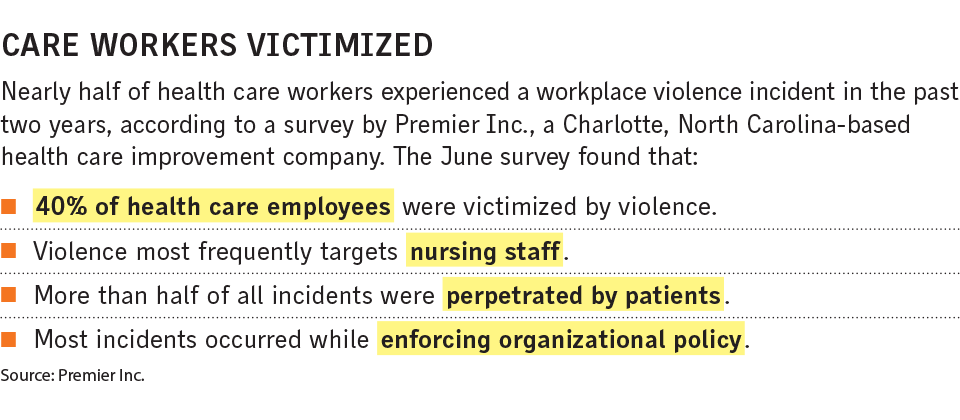
As attacks on health care workers become increasingly more common, workplace safety experts are calling on regulators and employers to better protect those caring for patients.

Incidents spiked during the COVID-19 pandemic amid understaffed medical facilities, increased substance abuse and an overall lack of mental health services, experts say. And although the issue is on the radar of federal and state lawmakers and regulators, some say change isn’t happening fast enough. 

“There’s been a substantial rise over the past few years,” said Mustafa Mufti, chair of the department of psychiatry at ChristianaCare Health System in Wilmington, Delaware. 

Dr. Mufti points to pandemic-induced patient frustration, hospital staffing shortages, and increasing substance abuse rates all contributing, as is the broadening of the definition of violence to include verbal threats and intimidation. Biological factors, psychological factors and social factors all play a role, he said.

Restricted access for family members at hospitals during the pandemic also contributed, Dr. Mufti added. 

“It’s been a very high period of intense emotion,” he said. 

Akin Demehin, senior director of quality and patient safety policy for the Washington-based American Hospital Association, said nurses are the workers most often affected by workplace violence. 

“Just given the flow of the work that happens inside of health care organizations, it really is nurses that tend to be in that uniquely vulnerable position,” he said. 

The U.S. Bureau of Labor Statistics reports that health care and social service workers experience the highest rates of injuries caused by workplace violence and are five times more likely to suffer a workplace violence injury than workers in all industries. 

In the second quarter of 2022, there were 1,739 nurse assaults a month, according to South Bend, Indiana-based patient safety organization Press Ganey.

BI 0923 05A

The assailants are often patients but also include family members, visitors and co-workers, according to Press Ganey.

An April 2022, National Nurses United survey showed 48% of hospital nurses reported increases in workplace violence, up from about 30% in September 2021. 

The American Nurses Association reported that the most significant workplace risk for nurses this year has been stress and that as many as one in four nurses have been assaulted at work. 

“Workplace violence in nursing is a longstanding issue that is unresolved,” Ruth Francis, ANA senior policy advisor for nursing practice and work environment, wrote in an email. 

Ms. Francis said a lack of consistent and accurate data is a major barrier to implementing effective violence prevention programs, especially in states without workplace violence prevention laws. Many nurses assume patient abuse comes with the job, so they choose not to report incidents, she said.

Priscilla Ross, senior associate director of federal relations for the American Hospital Association, said facilities are trying to address the concerns. 

“The vast majority of our hospitals have implemented programs and interventions to try to address workplace violence,” she said. 

The Joint Commission, an Oakbrook Terrace, Illinois-based agency that sets standards for hospitals, implemented accreditation benchmarks for hospitals designed to address violence. They went into effect in January 2022 and apply to all Joint Commission-accredited health care facilities and critical access hospitals in the U.S. 

The standards provide a framework for workplace violence prevention programs, including training and post-incident strategies.

The U.S. Occupational Safety and Health Administration has been trying to create a workplace violence in health care standard for years. An OSHA public comment period related to health care violence ended in July.

Attorney Wayne Pinkstone, with the Philadelphia office of Ogletree Deakins P.C., said the potential for an OSHA standard heightens the importance of the issue for employers and noted that some state laws already have compliance requirements regarding workplace violence (see related story below). 

There are also administrative controls that can be implemented, such as increasing staffing numbers and requiring workers to promptly report workplace threats, experts say. 

Federal lawmakers are also working to address the issue. 

One bill, to establish the Safety From Violence for Healthcare Employees Act, sponsored by U.S. Rep. Madeleine Dean, D-Pa., would establish criminal penalties for knowingly assaulting or intimidating hospital personnel, similar to existing measures related to assaults on airline workers. 

The bill also calls for $25 million in grants for education and training for health care facilities. 

“We have to lift up the issue and do what we can to protect health care workers,” Rep. Dean said. 


States pass laws aimed at strengthening protection for nurses

As workplace violence incidents against nurses rise nationwide, states are taking much of the lead on mitigation efforts. 

Many states already require health care employers to conduct hazard assessments and implement security measures such as installing metal detectors, physical barriers and door locks to reduce exposures, said Wayne Pinkstone, an attorney with the Philadelphia office of Ogletree Deakins P.C. 

Eleven states have laws requiring health care employers to establish workplace violence prevention plans, according to the U.S. Occupational Safety and Health Administration. They are California, Connecticut, Illinois, Louisiana, Maine, Maryland, Nevada, New Jersey, New York, Oregon and Washington. 

The rising workplace violence against nurses spurred the passage of Washington state Senate Bill 5454, which makes post-traumatic stress disorder a compensable occupational injury for nurses. The law takes effect in 2024.

Katharine Weiss, director of government affairs for the Washington State Nurses Association, said advocates brought the issue to legislators’ attention last year after several members were diagnosed with work-related PTSD but were denied workers comp benefits. 

“It just really put a microscope on those already pre-existing issues, like short staffing,” she said. 

In 2020, Pennsylvania state Sen. Maria Collett, who is a nurse, cosponsored a bill that was signed into law that permits nurses to leave off their last names from work ID badges to prevent stalking.

In June of this year, Pennsylvania legislators filed H.B. 1088, which would require hospitals, long-term-care nursing facilities and home health care agencies to develop workplace violence prevention committees to better protect employees. 

“Physical violence and verbal aggression in the workplace are never OK, but in a health care setting, this has the potential to compromise the quality of care and safe staffing levels,” said Pennsylvania state Rep. Ben Sanchez, a supporter of the bill.


Source link

Stress, burnout raise worker safety concerns


Longer work hours, higher demands and understaffing have made stress and burnout risk factors for employers, and experts say such mental health issues may be making workplaces less safe. 

“When there’s pressure for production … and things have to get done because there’s a deadline, people may cut corners on safety,” said Paul Landsbergis, an associate professor in the Department of Environmental and Occupational Health Sciences at SUNY Downstate Health Sciences University in Brooklyn.

Workplace stress is affecting many industries, including construction, warehousing, health care, transportation and manufacturing, where injuries can run the gamut from amputations and falls to poor ergonomics and muscle sprains, all of which have seen mental stress as a contributing factor, experts say.
BI 0923 06A

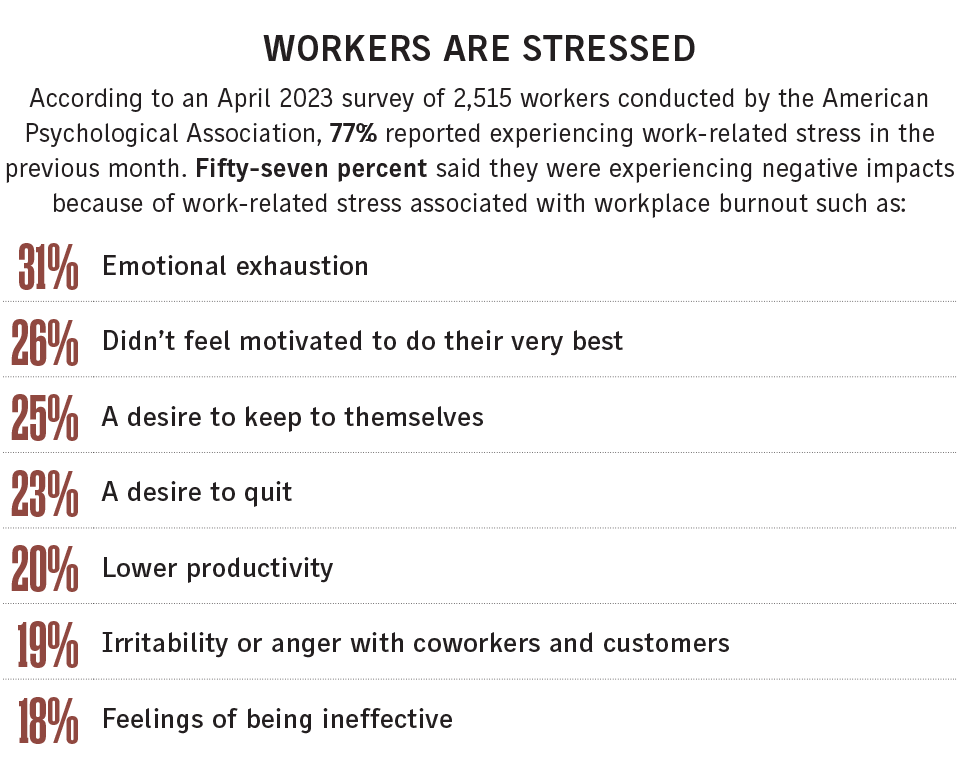
An average of 65% of U.S. workers surveyed annually from 2019 to 2021 characterized work as being a “significant” source of stress, according to the American Psychological Organization.

Under stress, workers “do things in a hurry, like not put the guard back on the machine, and that’s a way in which accidents and injuries can happen,” said Mr. Landsbergis, who also advises the National Council for Occupational Safety and Health.

John Dony, Itasca, Illinois-based vice president of workplace strategy for the National Safety Council, said stress is often a factor when studying root causes of accidents. 

“Stress and fatigue, particularly at extreme levels, can cause irritability, lack of focus, increased reaction time and decreased capacity for analysis and decision-making,” he said. “All of these symptoms can have indirect and direct effects on safety and incidents, and typically turn up as underlying causal factors when organizations analyze events for lessons learned.” 

Even poor ergonomics have been connected to stress, said Jonathan Rosen, an industrial hygiene consultant with AJ Rosen & Associates LLC in Schenectady, New York.

Mr. Rosen pointed to the Washington Department of Labor and Industries’ case against Amazon.com Inc., which is accused of overburdening workers with quotas and surveillance, leading to ergonomic injuries. Amazon contends it has safety programs in place. 

“These are psychological stressors that can cause people terrible physical stress,” Mr. Rosen said. 

Psychological stress as the injury itself is also showing up in workers compensation claims (see related story below).

Experts say the connection to safety is clear and the Occupational Safety and Health Administration in May launched a web portal to provide employers with information on stress, which it says is affecting many industries.

“As we recognize stress, increasingly and especially in the last several years, OSHA wants to make sure that employees are protected,” said Daniel Birnbaum, an associate in the Chicago office of Seyfarth Shaw LLP, which represents employers. 

However, employers are most likely shielded from citations for stress, Mr. Birnbaum said. “At this point, it would be very difficult for OSHA to engage in any sort of enforcement action against companies based on workplace stress.”

“There’s no specific standard that applies,” he said, adding that OSHA would have to use the catch-all general duty clause to fine an employer for an unsafe work environment, which “would be an uphill battle” for the agency. 

Mr. Dony said employers that recognize the connection between stress and accidents will have a better chance of avoiding incidents. 

“It’s important not to think of these factors as the fault of the human. Employers must design systems that address these factors and/or create capacity to fail safely when physical and psychosocial risk factors do come into play,” he said. 

Les Kertay, Chattanooga, Tennessee-based senior vice president for behavioral health with workers compensation services provider Axiom Medical Consulting LLC, said employers will not be able to remove all stressors — and he said that’s not a bad thing because stress can keep workers alert to dangers. 

Yet, Mr. Kertay said, “at a certain point, you get stressed enough that you start paying more attention to internal stimuli, like how you’re feeling on the inside, and you begin to pay less attention to the outside world. That makes you more accident prone. As stress increases, we tend to be less attentive to our environment.” 


Courts compare workers with peers when adjudicating burnout claims

Several states accept workers compensation claims for stress, yet such mental claims are often denied due to one caveat: The stressor must be greater than that which workers in similar positions face. 

Two recent cases in New York highlighted the complexity. 

In case No. 535539, decided Aug. 3 by the Appellate Division of the Supreme Court of New York, Third Department, an insurance company auditor quit her job and was hospitalized following a stress-related incident at work. The appeals court ruled in favor of the employer, writing that the “claimant’s peers were subject to the same daily and hourly quotas for completion of audits.”

Similarly, the same court on July 20 in case No. 535458 ruled against a bus driver who claimed in 2020 that he suffered “work-related stress and mental health injuries as a result of his exposure to COVID-19, the COVID-19-related death and illness of co-workers, the conditions of his employment and his treatment by co-workers and passengers.” 

The court, writing that “mental injuries caused by work-related stress are compensable if the claimant can establish that the stress that caused the injury was greater than that which other similarly situated workers experienced in the normal work environment,” said all bus drivers faced the same risks and stress in the pandemic. 

Michael Gaston, Long Beach, California-based attorney with law firm Cipolla, Bhatti, Hoyal & Roach, said he’s seen an uptick in stress claims. 

“Workplace stress or being upset at work is not a psychological injury,” Mr. Gaston said. “The most important thing in workers comp is predominant cause; what that means is, assuming that there is psychological disability, the doctor’s opinion has to be that at least 51% of it is caused by work.” 

“It’s possible that whatever is causing them stress at work may be the predominant cause,” he said, adding, “but it’s also possible that what’s happening at work may be lighting up something (the worker) had before, or the worker has been carrying a lot of psychological distress and it was what happened at work that pushed him over. That isn’t predominant cause.” 

Steve Bennett, Washington-based vice president for workers compensation programs and counsel for the American Property Casualty Insurance Association, said claims alleging stress, pervasive in many industries, need “strong guardrails.” 

“Claims should only be for what would be considered legitimate workplace injuries and we certainly do not believe that a no-fault system could survive economically if ‘I have stress at work’ claims are going to be covered,” he said.

Les Kertay, Chattanooga, Tennessee-based senior vice president for behavioral health with workers compensation services provider Axiom Medical Consulting LLC, said comp claims struggle because stress is not a medical condition.

“Burnout is what happens when you are excessively stressed with insufficient resources to cope with it over a long period of time,” he said. “That’s partly internal, partly external. It’s still not a diagnosable condition.”


Source link

Perspectives: Addressing workplace hygiene to mitigate the cost and risk of infectious disease


Over the past few years, employee wellbeing has moved from being a consideration to an expectation in the workplace. Discussions have grown to encompass everything from physical to mental health, and businesses have been tasked with meeting evolving employee needs across this spectrum. As companies evaluate what this means for their benefits programs, workplace offerings and business cultures, they would be remiss to gloss over how employee wellness — and, relatedly, workplace hygiene — affects their risk profile. 

Improving workplace hygiene is much more than just a worthwhile pursuit for company leadership or human resources executives. It’s also important for risk managers to consider how hygiene fits into their overall risk management approach. Ultimately, workplace hygiene can influence employee health, business health and the bottom line. 

Hygiene, health and productivity

While COVID-19 presents a particularly resonant example of how infectious disease can affect the bottom line — as well as the broader economy — pandemics are not the only cause for concern. 

Other pathogenic threats affect the workforce every day, and some with big consequences. Consider the flu: The Centers for Disease Control and Prevention estimates that the flu caused 9 million to 41 million illnesses, 140,000 to 710,000 hospitalizations, and 12,000 to 52,000 deaths annually in the United States between 2010 and 2020. When employees are sick with the flu — even if they continue to work but aren’t operating at full capacity — productivity declines.

Acute respiratory infections including the flu are among the most prevalent causes of missed work, accounting for about one third of sick days. Yet, each year as we move into flu and respiratory infection season, we accept absenteeism as inevitable, rather than look for a proactive approach to minimize the disruption.

The common cold costs businesses up to 111 million workdays lost each year. This leads to a $16.6 billion loss in on-the-job productivity annually. Protecting the workforce from infection must be an essential component of a company’s risk mitigation strategy. 

This is especially important as companies reconsider their approach to sharing office space among employees. Regardless of how often facilities are used, the way people act and interact within the facilities matters. Considerations around sharing desk space, working in open-concept or closed-office settings, the accessibility of hand sanitizer and other hygiene-related decisions can influence disease spread. For many companies, in-person collaboration time is precious, and hybrid schedules mean employees have limited time to work together in person. So, absenteeism may take a more significant toll because it can cut into that limited in-person collaboration time. While it’s true that some elements of protecting employees from disease are not in a company’s direct control — after all, disease exposure and transmission can also happen in employees’ personal lives — risk managers need to consider ways to prioritize more hygienic, safer workspaces. 

Investment in resilience

Here’s the catch: We still lack a declarative, neutral body of scientific evidence to help risk managers do this effectively. There are, however, certain intuitive actions risk managers can take to support workplace hygiene. These include making hand sanitizer readily accessible, installing air-filtration systems and implementing policies encouraging workers to stay home when they are not feeling well. Notably, some of these smaller-scale interventions rely on employee cooperation and the value employees place on adopting them. 

For risk managers to know for sure which measures will be the most successful in protecting worker health, we need a more robust evidence base of scalable, unassailable hygiene science. Investing in hygiene research that conclusively reveals the best practices is critical. So is understanding the economics of implementing these best practices. Risk managers need to know which hygiene interventions in the workplace will be the most cost-effective to determine what is and is not a worthwhile mitigation tactic. Otherwise, risk managers themselves risk relying on interventions that may not pay off in terms of employee health or the company’s financial health. 

Reducing business risk

Infectious diseases will continue to pose challenges. COVID-19 shed light on our need to be better prepared for what’s on the horizon, whether it’s a pandemic or the next flu surge, or something else entirely. Rather than accepting that businesses will be short-staffed during cold and flu season, or writing off viruses as “something going around,” businesses need to take action to prevent disease transmission inside and outside the workplace. Creating effective risk mitigation plans, however, will require thorough research into what works and what doesn’t work, what motivates people to adopt hygienic habits, what interventions are the most cost-effective, and more. 

Gone are the days when we can sit idly by in the face of infectious diseases. It’s not only reckless to overlook the threat of infections as a risk to employees, but it is also bad business. Hygiene must be a risk management consideration — employees, businesses and the health of our economy depend on it.

David Wheeler is acting executive director of the Reckitt Global Hygiene Institute, a nonprofit established in 2020 to support research into hygiene health through focused research and other measures to benefit public health globally. He can be reached at secretariat@mail.RGHI.org.


Source link

Editorial: Pushing the limits of workers comp


Workers are increasingly reporting feeling stressed at work, which is a problem for employers in terms of how they provide relief for them but also in how they respond to workers compensation claims that allege workplace pressures significantly contributed to or caused an illness or injury.

Work-related anxiety is not new and comes in many forms, ranging from the physical and mental stress that many manual workers have endured for centuries to the psychological pressures on professional employees performing crucial tasks and the extreme expectations that sales staff often live with.

Traditional methods of dealing with the issue, such as a smoke break or a three-martini lunch, are also well known but clearly problematic.

In recent times, the issue has been exacerbated by technological developments that have blurred the lines between work and personal life by enabling people to work at any time and in any place. While the added convenience may be seen as a benefit, many people must long for the days when they could leave their workplace at 5 p.m. and not have to be concerned about work again until 9 a.m. the next day; many others are too young to have experienced such an idyllic world.

The COVID-19 pandemic accelerated the trend and added to or intensified workplace stressors, including health and safety concerns, lack of personal interaction, and the numerous pressures unrelated to work that dominated people’s lives.

As we report here, workplace stress is also a factor in workers comp claims, with employees claiming they suffered stress-related illnesses as a direct result of burnout at work. A New York appeals court recently ruled against two employees and other courts should be careful about opening the door to such claims, unless the working environment is identified as the principal contributor to the illness. Few would doubt that work contributes to stress, but often there are factors outside the workplace, including pre-existing conditions, that contribute to the problem.

BI 0923 14

That does not let employers off the hook in terms of supporting workers and prioritizing employee well-being. They have a duty to care for their workers, and adjusting work hours, providing stress management programs, engaging in empathetic communication, and ensuring workers are not overloaded can go a long way to reducing workplace stress. 

Workers comp has evolved in numerous ways since the “grand bargain” between employers and workers was sealed more than a century ago, but it is still fundamentally designed to respond to work-related injuries. The seriousness of the problem of stress in the workplace should not be diminished, but expanding workers comp benefits to cover illnesses or injuries that are not predominantly caused by work will only drive up claims costs and potentially have far-reaching consequences for the whole system.


Source link

2023 Innovation Awards: EFA Wellness


Emerge Diagnostics

EFA Wellness 

Entering the wellness sector was a natural progression for Emerge Diagnostics Inc.

The Carlsbad, California-based company, which in 2011 began offering electrodiagnostic functional assessment, or EFA, tests to diagnose and identify the location, extent, nature and age of soft tissue injuries, saw an opportunity to use its resources to try to prevent injuries. 

EFA Wellness, introduced this year, is part of the trend of seeking to identify health concerns before an injury occurs, said Mary Rose Reaston, Emerge Diagnostics’ co-founder, chief of operations and chief scientific officer. 

“We found that workers comp is just a slice of the pie, because musculoskeletal disorders are a $50 billion annual spend in the U.S.,” Ms. Reaston said. “We would be remiss if we didn’t enter into the wellness space.” 

Emerge Diagnostics’ telemedicine technology can be used to diagnose musculoskeletal conditions of any muscle group, with a focus on back, neck, shoulder and extremities, and can identify repetitive-stress injuries from afar using telemedicine technology involving sensors, Ms. Reaston said. 

The wellness program then directs the worker to a fitness program — the company partners with several online programs — to help improve the worker’s mobility and strength, which can help prevent a workers compensation claim, Ms. Reaston said. 

EFA Wellness, which helps reduce potential misdiagnoses and prevent unnecessary or inappropriate surgeries and treatments, provides a good baseline on worker health, she said. 

ec4920c5 0425 4062 a1ce 6d0fd6ba1fe5

The program can also be used to address a significant issue in the workers comp sector: aging workers, Ms. Reaston said.

Aging workers tend to recover slower than younger workers, according to workers comp claims data, and identifying and treating issues early — a cornerstone of EFA Wellness — could be a better solution than a wait-and-see approach following an injury, she said. 

“There’s been a shift in medicine,” she said of the trend away from treating diseases to attempting to prevent them. “That’s where our wellness program fits in,” she said. 

Providing guidance and service after the assessment is an important element that goes beyond tradition wellness initiatives, Ms. Reaston said. “If you just give somebody a wellness evaluation, if you give somebody just bloodwork … then it’s, ‘What do I do with it?,’” she said.


Source link

2023 Innovation Awards: Nodal Medical Benchmarking For Workers Compensation


Milliman

Nodal Medical Benchmarking For Workers Compensation

Realizing the potential benefit of comparing treatment costs in workers compensation to the group health setting spurred Milliman Inc. to launch its Nodal Medical Benchmarking for Workers Compensation program. 

The product enables Milliman to measure the performance of providers in the comp sector against those treating similarly injured patients in group health. 

Organizations are able to benchmark what they pay for services against peers using the same services, said Chicago-based Michael Paczolt, a principal and consulting actuary at Milliman.

“We’re able to drill down by differences in region, differences in terms of utilization and unit costs across different service categories,” he said.

The program uses a medical data set representing a third of all U.S. adults across all 50 states, Mr. Paczolt said. It’s a collaboration between Milliman’s property/casualty and health care teams. 

Health care experts assembled medical data on diagnoses, procedures and treatments, and claims professionals helped identify injury and treatment medical codes, enabling a cost comparison between comp and group health.

Mr. Paczolt said the tool offers clients a way to compare comp and group health performance that can be updated as claims continue to mature. 

21effbef d5eb 4522 a89a 4df014e450e0

“It’s an automated process where they’re able to see how things perform,” he said. “From there, they can use it tactically on a claim-by-claim basis to understand potential targets for different types of services and outcomes.”

The program provides a way to “dig into that information to understand what’s causing the differences,” he said. 

Through the program, Milliman can help clients develop strategies to reduce comp claim costs by determining the “right treatment plan, the right provider, and at the right price.”

And while cutting costs is the primary driver, the program also gives clients tools to explore other strategies, such as bundled payments. 

Medical data can be complex, and benchmarking can help simplify processes by summarizing information in an “easy to consume and understandable way where you don’t have to be a clinician in order to get value out of this,” Mr. Paczolt said.

“You’ll be able to see trends within your data cost differential,” he said. “It’s really sort of making sense out of all that messy data.”


Source link

Economic conditions to impact comp frequency: Report


More workers at new jobs will likely cause a slight uptick in workers compensation claims frequency, and higher wages are affecting indemnity payments, according to an economic impact report released Thursday by the Workers’ Compensation Research Institute.

Researchers with the Cambridge, Massachusetts-based institute compared claims data from 2016 to 2021 against recent economic trends, including disruptions caused by the COVID-19 pandemic, to analyze how changes affected the workers compensation system.

High rates of job turnover — a key economic factor highlighted in the report— are contributing to a faster occurrence of work-related injuries during an employee’s tenure, as the researchers found that 50.4% of all injuries occur within a worker’s first two years on the job, with 35.8% occurring in the first year, according to WCRI.

Rising wages in the tight labor market have accounted for increases in the average indemnity payment for injured workers, to varying degrees. The report showed that an average weekly wage increase of $100 accounted for a 5.4% increase in indemnity payments overall. 


Source link

Exit mobile version