Workers at chemical plant exposed to dangerous substances: OSHA


The U.S. Occupational Safety and Health Administration cited a chemical plant operator for 16 violations for not doing enough to protect employees from exposure to chemicals, including ethylene oxide, a known carcinogen.

OSHA said Tuesday it issued both repeat and serious safety and health violation citations to BCP Ingredients Inc., a subsidiary of Balchem Corp., a Montvale, New Jersey-based producer of nutrition and health products for animals and humans. The alleged violations took place at BCP’s Verona, Missouri plant.

The company was cited for similar hazards less than two years ago.

OSHA proposed $393,798 in penalties in the latest case. The company has 15 business days to contest the citations and fines.

The agency cited BCP for failing to train workers on actions to take in the event of a chemical release, exposing respirators to ethylene oxide while in storage, allowing electrical safety hazards, and failing to develop an emergency evacuation plan.


Source link

Firefighter’s cancer comp claim improperly denied


An Arizona appellate court reversed a decision denying a workers compensation claim by a firefighter with brain cancer.

The Arizona Court of Appeals said Tuesday Robert Vande Krol should have been permitted to move forward with his claim even though it was filed before a 2021 comp law revision that heightened the standard to rebut a cancer presumption.

Benchmark Insurance, the insurer for Mr. Vande Krol’s employer, Superstition Fire & Medical, denied the comp claim filed in January 2021, about three months after he underwent surgery to remove the brain tumor. An administrative law judge affirmed the denial, saying the 2021 change in the law contained no retroactive component.

The appeals court found the administrative law judge improperly focused solely on the date the injury was reported to the employer and remanded the case to the administrative law judge to determine whether the insurer presented “clear and convincing evidence” to rebut the cancer presumption under the 2021 revised statute.


Source link

Workers comp line remains ‘favorable and predictable’


While there are some issues that could eventually affect the workers compensation line, much of the story was the same with regards to 2023 mid-year renewals, according to experts who say the line remains the most profitable, competitive and predictable.

Medical inflation, the aging workforce, and economic uncertainty are among the issues experts say they are watching.

Any ill effects on the industry, however, are likely to be offset by a favorable claims environment marked by low frequency combined with better safety measures.

This is the ninth year in a row for line profitability, according to the National Council on Compensation Insurance.

“The themes that we continue to see are that the line is favorable and predictable for clients and profitable for insurers because there’s underwriting profit, including six consecutive years of combined ratio under 90%, and billions in reserve redundancy,” said Debbie Goldstine, Chicago-based executive vice president and U.S. casualty leader for Lockton Cos. LLC. “All of that just creates a continuation of this competitive environment.”

Jeff Eddinger, Boca Raton, Florida-based senior division executive with NCCI, said insurers are also seeing higher premiums.

NCCI in May reported that net written premium increased 11% in 2022 to $47.5 billion, a level similar to 2019 prior to the start of the COVID-19 pandemic. “Premiums are going up because more people are back to work and wage increases are higher than they’ve been in recent years,” Mr. Eddinger said.

The industry remains cautiously optimistic, experts said.

“Everybody is talking about medical inflation, and I think we all acknowledge that’s real,” Ms. Goldstine said. However, “the reported results, coupled with a good interest rate environment, are going to keep the market competitive,” she said.

Job losses tied to a potential economic downturn is an area to watch, Ms. Goldstine said.

“Probably the biggest risk for this line of business is job loss,” she said. “If we hit an economic recession, job losses make return to work hard.”

During the last recession claims durations increased, and “that increased severity,” she said. “So, I think that could be the other shoe to drop that would actually maybe cause some change or accelerate market change.”

Haytham Zohny, New York-based senior vice president, complex risk and casualty practice, for broker Arthur J. Gallagher & Co., said another trend to watch in the market relates to forever chemicals in many industrial spaces.

While deemed an environmental and property liability concern, “we’re actually starting to see that impact on workers compensation,” he said.

“There are chemicals that really don’t break down in the environment they’re used in, in all the manufacturing processes,” he said. “The reason why we’re starting to see that more in comp is because of the manufacturing space.

Insurers are starting to get hesitant regarding that exposure because there are signs that (exposure to the chemicals) leads to potential cancers and other health effects.”


Source link

When sex crimes take place in the workplace


Sexual assault in the workplace is a crime that can happen almost anywhere.

It happens in restaurants. It happens in offices and at retail stores. It happens to housekeeping staff in hotel rooms. It happens on business trips and in parking lots, advocates for assault victims and legal experts say. 

“It happens so much more than it ever gets reported, and that coincides with any form of sexually inappropriate behavior that happens, whether it’s in the workplace or elsewhere,” said Sandra Henriquez, CEO of Sacramento, California-based ValorUS, formerly the California Coalition Against Sexual Assault, which has expanded across the United States. 

Oftentimes, victims attempt to sue employers. There’s no shortage of cases, especially in recent years, as the #MeToo movement — inspired in part by widespread and systemic sexual assault in the film industry — led to a flood of litigation, experts say. 

And the lawsuits are increasing, said Marshall Gilinsky, a Boston-based shareholder for Anderson Kill P.C. 

“We’ve seen a lot of these types of issues develop over the past five years, and it’s obvious that we as a society had a #MeToo reckoning,” he said. “People have been more comfortable coming forward with allegations.” 

What’s also changing is the awareness of the definition of sexual assault: It’s not always a violent rape involving penetration. It can be any unwanted touch, according to Ms. Henriquez. 

And physical touching can result in criminal charges. After a television news reporter doing a live shot in 2020 of the Savannah Bridge Run in Savannah, Georgia, had her buttocks slapped by a runner, the runner, Thomas Callaway, was sentenced to a year’s probation and fined $1,000 after pleading guilty to sexual battery.

Patrick Perotti, a Cleveland-based partner at Dworken & Bernstein Co., which represents employers, summed it up: “You are not allowed to touch someone else without their permission.” 

Employers grappling with lawsuits filed by workers who claim they were sexually assaulted in the workplace typically turn to workers compensation’s exclusive remedy in defense of allegations that could, if a jury finds the employer to be at fault, translate into millions of dollars in damages, legal experts say. 

A 2010 case that went to trial in Tennessee resulted in a $3 million jury verdict against P.F. Chang’s China Bistro Inc. The case involved a restaurant manager who was violently raped at gunpoint by a cook who had clocked out for the evening but jammed the back door of the restaurant where the alarm system had been repeatedly documented to be malfunctioning. 

The plaintiff’s attorney, Gary Smith, of Memphis, Tennessee-based Gary K. Smith Law PLLC, said, “We knew from day one that exclusive remedy would be their first defense.” 

A lower court and the Tennessee Court of Appeals in 2017, in Jane Doe et al. v. P.F. Chang’s China Bistro Inc., agreed that exclusive remedy did not apply because the company had numerous security failures, Mr. Smith said.

“We also thought that the risk of rape by a co-employee in a store that was closed after hours and not open to the public, was not a risk of the employment … and we prevailed on that,” he said.

A spokeswoman for P.F. Chang’s said the company does not comment on litigation. 

The Iowa Supreme Court in June came to a different conclusion in a case involving a call center worker who sued Cedar Rapids, Iowa-based Thomas L. Cardella & Associates, which operates call centers in several states, for negligence for allegedly failing to protect her from sexually-related assault and battery by two supervisors at its Ottumwa, Iowa location. 

In case No. 22-0918, the woman said she complained about the behavior of both men and quit when Cardella failed to offer a solution. The state’s highest court ruled that exclusive remedy barred the suit, writing that “(w)hen an employee is injured by the tortious acts of another employee at work, the workers compensation exclusivity rule precludes a common law tort action against the employer for the resulting injuries, even when the co-employee’s conduct is intentional.”

The Iowa Supreme Court, which overturned a $400,000 verdict from a lower court, ruled that the case involved “recovery of mental health injuries caused by Cardella’s failure to protect her from injuries caused by assault and battery in the workplace: in other words, physical injuries” under state law. 

Cardella did not return requests for comment. 

Legal outcomes often depend on the facts surrounding the assault: Was the perpetrator a coworker, an acquaintance or a stranger? Were there warning signs or security lapses? Where did the incident happen? Was a physical injury documented?

Jurisdiction is also an important factor in the success or failure of a case, legal experts say. 

“There are a lot of questions that have to be answered,” said Jeff Adelson, a partner with the Newport Beach, California-based law firm Adelson McLean P.C., which represents employers. Cases in California often hinge on who the perpetrator was: a coworker, where the risk is not inherent, or a member of the public, in a public-facing business where violence is always a workplace risk. 

“There’s a flood of people coming in retail stores all the time,” Mr. Adelson said. 

Most states allow for exclusive remedy defense in sexual assault cases, and the cases often see years of litigation. Complicating the issue, many assaults are determined to have resulted in mental injuries only and not all states allow for mental injuries in workers compensation. 

That question arose in Truman Arnold Companies v. Circuit Court, which was heard by the Arkansas Supreme Court in 2017. The case was filed by a woman at a car wash who alleged her supervisor raped her. A circuit court assessed that the injury was mental, and Arkansas doesn’t accept mental-only workers comp claims. The state’s highest court sent the case back to the comp court for further evaluations on the type of injury, among other issues. 

“One fact could change the outcome of whether or not it’s a work comp case,” said Zachary Rubinich, Philadelphia-based partner at Rawle & Henderson LLP, which represents employers. 

William Anderson, Atlanta-based partner at Hamilton, Westby, Antonowich & Anderson LLC, said workplace sexual assault is “extremely fact sensitive and case specific” but added that change may be on the horizon. 

“This is a very different conversation that people would have had 25 years ago,” he said. “I think the case law — many of the cases that we rely upon are 25 years old, 20 years old, 10 years old — is going to become more fluid.” 

In addition, lawmakers in two states have attempted to remove the exclusive remedy defense through legislation. 

For the seventh consecutive year, New York lawmakers were presented with a bill that would override exclusive remedy in cases involving a “sexual offense,” as described in state law as a sexual act “committed without consent,” including “forcible touching.” S.B. 5698, introduced in March, stated that injuries from a sexual offense would be compensable under workers comp and would allow “such employee to pursue any other remedies available at law or in equity.” 

S.B. 5698 also would have clarified “that workers compensation should be exclusive remedy except when the employee suffers personal injury as a result of a sexual offense committed by a co-worker.” Legislative documents filed in support of the bill said that “(w)hile workers compensation should be available to those injured by a sexual offense, committed in the workplace, it should not be the exclusive remedy, since there are sometimes egregious instances of employer malfeasance and negligence in the workplace which tragically lead to the workplace sexual assault or injury.” In addition, “an already victimized employee should not be forced to endure an employer’s claim that a violent and repeated sexual assault was a natural condition of her employment.” 

H.B. 3977, introduced in Texas in March, stated that an employee who is a victim of a sexual assault may sue their employer if the injuries “arose from the employer’s negligence.” 

Both bills failed to progress, according to a spokesman for the American Property Casualty Insurance Association. Sponsors in both states did not return repeated requests for comment.

Andrea Giampetro-Meyer, a professor in law & social responsibility at Loyola University Maryland in Baltimore, said she was glad to see states attempting to tackle the issue — which she researched for an article for the University of California-Los Angeles Women’s Law Journal in 2000: “Raped at Work: Just Another Slip, Twist, and Fall Case?”

For the analysis, Ms. Giampetro-Meyer and two co-authors examined cases in which courts determined that a woman’s only remedy for a workplace rape was workers compensation. The authors argued that “rape is an extraordinary injury and therefore should not be treated like purely physical injuries more commonly covered under workers compensation.” 

“We were just ahead of our time apparently,” she said. “The workers compensation system never intended to cover the kinds of injuries victims experience after a rape.”




Source link

Experts say employers lag in sexual harassment prevention training


While the term sexual harassment has been in widespread use since the 1970s, some experts say employers still fail to adequately train employees on what constitutes improper behavior and it’s putting businesses at risk. 

Incidents occur despite ever-increasing regulations on mandatory workplace training, they say. 

“What’s happened is it has become a check-the-box exercise for the employers; it’s just another training that these employees all have to have,” said Renee Noy, co-owner of Calabasas, California-based WorkWise Law P.C., which provides training.

Companies often underestimate the risk of sexual harassment, mainly because they have a policy in place, she said. 

“Nobody ever believes that this stuff happens because it’s insane that it does happen,” Ms. Noy said. “You would think with all these new rules and the zero tolerance policies that so many companies now have to have, or internally decide to have, that it would start to diminish a little bit, but it really hasn’t. It’s just gotten really, really bad.” 

Government statistics show sexual harassment cases fell slightly in 2020 and 2021, but experts attribute that to the drop in attendance at offices and other workplaces during the pandemic (see chart). 

In a recent workplace sexual harassment case, the 9th U.S. Circuit Court of Appeals in San Francisco in June overturned an earlier ruling and found that loud “sexually graphic, violently misogynistic” music blared throughout the workplace can be considered sexual harassment. 

In Stephanie Sharp et al. v. S&S Activewear LLC, eight former employees — seven women and one man working at a Reno, Nevada, location — sued apparel manufacturer S&S Activewear after they repeatedly complained of blasted music that denigrated women, glorified prostitution and described extreme violence. The sounds from commercial-strength speakers placed throughout S&S’ 700,000-square-foot warehouse were considered “motivational” music for workers, according to court papers. 

Mark Mausert, a Reno-based lawyer who represented the plaintiffs in the case, said most companies have an anti-sexual harassment policy, but “usually what the companies have is a policy on a page in the personnel manual and it’s not enforced.” 

“When you think about some rap music, it’s the implicit message that negates any training or any policy or any instructions that you’ve given,” he said, adding that the lyrics sometimes include details of graphic acts of violence toward women. The warehouse workers, in their complaint, said the music prompted male workers to imitate sexual acts. 

S&S did not return requests for comment. It does, however, tout employee-friendly policies on its website. 

Richard Chapman, a Chicago-based employment litigation attorney with Clark Hill PLC who conducts sexual harassment training as a managing member of the training company Chapman Associates, said companies with no follow-through or disconnected sexual harassment training will see it manifested in the organization’s culture. 

“If it’s just, ‘Here, sign a form, check in the box,’ then that’s what employees see,” he said. “Because they see it’s not important to the firm, and I think that’s a pervasive feeling that people have.” 

Camille Oakes, Atlanta-based president and CEO of Better Safety LLC, which provides safety training, said that despite more and more training being mandated in many states and municipalities, “it feels like there’s been no change.” 

Of training, she said, “there’s a concept in safety called work as prescribed versus work as done. There’s the stuff that we say we’re going to do on paper and then there’s the stuff that we actually do.” 

Often, training materials don’t relate to job sites where they are used, said Kathleen Dobson, Detroit-based safety director at Alberici Constructors Inc. 

Citing the example of videos that show harassment in an office setting, she said, “People on our job sites don’t act that way. They don’t respond that way. They don’t interact that way. And, so, that just becomes 20 minutes where people can just snooze off because it’s not relevant to them.” 

Ms. Dobson continued: “They need real people talking about real situations, bringing up the dirty little secrets that all construction companies have, where they can say, ‘Hey, on this occasion 15 years ago we had a problem with sexual harassment and here’s what happened, here’s how we dealt with it and we’ve learned from it.’” she said. 

Lance Ewing, vice president of enterprise risk management and operations for the San Manuel Band of Mission Indians in Highland, California and a longtime risk professional, said companies should audit themselves on compliance and follow through. 

“There’s the spirit of the law and then there’s the actual letter of the law, and we think in this case, you’ve got to be in the spirit of the law and make sure that it gets down to the hundreds of thousands of employees,” he said. “Do you need to reach all of them? Yes. And ask yourself, ‘Is this a concrete block in our defense wall if something would happen?’” 

Updating policies to stay ahead is also vital, said Michael Schmidt, a New York-based labor and employment attorney with Cozen O’Connor P.C. 

“We are seeing ever-changing standards on dealing with sexual harassment and other types of harassment,” he said. “Companies not only need to look at their actual policies, but they need to look at the training that they’re giving to make sure that they’re doing what needs to be done and keeping up with changes in the law in their jurisdictions.” 

And training, Ms. Oakes said, is only one piece of the puzzle; firing offensive workers is something companies are reluctant to do but should, she said. 

“You can’t change a person by sending them through a computer-based training that tells them, ‘Don’t be racist, don’t be homophobic, don’t be sexist,’ because it’s already in them,” she said. “So, sometimes, if we really want to change culture we have to get rid of the people that are doing it.”


Source link

Failure to respond to assaults opens employers to liability


It’s not always the act of sexual assault or harassment that puts companies at risk, as few have direct control over the intentional acts of others; it’s when companies don’t promptly respond to concerns that liability issues arise, experts say. 

“It’s important that companies take immediate action in responding to these claims and address the concerns raised by the people who come forward,” said Marshall Gilinsky, a Boston-based shareholder at Anderson Kill P.C. 

“That involves taking very seriously their allegations and assessments as to what’s happened and investigating them thoroughly to make sure that any problems that exist are identified and dealt with.” 

Lance Ewing, vice president of enterprise risk management and operations for the San Manuel Band of Mission Indians in Highland, California, said an immediate response can help mitigate legal ramifications later on. 

“Companies need to embrace the fact of sexual harassment and sexual assault, or even sexual bullying; they need to be aware of that and take immediate action,” he said. 

Sometimes the response can be better security, experts say. 

“It’s always important to determine what the employer has done to safeguard the employees in high-risk situations,” said Zachary Rubinich, Philadelphia-based partner at Rawle & Henderson LLP. 

“It could be something as simple as additional security cameras, additional lighting in certain areas where you may have overnight workers, or you may have workers who work alone who could be susceptible to criminal activities.” 

Panic buttons for hotel housekeepers, for example, are required in several jurisdictions, including New York and Illinois — mostly in response to complaints from workers facing sexual harassment or assault. 

But companies don’t have to wait for regulations. 

William Anderson, Atlanta-based partner at Hamilton, Westby, Antonowich & Anderson LLC, recalled a large chain-hotel client that implemented a “buddy system” for housekeepers — requiring them to work on the same floor in pairs. 

“I thought it was a great idea, not only because of sexual assault but for other safety reasons, such as slips and falls,” he said.


Source link

View from the top: Ramona Tanabe, Workers Compensation Research Institute


In May, Ramona Tanabe became president and CEO of the Workers Compensation Research Institute, where she began working in 1996. During her tenure, she has helped the Cambridge, Massachusetts-based institute evaluate the workers comp industry by conducting studies on state policies and trends. Business Insurance Assistant Editor Louise Esola interviewed her recently on her work and what’s to come. Edited excerpts follow. 

Q: Your background is in law. What was your career trajectory into the comp space? 

A: I changed from private practice at a law firm because of a move to Boston from Chicago. And I wasn’t licensed in Massachusetts. I was looking for something that sparked my interest and made me feel like I was contributing to public policy research. One of the best classes I took in law school was about legislation and how was it created. Looking up legislative histories was fascinating to me. So, being able to work at a firm that did public policy research as a tool to help policymakers make those decisions, and make those decisions with more information, I thought, well, that’s a pretty interesting thing. On workers comp, I learn something new every single day. It’s been a wonderful and fascinating ride and I hope more people that are looking for career paths go into workers comp.

Q: What surprised you about workers comp? 

A: Just how different every state is, and why they’re all different. I just found it fascinating that there were so many different ways to operate within this umbrella of workers comp.

Q: Which WCRI study have you been most excited about?

A: I get excited about all of the work we publish because of the value we are providing to policymakers and other stakeholders. Our objective is to have WCRI research help them make informed decisions about state workers compensation systems and policy discussion. Our opioid research helped identify the unnecessary prescriptions of opioids to injured workers and tracked the various methods to stem the flow by jurisdictions. Our worker outcomes research gave us a first-of-its-kind window into the experience injured workers have within the system. Our attorney involvement studies found workers with injuries were more likely to seek a lawyer when they feared getting fired. Our annual benchmarking studies allow us to track the performance of state workers compensation systems. 

Q: What are some top issues to watch in comp? 

A: It’s not unique to workers compensation — there are shortages in the medical workforce. The shortages happened in two waves — because of the great resignation at the beginning of the pandemic, and the second wave was the post-pandemic burnout among medical workers. The questions that one wants to ask about that are: How is that going to impact claim outcomes? How will it affect return-to-work timing? How does it affect access to care and good outcomes while operating within this shortage? There are also general labor shortages that will affect workers compensation because of increasing wages. There are longer shifts, lack of training and fatigue — all of that will affect claims. And there might be limitations on light-duty work or transitional work for those injured workers that want to return to work. Medical inflation is something we hear people ask about all the time, and we have a report coming out on this shortly. Behavioral health strategies and treatment and expansion of mental health access are also rising focuses.

Q: Mental health seems to be the talk of the town in comp circles. What are you seeing? 

A: It’s about the expansion of mental health access as a corresponding piece within behavioral health, because behavioral health is different than mental health. Behavioral health is about how somebody reacts to a crisis or stress within their life. In workers comp, it’s treating the whole person as opposed to the specific injury that they had, because that piece really affects the recovery of people. Full recovery is also determined by social determinants of health, the underlying contributions of general health functioning, and quality of life. Those include economic stability, education, access to quality health care, the neighborhoods you live in, in social and community context — all of those things are important, and I think there’s a focus on that.

Q: Data and analytics are taking over in terms of predictive modeling in comp. What are some goals for WCRI in helping the industry better understand claims? 

A: We’ve been helping the industry understand the workers compensation system since 1983. We use data in order to analyze and provide insights. Recently, we started looking at some of the predictive assumptions, changes in the workforce and how that impacts workers compensation outcomes. That study uses statistical methods to create relationships between claim characteristics and economic conditions. And then it makes several assumptions about claim composition trends in the future and provides a prospective look at how the workers comp features might change. It’s providing the insight into how the economic changes and demographic characteristics might influence the workers compensation systems.

Q: What do you wish more employers understood about injured workers?

A: It’s not necessarily about injured workers but just about workers in general. Whether it’s telecommuting or a hybrid workforce; there’s a challenge of creating a continuity with communication and giving the workers tools that they can use to be more resistant to some of the things that come with working remotely, like loneliness or feeling disconnected from your employer. One has to imagine that happens in an injury situation in workers compensation where you’re not in the workforce. And there is an important role that employers can take on to make sure that people feel connected. Creating those tools to increase the communication is always important. 


Source link

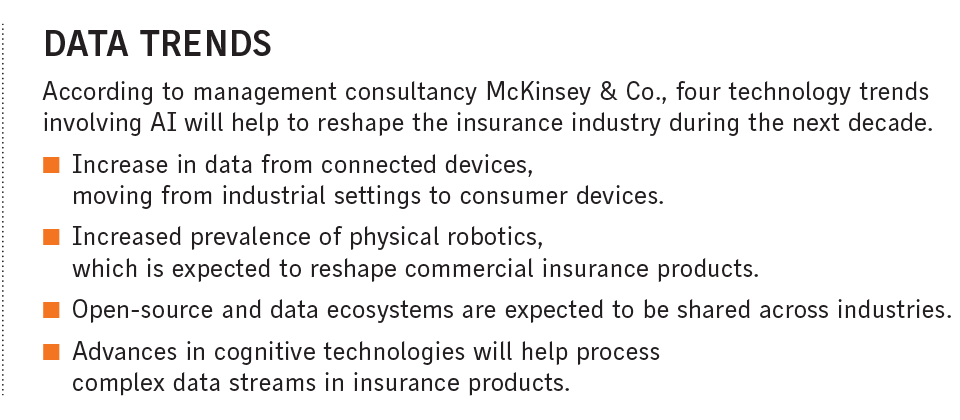
AI technology builds momentum in claims sector


The insurance claims sector is tapping into technologies such as machine learning and artificial intelligence to increase efficiency, improve outcomes and detect fraud. 

Whether it is a simpler version of AI that can be used to automate back-office processes or the newer generation AI, which can be used to analyze policyholders’ claims history and policy preferences, these new technologies are becoming more widely used in the industry. 

“There are a lot of policies that are written and a lot of claims that occur, which all have data around them,” said Stan Smith, founder and CEO of Boston-based Gradient AI, which provides AI services for the insurance industry. “As I looked into it, claims were more of a challenge than underwriting. There was a lot of focus on how to get our claims costs under control.”

Yet “the vast majority of claims being pretty benign means a lot of people have busy work to do,” he said, adding that technology can help mitigate workloads.

Gia Sawko, Gradient’s senior product manager of claims, said AI will change the way jobs are performed. 

“There are jobs out there that are duplicative, or the resources could be divided differently so you’re spending more time on the complex claims,” Ms. Sawko said. “There are things that could be done that could be automated with the use of AI.” 

While the term AI is used broadly, it encompasses various platforms and processes. Automation and AI, for example, are sometimes used interchangeably, but they differ, said Leah Cooper, Chattanooga, Tennessee-based managing director of IT for Sedgwick Claims Management Services Inc. 

“AI is just the tool,” Ms. Cooper said. “Automation is putting all of the pieces together.”

When rolling out AI pilot programs, Sedgwick saw success in document digitization and validation, reading for content, and automatic eligibility confirmation used to validate whether someone has proper coverage. 

“AI is not going to replace someone’s job. What it’s going to do is take the red tape and the busy work off someone’s desk so that you change the story about that person’s job,” Ms. Cooper said.

She said AI is also being used to detect claims oddities and discrepancies that could potentially signal insurance fraud (see related story below).

“There are a lot of different opportunities when it comes to plugging into tools that can spot abnormalities,” she said. “Using AI, we’re able to spot the outliers, what’s not normal.” 


The insurance industry traditionally lagged in technology, said Cheryle Tuttle, Tampa, Florida-based vice president of property/casualty and workers compensation for Sapiens International Corp. 

“A lot of the problems have not changed,” Ms. Tuttle said. “It’s just technology and things like AI, data analytics, automation, these are all helping people in being proactive instead of reactive.”

New technologies such as AI have “tremendous promise for our industry but if misused could be certainly damaging and counterproductive,” said Joe Powell, Fort Wayne, Indiana-based senior vice president for data and analytics with Gallagher Bassett Services Inc.

Mr. Powell drew distinctions between the different forms of AI, including “narrow” AI, or machine learning, where models are built or “trained” on data targeting a specific desired decision outcome, and generative AI, which can involve taking a “single, very general model and (applying) it to a whole host of use cases.”

“Those two are not substitutes for each other,” he said. “It’s not like we’ve moved from one to the other. I think the new, generative AI models are going to complement our narrow AI models in a lot of ways,” Mr. Powell said.

Generative AI has the potential to improve the claims process because it enables claims professionals to “deliver a consistent product in an efficient way,” he said.

Mike Cwynar, Orange County, California-based senior vice president of product delivery for Mitchell Casualty Solutions Group, said AI can benefit back-office claims management as well as customer service and document digitization tasks.

“A lot (of our clients) are really putting thought into how to make it a really user-friendly claims experience,” he said. 

Insurance personnel considering using generative AI should start small. “I wouldn’t go in and try to rewrite your back-office process here,”  Mr. Cwynar said.

“It’s key to partner with folks who understand not just the technology but the business domain, the problem that you’re trying to solve, and being really careful in what you end up going after,” he said. 

Generative AI, he said, can generate content such as photos, video, text and code, and attempts to read questions and provide answers. But it can also suffer from what’s known as “hallucination,” a term referring to times when AI provides an answer not in line with what is expected. 

“You really need to understand what you’re trying to get out of tools like this, because they’re tools right now,” Mr. Cwynar said. “I wouldn’t throw generative AI at the most complicated problem that I have out there. I’d use it to automate tasks and build my expertise and sophistication with it over time.” 


Machine learning  powers fraud detection

As artificial intelligence becomes more widely used in the insurance industry, one function that can benefit from its implementation is fraud detection. 

Generative AI can look at various factors in claims filings to see if there are any indicators of fraud, such as “falsification of details around the damage level,” said Leah Cooper, Chattanooga, Tennessee-based IT managing director for Sedgwick Claims Management Services Inc. 

AI can be used to detect atypical behavior, a sign of potential fraud, said Joe Powell, Fort Wayne, Indiana-based senior vice president for data and analytics with Gallagher Bassett Services Inc. 

“What’s great about these AI systems is that they can learn what’s typical across a much broader spectrum of data than a human can ever look,” Mr. Powell said. 

AI, especially Microsoft OpenAI’s language model GPT, can be particularly useful in fighting fraud, since it can “analyze vast amounts of claims or communication data, spotting patterns and inconsistencies that may suggest fraudulent activity,” said Gregg Barrett, CEO of Kalispell, Montana-based insurance software provider WaterStreet Co. 

QBE North America partnered with Vejle, Denmark-based DETECTsystem A/S after learning about that company’s fraud detection system, FDS, which uses advanced technology to detect image and document fraud in claims, said Brian Wilson, vice president and head of the special investigations unit at the New York-based insurer. 

“You receive a lot of these (supplemental documents) with every single claim that comes in,” said Dan Gumpright, Scottsdale, Arizona-based executive vice president of products and operations for DETECTsystem A/S. “It’s kind of like looking for a needle in a haystack.”

Putting a human on fraud detection would be “very inefficient in terms of cost,” whereas AI can complete the task quicker and more accurately, he said.


Source link

Commercial rates up 5% in Q2: MarketScout


Commercial insurance rates rose an average of 5% in the second quarter, as commercial property and cyber liability saw the biggest increases, according to data from insurance exchange MarketScout Corp. released Friday.

Cyber liability rates rose 13.3%, softening from a 15.7% increase in the first quarter, according to the Dallas-based company.

Commercial property rates rose 10.7%, up from a 9.3% increase in the first quarter.

Among other lines of coverage, commercial auto rates increased 8%, general and umbrella/excess liability were up 7%, and business interruption increased 6%.

Workers compensation rates inched up 0.3%.

“Property, business interruption and general liability and umbrella/excess rates increased, while most other coverage classifications softened a bit,” MarketScout CEO Richard Kerr said in a statement.

By account size, small accounts, those with up to $25,000 in premium, saw rates rise 5.7%; medium accounts, between $25,001 and $250,000, and large accounts, between $250,001 and $1 million, were up 6%; and jumbo accounts, over $1 million, increased 4.7%, MarketScout said.


Source link

Patient aggression causing workplace safety concerns for receptionists


With incidents of workplace violence on the rise at health care facilities, researchers now say receptionists at general physician practices are also experiencing increased levels of patient aggression.

An article published Thursday in the open-access journal Family Medicine and Community Health says that patient aggression against receptionists is having an adverse effect on doctors’ offices, boosting workplace absenteeism and causing staff to leave the health care workforce in greater numbers.

The researchers reviewed data from Australia, England, Ireland, Spain and the United States, most of which appeared to show patient aggression toward receptionists rising in frequency since the 1970s.

Incidents of aggression included verbal abuse, hostility, and the use of derogatory insults including racist and sexist remarks. Some of the data showed acts of physical violence toward receptionists, although verbal abuse was more prevalent.

The article says many root causes of patient aggression toward receptionists arise from “avoidable operational factors,” including inefficient scheduling systems and difficulties in communicating with medical staff.

The researchers said patient aggression toward reception staff is a growing workplace safety concern for general physician practices and that evidence-based strategies are needed to help prevent, manage and mitigate such incidents and to improve working conditions.


Source link

Exit mobile version