Colorado contractor previously cited over teen death faces new OSHA citation


A Colorado contractor who was cited by safety regulators last summer after a teenage worker died after being struck by a chunk of asphalt at an excavation site has once again been cited by the U.S. Occupational Safety and Health Administration.

OSHA on Wednesday announced a citation against Commerce City-based GoldStar Excavation and Sewer after investigators said the company once again exposed employees to trenching hazards at an excavation project in Fort Collins in March.

One of the workers reportedly exposed to the dangers was a foreman who had also been injured on Aug. 13, 2022, at the site of the teen worker fatality, which had led to $15,625 in proposed penalties.

In the latest case, OSHA cited the company for willful violations for exposing employees to cave-ins and failing to train workers to recognize trenching hazards. This time, the company was issued proposed penalties of $206,698.

OSHA also placed the company into its Severe Violator Enforcement Program.

The family company, which provides water and sewer line services, has 15 days to contest the latest citation and penalties.  


Source link

NY lawmakers introduce another bill to protect warehouse workers


Months after Gov. Kathy Hochul in New York signed a bill aimed at protecting warehouse workers from unfair quotas that increase the risk of musculoskeletal injuries and disorders, lawmakers have introduced a second bill that would require companies to develop safety initiatives to prevent injuries.

S.B. 5081, introduced Tuesday, would bolster requirements set by S.B. 8922, known as the Warehouse Worker Protection Act, which became law in December 2022 and requires employers to establish an injury reduction program to minimize the risk of musculoskeletal injuries and disorders.

The new bill states that companies with “workers involved in performing manual materials handling tasks” would need to have in place an injury reduction plan that calls for the hiring of a certified ergonomist to perform worksite evaluations and gather input from workers. The bill includes anti-retaliation language to protect workers who report issues.

The bill also requires employers to correct “in a timely manner any risk factor identified as having  caused or being likely to cause musculoskeletal injuries and disorders.”


Source link

Property insurance price surge leads rate hikes


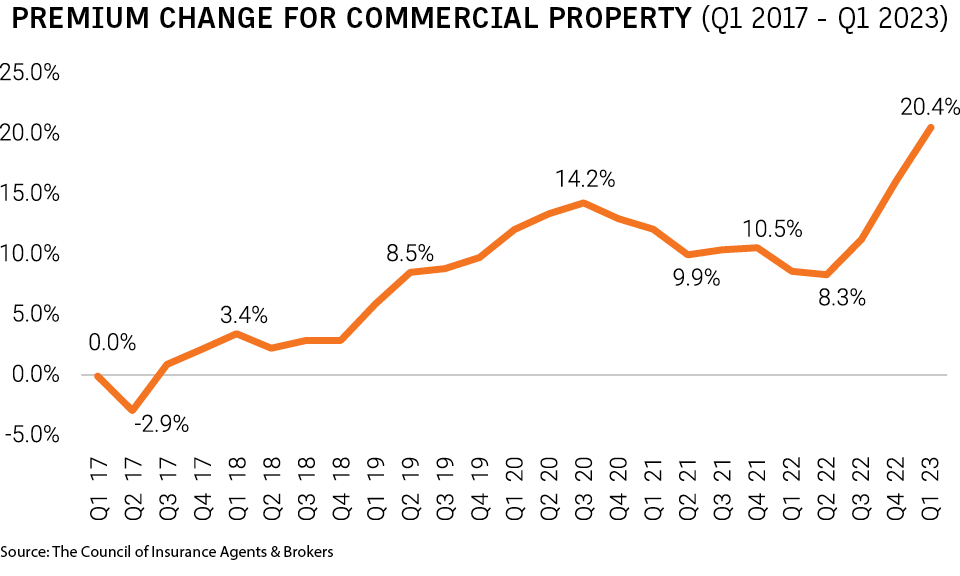
Average annual commercial insurance premium increases accelerated to 8.8% during the first quarter of 2023, up from 8% during the previous quarter, with commercial property rate hikes far outpacing other lines, according to a report Wednesday from the Council of Insurance Agents & Brokers.

By account size, the Council’s quarterly report showed large accounts with the greatest increase at 11.4%, followed by medium-sized accounts at 9% and small accounts at 6.2% during what was the 22nd consecutive quarter of increased premiums for all account sizes.

Property and cyber were singled out in the report for seeing tumult and calming, respectively. Commercial property premiums increased 20.4% on average in the first quarter, “which is by far the highest out of all lines” and compares with 16% in the prior quarter, said the report. Respondents cited inflation and natural catastrophe losses as the main drivers of the sharp increase.

c1a583ce 2fd5 48b0 a7cd c4067cd909e4

Commercial cyber insurance rate increases slowed significantly with an average increase of 8.4% in the quarter, down from 15% in the previous quarter and a high of 34.3% in the fourth quarter of 2021, according to the report.

In other major lines, umbrella liability rates increased 8.5% in the quarter, down from a 9.6% increase in the fourth quarter of 2022; commercial auto rates rose 8.3%, up from 7.3%; general liability rates rose 4.6%, down from 4.9%; and workers compensation rates fell 0.5% compared with a 1.1% decrease.


Source link

Physician assistants can treat comp patients under new Oregon law


Oregon’s governor has signed into law a measure that permits physician assistants to treat injured employees in workers compensation claims.

Gov. Tina Kotek on Tuesday signed into law House Bill 3412, which authorizes physician assistants to provide the same level of services as nurse practitioners for workers comp patients in a managed care organization setting.

Qualifying physician assistants must be licensed by either the Oregon Medical Board or similar regulatory agencies in other states.

The law says that if a treating physician assistant is not a member of a managed care organization, they are still allowed to provide the same level of service as a primary care physician if the individual maintains the injured worker’s medical records and if he or she has a documented history of treating the worker.


Source link

Shot worker can recover judgment from State Farm: Court


A federal court has determined that a former Alabama convenience store employee shot while walking to his vehicle after his shift ended can recover damages from his employer’s insurer.  

In a Monday decision, the U.S. District Court for the Northern District of Alabama ruled State Farm Fire and Casualty Co. must indemnify owners of the Pit Stop Grocery in Birmingham after employee Amanali Babwari was shot numerous times in the parking lot on Oct. 10, 2016.

Mr. Babwari obtained a consent judgment against his former employer in state court after claiming the owners’ failure to implement proper security measures led to his attack. In his suit, Mr. Babwari argued the employers were negligent when they failed to hire a second employee during the night shift and that a failure to fix a streetlight in the parking lot also contributed to the attack.

Mr. Babwari later went to federal court seeking to force State Farm to satisfy the $877,659.66 state court judgment entered against the employer. The insurer had argued that the parking lot gunshot injuries were not covered by the business’s liability policy.

The federal court ruled that State Farm failed to demonstrate any exclusions applied in the policy, and it ordered the insurer to indemnify the store owners for the underlying judgment awarded to Mr. Babwari.  

The tort action was permitted because under the Alabama Workers’ Compensation law, incidents that occur while an employee is traveling to or from work does not constitute an injury arising out of and in the course of employment. 


Source link

Diet drugs trend unlikely to make it to comp


While obesity is considered one of the top comorbidities among injured workers that can impede their recovery, and insurers and employers have funded weight loss surgeries, the workers compensation industry is unlikely to cover increasingly popular and less-invasive weight loss pills, experts say.

Semaglutide, which goes by brand names Ozempic and WeGovy, is a diabetes drug that has been making headlines as it also causes patients to lose weight by slowing down the digestive system and quelling the appetite. A “Hollywood effect” is also driving its popularity, as film stars have been knowingly taking the drug to lose weight.

Unless a patient is diabetic the drug is typically not covered by insurance, and studies show that when a patient stops taking the drug the weight creeps back on. It also comes with a list of side effects including the more common nausea and constipation to, possibly, thyroid cancer and gallbladder disease.

It’s the side effects and that the drug must be taken long term that will keep comp from covering it, experts say.

“It is a drug; it does have side effects. It does have consequences and, if it is not monitored properly, people could harm themselves,” said Reema Hammoud, Southfield, Michigan-based assistant vice president of clinical pharmacy for Sedgwick Claims Management Services Inc.

Hypothetically, if the drug is prescribed to an injured worker and covered under comp, the payer also inherits side effects as part of the claim, and if the claimant is kept on the drug indefinitely — as most semaglutide patients are — then it’s the payer that’s charged with continuous monitoring, Ms. Reema said, adding, “We have to be careful about that.”

The industry, also, rarely voluntarily covers costs related to weight loss despite the correlation between recovery and obesity, said Stuart Colburn, a shareholder of Downs & Stanford P.C., headquartered in Dallas.

The Boca Raton, Florida-based National Council on Compensation Insurance Inc. in 2012, found that claims with an obesity comorbidity have 81% higher lost-time costs compared with claims involving non-obese injured workers. That was among the last larger studies that examined the obesity connection in comp although smaller studies have reinforced the idea that some injured workers won’t recover if their weight is not addressed.

“We do have case law from various states,” Mr. Colburn said. “They say reasonable and necessary medical treatment would include something so invasive as bariatric surgery. No payer that I know of is going to just voluntarily as a matter of rule go ahead and volunteer to do that.”

Mr. Colburn and others say semaglutide’s popularity could push it into the comp system.

“We haven’t seen evidence of that approach surface within our pharmacy data as of yet, but this is not beyond the realm of possibility given the attention these drugs are receiving for weight loss effects,” Nikki Wilson, senior director of clinical pharmacy services at Enlyte LLC, wrote in an email.


Source link

CVS settles with Massachusetts over workers comp pricing allegations


The Massachusetts attorney general’s office has reached a $6.15 million settlement with CVS Pharmacy Inc. to resolve allegations that the retail pharmacy failed in some instances to follow prescription pricing procedures designed to keep costs down and prevent overcharges in the workers compensation system.

The state claimed CVS billed and was paid for prescription drugs in excess of prices allowed by state law. CVS allegedly also failed to follow federal limits for Medicare and the Massachusetts maximum allowable costs when making pricing determinations, according to a statement issued by the state attorney general’s office.

The attorney general’s office also said it would work with CVS, “to seek improvements to the Massachusetts workers’ compensation billing system and establish procedures to prevent overcharges.”

The office said it has recovered more than $20 million in settlements over comp drug pricing violations with Walgreens Co., Express Scripts Holding Co., Optum Rx Inc., Stop & Shop Supermarket Co. and United Pharmacy Inc.


Source link

Medical treatment review requests continue to decline in Calif.


The number of independent medical reviews in California hit an all-time low in 2022, with 127,215 letters from injured workers challenging the denial of treatment or medications in the workers compensation system, according to a report issued Friday by the California Workers’ Compensation Institute.

The report also found that independent medical reviews upheld 91.1% of earlier decisions in 2022 — a figure that has remained steady, with between 88.2% and 92% of decisions upheld since 2014.

Reviews related to opioid prescriptions have continued to decline “sharply,” with overall prescription-related review requests at 33% in 2022, a steady decline from a high of 49.9% in 2014.

Changes to workers compensation law in 2012 called for a process to appeal decisions with independent medical reviews and the industry saw an all-time high of 184,735 appeals in 2018.

The report also compared California’s volume with that of Texas, which has a similar process in place, finding that between 2014 and 2022 California had more than 92 times the IMR letter volume of Texas.  


Source link

California written premium on upswing


Despite continued declines in insurer rates, California’s worker compensation written premium in 2022 was 14% higher than 2021, and at approximately the pre-pandemic level, according to a first-quarter 2023 report released Friday by the Workers’ Compensation Insurance Rating Bureau of California.

WCIRB said the increase was driven by higher employee wage levels and the economic recovery, as written premium decreased sharply in 2020 and remained low in 2021 due to the pandemic-related economic downturn combined with continued insurer rate decreases.

After increasing over the prior four years, the 107 projected combined ratio for 2022, which included COVID-19 claims, is five points lower than in 2021, according to the report.

The average charged rate for 2022 was $1.68 per $100 of payroll, 7% below 2021 and the lowest in decades. The WCIRB proposed a modest overall increase of 0.3% in advisory pure premium rates in its rate filing this year.  


Source link

Oregon appeals says injured school worker can sue


The Oregon Court of Appeals on Thursday reversed an earlier decision that found a school worker’s lawsuit over an injury she suffered while watching children on the playground, ruling that the woman may sue the district over an injury that was deemed not compensable.

Linda Jean Preble was working as an educational assistant for the Centennial School District, No. 287, in Portland, Oregon, in 2013 when a child riding a scooter crashed into her, injuring her knee, according to Preble, v. Centennial School District, No. 287.

The district denied the claim on the ground that hers was “a combined condition resulting from the scooter accident in conjunction with a long-term degenerative knee condition, and the scooter accident that occurred at work was not the major contributing cause of the resulting combined condition.”

In 2016, Ms. Preble sued the district for negligence, more than two years from the date of her injury, which the district argued was time-barred.  A trial court agreed and dismissed the complaint.

The appeals court ruled the trial court applied the wrong statute and that since Ms. Preble’s suit was filed within a legal time frame after she aimed to prove her injury was compensable under comp, the suit can proceed.

The court wrote that “(w)here a worker offers evidence that work was the major contributing cause of a combined condition, but the (administrative law judge) or board finds that evidence less persuasive than the employer’s contrary evidence, the worker has ‘failed to establish that a work-related incident was the major contributing cause of the worker’s injury’… the worker may pursue a civil action” under limitations set by law, of which plaintiff’s case applies. 


Source link

Exit mobile version