Sedgwick names global chief digital officer


Sedgwick Claims Management Services Inc. on Monday named Leah Cooper global chief digital officer.

Ms. Cooper, based in Chattanooga, Tennessee, will lead Sedgwick’s technology research and development efforts in the newly created role.

She most recently served as managing director of global consumer technology and joined Sedgwick when it acquired Absentys LLC, a software developer which she co-founded, in 2014. 

Ms. Cooper was a 2022 Business Insurance Women to Watch honoree.


Source link

Chemical manufacturer cited after worker fatally burned


The U.S. Occupational Safety and Health Administration said Friday that it cited a Georgia chemical manufacturer following the June death of an employee who had only been on the job for two months.

OSHA cited Cartersville-based Chemical Products Corp. for five serious violations following the accident in which the worker suffered fatal chemical and thermal burns from hot sludge after opening an air intake valve. Another employee suffered second-degree burns in the incident.

Another Chemical Products worker suffered chemical burns 25 days later, according to the agency.

OSHA said the company failed to employ various safety precautions designed to protect workers from such hazards and proposed $55,403 in penalties.

Chemical Products has 15 business days to contest the citation and proposed penalties.


Source link

Washington state workers comp premium rate to rise 4.9% in 2024


Employers in Washington state will pay around $65 more a year in workers compensation insurance for each full-time worker under a rate increase approved by state regulators.

The Washington State Department of Labor & Industries announced Thursday that it adopted a 4.9% increase in the average workers comp premium rate, effective Jan. 1, 2024.


Source link

Comp benefits denial overturned | Business Insurance


A New York appeals court ruled Thursday that an employee injured in a vehicle accident didn’t violate the state’s Workers’ Compensation Law by not disclosing a third-party settlement.

The Appellate Division of the Supreme Court of New York found that the state’s Workers’ Compensation Board erred in terminating comp benefits for Leonore Salvia, who was injured in the August 2013 accident.

Ms. Salvia had filed for benefits in February 2015, a year after a third-party suit was filed on her behalf.

In June 2021, Ms. Salvia’s employer, Nutritional Frontiers LLC, and its insurer, Uninsured Employers’ Fund, petitioned to have the benefits suspended because Ms. Salvia settled a third-party lawsuit without their consent.

A workers comp judge found no violation of state law, but the Workers’ Compensation Board reversed that decision and ordered benefits terminated.

The appellate court said there was no evidence Ms. Salvia received any compensation in the third-party action and that the board wrongly reversed the workers comp judge, who had found “no evidence of a willful misrepresentation with the intent to deceive.”


Source link

Massachusetts concrete contractor cited after worker’s death


The U.S. Occupational Safety and Health Administration said Friday that it cited a Massachusetts concrete contractor after one of its workers was fatally injured in September.

OSHA cited East Freetown-based John Oliveira & Sons Stamp Concrete Inc. for three willful, two serious and one other-than-serious violations and proposed $200,905 in penalties.

The worker was instructed to remove a soil screen on a conveyor and became caught between the conveyor and its frame because the power source was not disabled to prevent an unintended startup, OSHA said.

The company, which has 15 business days to contest the citation and proposed penalties, failed to employ numerous safeguards to protect workers from equipment hazards, OSHA said.


Source link

Trucker shouldn’t have received PTSD comp benefits: Appeals court


The Pennsylvania Commonwealth Court Thursday reversed a decision to award workers compensation benefits to a tractor-trailer driver who said he suffered a psychological injury during a vehicle fire.

The driver had filed a workers comp claim seeking benefits for a frostbite injury to one of his fingers as well as post-traumatic stress disorder stemming from the incident in which the tractor-trailer he was driving caught fire in February 2015. He subsequently amended his petition to only seek compensation for PTSD. 

A workers comp judge in 2022 held that the driver suffered work-related PTSD and awarded him benefits. The driver’s former employer, Premium Transportation Staffing Inc., appealed, arguing the fire didn’t constitute an abnormal working condition, but a workers comp board affirmed the benefits.

In reversing those decisions, the appeals court said the claimant could have anticipated a truck fire and had been trained on how to respond to such an incident. It said the “relatively minor fire” was quickly extinguished and did not constitute an “extraordinarily unusual and distressing” employment event that could serve as the basis for a PTSD claim.  


Source link

OSHA not doing enough for warehouse workers: OIG


The Occupational Safety and Health Administration continues to fail to protect warehouse workers from injuries and needs better protocols for addressing complaints regarding worker safety, according to the Department of Labor’s Office of Inspector General’s annual report to Congress.

The report, released Thursday, calls on OSHA to develop “specific, measurable inspection goals” for programs that target specific warehouses, including establishing a baseline for the number of inspections and periodically monitoring progress toward safety and inspection goals.

The OIG also recommends that OSHA develop a more effective enforcement strategy to improve employers’ reporting of injuries and that the agency “gather more specific supporting information about injuries to better identify the count and type of injuries reported, such as musculoskeletal disorders.”

In addressing protocols for managing safety complaints from workers, the OIG recommends OSHA modify its manual to require mandatory interviews of complainants and witnesses.

The report also reiterated that OSHA did not do enough to protect workers during the COVID-19 pandemic, as previously noted in audits.


Source link

Overdose cure at work may bring liability risks


Following the federal government’s approval of over-the-counter use of the lifesaving opioid antagonist naloxone, efforts are underway to encourage employers to keep it in workplace first-aid kits to help prevent employee overdoses. 

The campaign to do so, launched by the National Safety Council at its annual Congress & Expo in October and endorsed by organizations such as The National Institute for Occupational Safety and Health, is one push in reversing a yearslong trend of deadly opioid-related overdoses, some of which take place in the workplace.

Legal experts, however, warn that the move comes with risks for companies.

Naloxone, which goes by the brand name Narcan and has been available over the counter as a nasal spray since the U.S. Food and Drug Administration expanded its widespread availability in July, is known to quickly reverse the effects of an overdose of such drugs as heroin, fentanyl and prescription opioid medications. 

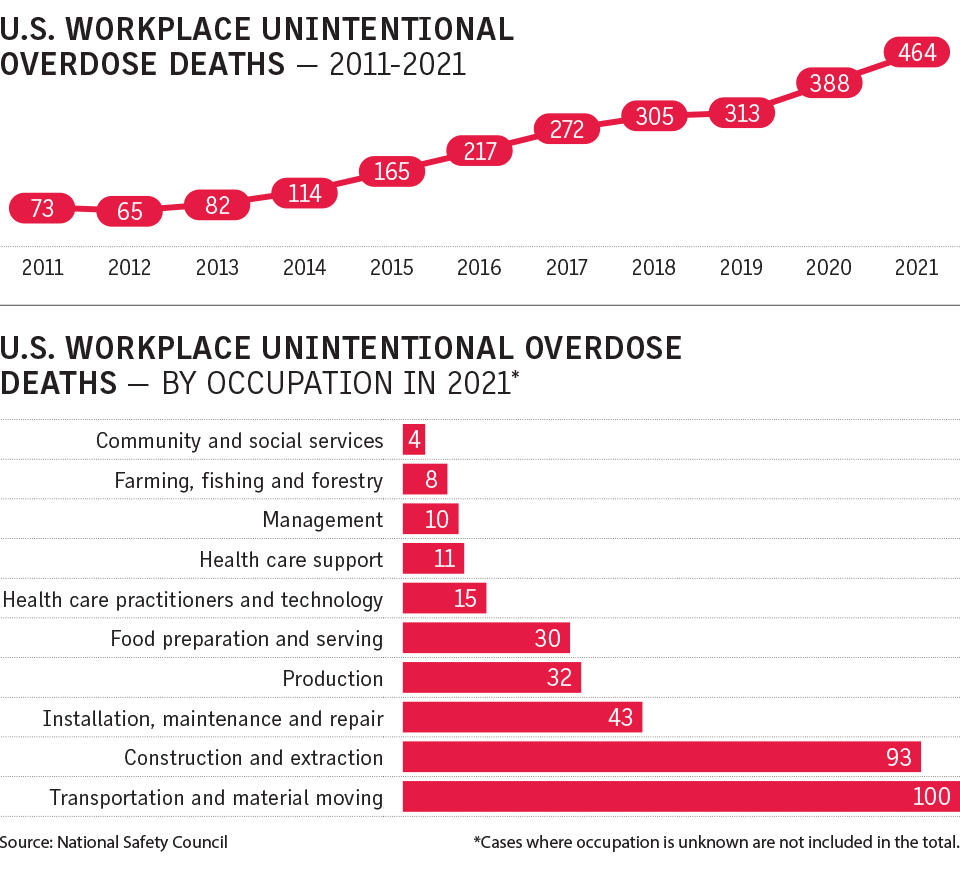
According to the National Safety Council, workplace “unintentional overdose deaths from nonmedical use of drugs or alcohol” have increased 536% since 2011, and workplace overdose deaths totaled 464 in 2021, which is equivalent to nearly 9% of all occupational injury deaths that year.

The advocacy group says that increases have been experienced across employee demographics, industries and occupations. 

Lorraine Martin, CEO of the National Safety Council in Itasca, Illinois, said getting employers on board with prevention is a logical step. 

Employers need to “make sure that their workforce is ready to respond just like you would for things like a heart attack in your workplace or somebody you know needing a tourniquet or bandages,” she said. “First aid and emergency response are what companies have been (doing) for years. … We now need to add this additional emergency, as a potential overdose is something that you have to be ready for.”

Several organizations, including the American Red Cross, have increased low- to no-cost training on administering naloxone. Yet taking steps to store and provide the drug in the workplace has some risk and legal implications for employers, according to legal experts. 

Novelty is an issue, as over-the-counter approval for naloxone is relatively new, and the U.S. Occupational Safety and Health Administration has remained silent on what employers are obligated to do if an overdose takes place on site, experts say. 
BI 1223 02A

OSHA has since 1993 collected data on reported drug overdoses, which some say goes underreported unless the fatality is linked to another incident, such as a fall. For example, for 2021 the agency records 12 incidents involving a “drug overdose” in the workplace while U.S. Bureau of Labor Statistics numbers show hundreds. 

The agency has acknowledged how the opioid epidemic has affected workers, citing the steady rise in overdose deaths. But there is no standard for managing overdoses, and it’s up to employers how to handle the issue, according to legal experts. 

John Ho, New York-based co-chair of the OSHA Workplace Safety Practice at Cozen O’Connor P.C., said OSHA’s first-aid standard — which requires workplaces to have first-aid kits and an employee trained in application of first aid — isn’t clear on overdoses. 

The standard requires that employers that are not in proximity to a medical facility have on site and in first-aid kits materials that are specific to the needs of their operation. For example, a workplace that handles hot substances must have materials on hand to assist with burns. 

Putting naloxone in a first-aid kit has to be “deliberate and thought out,” said Mr. Ho. Keeping the substance on site could potentially indicate that an employer knows its workers may be on drugs, he added.

In high-risk industries such as construction, this could create liability considerations if a worker is injured as the result of another worker being on drugs, Mr. Ho said. 

“Employers really need to get their arms around the legal liability for engaging in this,” he said. 

Caroline Berdzik, Princeton, New Jersey-based chair of Goldberg Segalla LLP’s employment and labor, health care, and long-term care groups, wrote in an email that “since OSHA has not yet weighed in on overdoses in the workplace and handling of overdoses” it will be up to employers, who will be taxed with training on administering the drug. This would bring OSHA requirements for administering medical care into play. 

“There are no specific standards for employers to be guided by other than the existing OSHA standards which cover areas such as safety training and blood-borne pathogens,” Ms. Berdzik said, adding that “other risks that come into play involve when an employee may mistakenly believe someone is overdosing and improperly administers the drug, which can have side effects for the recipient.” 

Companies should consider state “Good Samaritan” laws that provide legal protections for people engaging in lifesaving acts. 

According to a paper filed with the National Library of Medicine in 2022, 40 states and the District of Columbia have such laws written specific to opioid overdoses, many of which were created to encourage bystanders to call emergency services in the event they witness an overdose. Experts say it’s not clear how such laws would apply to naloxone administration, considering how recently it was approved for over-the-counter use. 

Ms. Martin said companies’ experience with automated external defibrillators can provide some clarity on how to proceed. OSHA provides some guidance on such devices, intended for use in sudden cardiac arrest, calling on employers to maintain a written plan for use and training. 

Issues of liability and safety “were navigated for most workplaces” that installed AEDs on site, she said, adding that it’s likely regulators will catch up when it comes to opioid overdoses. 

It’s a common question whether naloxone, wrongly administered, would cause an adverse health reaction, but the risk is little to none, said Dr. L. Casey Chosewood, Atlanta-based director of NIOSH’s Office of Total Worker Health. 

Naloxone is “safe even if someone is disabled or unconscious and it’s not from overdose,” he said. 

“Let’s imagine in the workplace you find someone who’s unconscious or appears to be struggling to breathe and you’re uncertain as to what the cause of their impairment or their disability or medical symptoms. … You do not do any harm by using naloxone. It may not work if the condition is not an overdose, but you’re certainly not doing any additional harm to that person.” 



Source link

Comp award for trucker may have been overinflated: Appeals court


A truck driver who suffered leg burns and eventually a sepsis infection from spending long hours sitting atop an engine compartment was entitled to workers compensation benefits for his injuries, but the benefits should have been offset by income from his second job, a Pennsylvania appeals court ruled Thursday.

The Pennsylvania Commonwealth Court determined that a comp judge correctly awarded benefits to Mark Warner, who worked for Newman & Co. Inc. driving a cab-over truck for 12 to 15 hours a day and became injured in 2020.

Mr. Warner, who said his leg had to rest up against a hot engine compartment while driving, was treated in 2021 for a leg wound that eventually turned into sepsis requiring a four-day hospital stay.

A comp judge directed the employer to pay total disability benefits for an ongoing period, but the company argued the award should have been offset by income Mr. Warner earned from his second job.

The appellate court upheld most of the award, but reversed and remanded the aspect of the case involving the amount of compensation, saying a comp judge must determine whether Newman & Co. is entitled to a credit for any post-injury earnings.   


Source link

Exit mobile version