Study shows lag in physical therapy continues in comp


The time between injury and physical therapy for workers in the workers compensation system continues to stall, according to a trends report released by MedRisk LLC.

Using 10 years of data on coordinated care, comp services company MedRisk examined the lag time between injury and an injured worker’s first physical therapy appointment. It found that in 2013 26.2% of injured workers in need of therapy were seen within seven days. In 2013, that time increased by two percentage points to 28.2%.

The so-called “speed-to-care” timing improved 28 days post-injury, with 60.7% of patients in 2023 receiving care by that time. In 2013, 60.7% of injured workers saw a physical therapist in that time frame.

MedRisk said in its report that decreasing the time for appointments would provide better outcomes for injured workers.


Source link

CompSource names CEO | Business Insurance


CompSource Mutual Insurance Co., a provider of workers compensation coverage in Oklahoma, on Monday named Trey Ingram as CEO.

He replaces Jason Clark, who left his role as CEO in 2023, the Oklahoma City-based company said.

Mr. Ingram is a nine-year veteran of CompSource’s board and previously served as CEO of two oil and gas service companies. He most recently was CEO of Momentum AI.

CompSource Chief Financial Officer Steve Hardin, who has served as the acting president of the company since November,  will continue as president along with his current role.


Source link

One Call names Jenkins chief operating officer  


One Call Care Management on Monday named Matt Jenkins as its chief operating officer, a newly created role for the company, which coordinates care for injured workers.

Mr. Jenkins, who will be based in Jacksonville, Florida, will oversee operations and information technology, according to a One Call statement. He previously was chief operations officer and general manager of Oportun, a loan company.  


Source link

Lawmakers consider doubling comp benefits for employer misconduct


Lawmakers in Rhode Island are considering a bill that would double the workers compensation “remedy” for a worker who is injured as the result of willful misconduct by the employer.

S.B. 2689, introduced Friday, states that such “willful misconduct by an employer involves deliberate or intentional wrongdoing with knowledge of, or wanton and reckless disregard of one’s safety, knowing that injury to a person will probably result.”

The bill, which would go into effect immediately, was sent to the Senate Labor Committee.


Source link

Most cumulative trauma claims in California involve litigation: Report


Seventy percent of cumulative injury trauma claims in California involved an attorney, according to research published Friday by the California Workers’ Compensation Institute, which called the issue a “unique phenomenon” for the state.

The study, which examined claims that involve injuries that develop over time, also found that cumulative trauma represented 37.5% of all litigated claims in the workers comp system in 2022 — up from 29.4% in 2010. Overall, cumulative trauma claims accounted for 13.4% of workers comp activity in 2022.

The report also highlighted the complexity of the claims: between 2018 and 2022, researchers found that 43% of all litigated cumulative trauma claims involve more than one part of the body, while 5.1% to 20.9% involve only one area of the body, such as spine, lower or upper extremities.  

By industry, 48.8% and 46.9% of litigated claims in manufacturing and food services, respectively, involve cumulative trauma. The lowest percentages were reported in construction and agriculture, at 25.4% and 24.2%, respectively. 


Source link

Minnesota lawmakers aim to tackle retail violence


Lawmakers in Minnesota on Thursday read through a new bill that would require retailers to have in place anti-violence measures to protect workers.

S.B. 4383, which was referred to the Senate Labor​ Committee, states that by Jan. 1, 2025, retail stores “must design and implement a​ preparedness and incidence response action plan to acts of violence” that are “specific” to the establishment.

The plan “must include assessment procedures to identify and evaluate​ workplace violence hazards for each facility, unit, service, or operation, including​ community-based risk factors and areas surrounding the facility, such as employee parking​ areas and other outdoor areas,” according to the bill.

Under the proposal, retail stores must​ designate a committee of representatives of​ workers employed by the retail store, including nonmanagerial workers, consumer safety experts, and other appropriate personnel to develop the action​ plan, which must be reviewed and updated annually.


Source link

Plumbing contractor cited in fatal trench collapse


The U.S. Occupational Safety and Health Administration said Thursday that it cited a Georgia plumbing contractor after a worker died in a trench collapse in August 2023.

OSHA proposed $308,125 in penalties for Macon-based Pyles Plumbing and Utility Contractors Inc.

The fatality occurred as two employees were installing sewer line piping in a trench when its side collapsed. The second worker suffered several fractures and needed to be hospitalized.

OSHA cited Pyles Plumbing for two willful violations for failing to provide trench shields and three serious violations for permitting employees to work inside a trench with defective shields and without head protection, and for failing to train workers to recognize and avoid trenching hazards.

The company has 15 business days to contest the citation and proposed penalties.


Source link

DOL rule set to broaden liability for employers


A U.S. Department of Labor rule that takes effect this month may result in more contract workers being classified as employees, potentially requiring employers to provide benefits and insurance coverage such as workers compensation and possibly exposing them to employment-related lawsuits. 

The Employee or Independent Contractor Classification Under the Fair Labor Standards Act rule, which was finalized Jan. 10 and rescinds a Trump administration rule, covers employment classification under the FLSA, but employers worry it might have broader influence. 

Government officials say the rule provides a clearer analysis for employers to use to determine a worker’s employment status. It re-adopts an enhanced economic realities test for worker classification that was in effect under an Obama administration rule. 

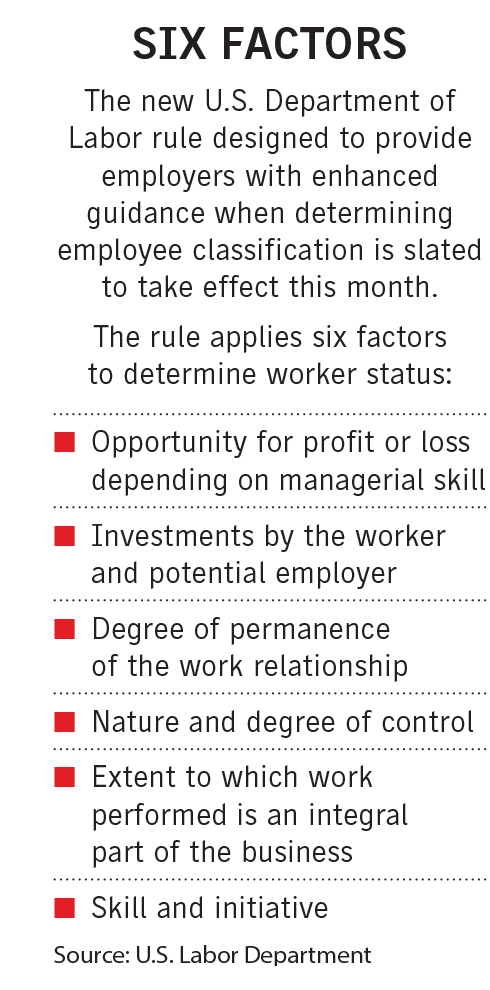
BI 0324 08AThe new rule contains a six-factor test to guide employers in determining a worker’s employment status under the FLSA (see box), whereas the Trump administration rule had a two-factor test. 

The Labor Department says misclassification of employees as contractors may deny workers a minimum wage, overtime pay and other protections. 

Some experts say the change is narrowly tailored and limited in scope, a view shared by the Labor Department. 

“The rule is how the Department of Labor is going to interpret who is an employee under the Fair Labor Standards Act,” said Todd Lebowitz, an attorney with Cleveland-based Baker & Hostetler LLP who represents employers. “So, one agency, one law.”

One group that came out in support of the new rule is the National Electrical Contractors Association, which said the change is a win for its member contractors because it would address the “rampant misclassification across industries, particularly the construction sector.”

But others are concerned the change may have consequences beyond just minimum wage and overtime pay protections. 

“Once you’re an employee for wage and hour reasons then I think everything else just starts to morph into the rule,” said Robert Boonin, a labor and employment attorney with Ann Arbor, Michigan-based Dykema Gossett PLLC.

The rule faces court challenges, but if it proceeds, certain workers would be considered employees for wage and hour purposes, a change that some labor unions and others support.

App-based gig workers, though, may prefer to remain independent contractors, some business advocates say.

“The concern if gig workers were suddenly reclassified would be that there would be fewer opportunities and less flexibility, which we know that they value,” said Ruth Whittaker, director of civic innovation policy for the Washington-based Chamber of Progress, a technology trade association.

Possible confusion could result if workers are classified as independent contractors under one statute and as employees under another, said Alex MacDonald, a shareholder with Washington-based law firm Littler Mendelson P.C. and a core member of the Workplace Policy Institute, a division of the firm.

“It gets very confusing very quickly, and it is even different from state to state and within a state,” Mr. MacDonald said. “So, there’s like a Byzantine web of classification tests.” 

This confusion, experts say, could lead to more employment-related litigation. 

Mr. MacDonald is lead attorney in Coalition for Workforce Innovation et al. v. Walsh et al., one of the lawsuits challenging the rule. 

The suit, which is pending in the Eastern District of Texas and targets procedural issues associated with the law, was filed by various groups, including an organization representing independent workers, small businesses, start-ups, entrepreneurs and technology companies. 

Advocates of the new rule say many workers themselves pushed for reclassification. Some say the federal rule was inspired by California Assembly Bill 5, which was passed in 2019 and created a new test for determining employee classification (see related story). 

Those who pushed for AB 5 to become law included labor unions and legislators who voiced concern that independent workers were being deprived of employment protections such as overtime pay and sick leave. 

Matthew Estipona, director of government affairs and community engagement for the Northern California chapter of the Associated Builders and Contractors, said if the federal Labor Department rule proceeds, it may lead to more confusion and potentially expensive litigation as employers navigate how to determine employee status. He said that has been the effect of the California law.

“The final rule will jeopardize the ability of construction firms to continue the industry’s longstanding practice of utilizing legitimate independent contractors,” Mr. Estipona said. “Under the rule’s multifactor test, employers will now be forced to guess which factors should be given the greatest weight in making the determination.” 

Some experts said the DOL rule will have employers rethinking insurance coverage. 

“There may be more confusion about whether certain claims are covered by a policy that the employer has or whether employers would consider getting additional coverage,” said Bill Kennedy, a partner with Philadelphia-based Montgomery McCracken Walker & Rhoads LLP. 

Experts say companies may consider adding employment practices liability insurance or directors and officers liability insurance.


California law paved way for federal change

In 2019, California Gov. Gavin Newsom signed into law Assembly Bill 5, which created a new test for employers to determine whether workers should be classified as employees or independent contractors. 

As the U.S. Department of Labor prepares to implement a similar rule at the federal level, opponents are pointing to the impact of the California law. 

Matthew Estipona, director of government affairs and community engagement for the Northern California chapter of the Associated Builders and Contractors, said the law has led to a drop in employment. 

Mr. Estipona cited a January study from the Mercatus Center at George Mason University in Arlington, Virginia, that found California self-employment fell by 10.5% and overall employment dropped by 4.4% following the passage of AB 5. 

The study, however, noted that a drop in employment due to the pandemic could also be taken into consideration. 

Alex MacDonald, a shareholder with Washington-based law firm Littler Mendelson P.C. and a core member of the Workplace Policy Institute, a division of the firm, said the belief that employment would rise as companies classify more workers as employees is a “reductive way to think about it.” 

“If businesses stop using contractors, that reduces overall economic activity, which could affect the number of traditional employee jobs in that industry,” he said. 

Fallout from California’s AB 5 passage has included lawsuits by the trucking industry, which claims the law represents a huge cost burden for employers forced to cover independent drivers with workers compensation insurance, and by the ride-sharing industry, which contends the law has negatively affected its business.

In December, the U.S. Court of Appeals for the Ninth Circuit agreed to rehear a case by Uber Technologies Inc. seeking to overturn a judge’s dismissal of the company’s challenge to AB 5. 


Source link

Rising PTSD claims, wider comp liabilities spotlight importance of treatment guidelines


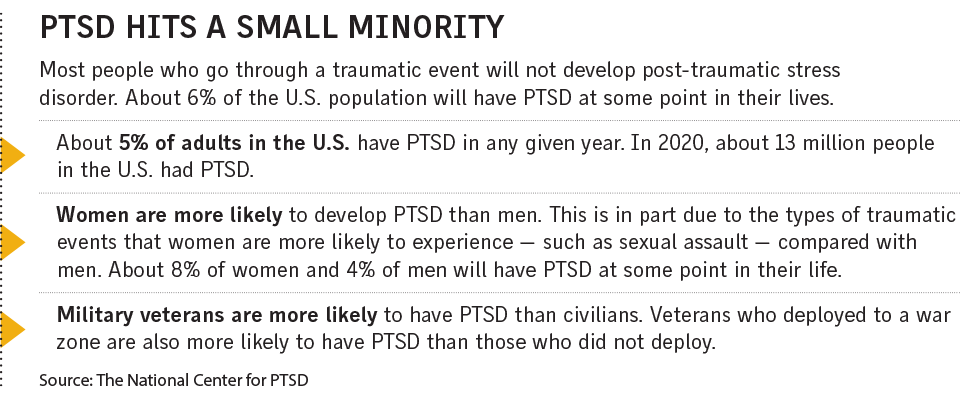
Post-traumatic stress disorder is a commonly misunderstood mental illness that is increasingly a component of workers compensation claims, raising concerns over how to navigate and close the often complex claims.   

Mental health experts say that adherence to guidelines for the diagnosis and treatment of PTSD is essential when treating affected workers. 

“The prognosis for well-treated PTSD is actually quite good,” said Les Kertay, Chattanooga, Tennessee-based behavioral health medical director for Genex Services, an Enlyte LLC company. “People tend to recover.”

State lawmakers have repeatedly sought to expand or introduce presumption laws that would make PTSD a compensable illness for some occupations allowing for more so-called mental-mental claims, or mental claims that result from a psychological event.

The push to expand workers comp into the mental health arena has mostly related to first responders, but there’s a growing interest in broadening eligibility for all workers (see related story below). 

The workers comp industry has generally been wary of accepting mental injury claims (see second related story below).

Reference to the universally accepted checklist in the Diagnostic and Statistical Manual of Mental Disorders, Fifth Edition, is necessary to make a PTSD diagnosis, experts say.

Most checklists start with the question of whether a person experienced a tragic event. Most PTSD presumption laws and proposals mention the DSM-5 and refer to experience of tragedy as a bar for accepting claims. 

“The No. 1 criterion in the DSM for PTSD is that the individual must have experienced or witnessed traumatic death or serious injury,” said Ron Heredia, a psychologist and founder and director of Los Angeles-based Good Mood Legal, which specializes in reviewing psychological evaluations in insurance claims.

After that determination is made, assessors should look at symptoms such as debilitating anxiety, nightmares and flashbacks, said Dr. Elspeth Cameron Ritchie, Washington-based chair of psychiatry at MedStar Washington Hospital Center, who spent part of her career as a U.S. Army doctor treating veterans with PTSD. 

Under the DSM-5 checklist, a person needs to have a certain number of symptoms over a long period to receive a PTSD diagnosis and the symptoms should not be confused with temporary discomfort after a traumatic event, Dr. Cameron Ritchie said. A key distinguisher is seeing, smelling or hearing triggers that ignite PTSD symptoms, she said. 

PTSD may not show up immediately, Dr. Cameron Ritchie said, recalling working in South Korea with veterans who had served during the Vietnam War and began experiencing PTSD symptoms years later. 

“Korea is an Asian country that has many of the same sights and smells … which brought them back to Vietnam. Some of them had been symptom-free for 20 years and then they started to develop some symptoms, and those symptoms are normally the flashbacks and the nightmares.”

David Faust, professor emeritus in the Department of Psychology, Clinical Psychology, at the University of Rhode Island in Kingston, Rhode Island, called PTSD “a condition of suffering.”

“Some of the symptoms, for example, include intense anxiety and hyper vigilance — that is, looking around you everywhere for something that might be threatening and so on,” he said. “That can cause significant disruptions and affect focus and concentration, (which) can lead to errors on the job or just intolerable levels of discomfort.”

Experts say PTSD is treatable and most sufferers get better. They point to such treatments as talk therapy, medications and emerging methodologies — technological developments have helped PTSD patients in recent years, for example — as best practices.   

“It’s going to depend on the person and how resilient they are,” Dr. Cameron Ritchie said, adding that preparation is also key. “How prepared they were for the stressor counts. For example, if you’re in the Army, you go to basic training and you get a lot of preparation; you know you’re going into war.”

Recovery is possible and very likely, but sometimes PTSD is in “remission” and can reoccur with triggers, Mr. Heredia said. “It’s different for everybody,” he said, adding that adherence to guidelines and documenting progress are vital, especially for workers comp patients.  

Mr. Faust said that “getting better means improving, and there are plenty of people with PTSD who can work, and it depends a lot on the nature of the job. With all the caveats … most workers want to get back to work.”


Workers comp industry cautious in accepting mental health injuries

Historically, the workers compensation industry has sought to avoid mental injury claims, fearing that the subjectivity surrounding the diagnosis of conditions such as post-traumatic stress disorder would result in workers falsifying claims, exaggerating injuries or malingering for financial gain, experts say. 

“PTSD has always been a controversial diagnosis,” said Dr. Elspeth Cameron Ritchie, Washington-based chair of psychiatry at MedStar Washington Hospital Center.

She cites several reasons: The criteria for PTSD have changed over time; the diagnosis is often misused by claimants; and some of the characteristics of the disorder can be mistaken for other conditions, as the symptoms can overlap. 

The expense of treating mental injuries is also a significant concern — most opponents of expanding mental claims in workers comp say unknown costs comprise the top issue. There’s also a well-documented shortage of qualified mental health practitioners to diagnose and treat PTSD. 

“Employers don’t like PTSD or mental claims,” said Brad Young, St. Louis-based member at Harris Dowell Fisher & Young LC, which represents employers. “They’re inherently subjective. You can’t point to a test. You can’t point to an MRI … and say the person has this problem.” 

Mr. Young noted that prior stressors and mental issues can be at work. 

“They may have had other trauma in their life,” he said. “When you have a mental injury on the job, that mental injury that’s being treated is not just for that injury, but it’s also encompassing all of the prior stressors.”

So-called mental-mental claims are those caused by a mental stimulus — such as something a person experienced — and result in a mental injury. A physical-mental claim is precipitated by a physical injury. States vary on how claims are accepted, with most states strictly prohibiting mental-mental claims, but that is slowly changing. 

Les Kertay, Chattanooga, Tennessee-based behavioral health medical director for Genex Services, an Enlyte LLC company, said the expansion of presumptions is “problematic” because they imply that all people who experience trauma will develop a potentially long-term mental condition. 

“We have all experienced at least one (traumatic) event by the time we are 40 years old,” he said, referring to what many existing and proposed presumptions list as qualifying events for eligibility. But he cautions insurers and employers to not dismiss the claims without careful review. 

“You don’t want to turn it into a battle,” Dr. Kertay said. “If somebody has an event, they do meet the criteria, they actually have PTSD, and they’re being treated, don’t turn it into a fight. Don’t turn it into an adversarial relationship because that just makes people dig in further. It’s a real thing; it really does happen.”


States continue efforts to expand PTSD eligibility to more workers

Three months into 2024 and the years-long trend to expand, amend or introduce legislation involving post-traumatic stress disorder and other mental injuries as occupational diseases continues. 

More than a dozen new and revived bills have been filed for consideration this year. Some call for new presumptions or add types of workers that would qualify; some deal with diagnoses and treatments for mental injuries; and some offer new parameters for qualifying for benefits.

As examples:

  • Colorado lawmakers are considering a bill that would authorize benefits for all workers who are repeatedly exposed to trauma.
  • Arizona and Virginia lawmakers have introduced bills that would expand presumptions to include emergency dispatchers.
  • West Virginia lawmakers are considering a bill that would expand which professionals can diagnose a first responder with PTSD.
  • Kentucky lawmakers are considering amendments that would make off-duty work compensable for PTSD. 

“There’s a lot of expansion in the presumption space,” said Brian Allen, Salt Lake City-based vice president of government affairs for Enlyte LLC, which provides workers compensation services. 

This year looks much like 2023 in terms of the wave of bills introduced, according to annual analyses by the National Council on Compensation Insurance in Boca Raton, Florida. Last year’s results were mixed, with most bills introduced failing to gain traction. In 2022, only three states enacted changes after more than 60 bills were introduced, according to two analyses by NCCI. 

In 2023, the trend of expanding PTSD presumptions beyond first responders was successful in two states: Connecticut now allows all workers who witness harrowing events to qualify for PTSD presumption, and Washington allows nurses the same benefits as first responders. 

The costs of implementing presumptions are unknown as data is limited, experts say. 

A spokeswoman for the NCCI wrote in an email that “first responders are typically employed by municipalities who are often self-insured and therefore are not required to report data to NCCI. … This limits the amount of information available to NCCI since this population of employees may represent a greater proportion of work-related PTSD claims.” 

Aiming to take the issue out of the workers compensation system, where the industry is wary of the unknown costs, lawmakers in Georgia, Indiana and Mississippi have introduced bills that would create programs for first responders suffering from PTSD that include such parameters as benefit limits and treatment options. 

John Hanson, Atlanta-based vice president at Alliant Insurance Services Inc., said the Georgia bill to create an alternative program for first responders with PTSD is in response to the unknown costs associated with keeping the claims in the workers comp system. 

California and Minnesota have reported high volumes of claims of PTSD that typically include frictional costs such as litigation associated with claim acceptance, he said. 

“All of the costs associated with investigation, with litigation or arbitration are growing very quickly as opposed to just the claim costs,” said Mr. Hanson, who supports the Georgia bill. 

Steven A. Bennett, vice president of workers compensation programs and counsel for the Washington-based American Property Casualty Insurance Association, said the industry needs strict standards for claiming PTSD. 

“Mental injuries are subjective. … It’s unclear whether this injury is due to work or due to something in the person’s private life or something hereditary,” he said. “That’s why mental claims are problematic.”

APCIA advocates for changes to presumptions so that they “have limitations on the scope of employment on the type of situations recoverable,” and, for proof of mental illness, “we would like a clear and convincing standard, and we would want it to be for very specific, egregious circumstances,” Mr. Bennett said.

Florida, for example, in 2019 modified its PTSD presumption for first responders to require that the worker witness a so-called “qualifying event” to receive care and income benefits. That change went into effect one year after the state passed the original presumption bill.



Source link

Exit mobile version